


Page 564 - Clinical Immunology_ Principles and Practice ( PDFDrive )
P. 564
CHaPtEr 38  Immune Deficiencies at the Extremes of Age                541


                                               Infant                   Elderly
                                                                                               Up
                                                              TCR                      TCR
                                                 CD4                      CD4                  Down
                                                      Lck  Zap70                Lck  Zap70


                                                          PLC                       pERK    DUSP6

                                                                                            miR-181a
                                                       T cell activation        T cell activation
                                                                   Internal changes
                                  Telomere length         +++                       +
                                    DNA damage            +                        +++
                           Epigenetic modifications       +                        +++
                                                                 Functional outcomes
                              Proliferation capacity      +++                      ++*

                                  T cell activation       +                         +
                                  Effector function       +                         +*
                                                 + = low  ++ = normal  +++ = high  *controversial
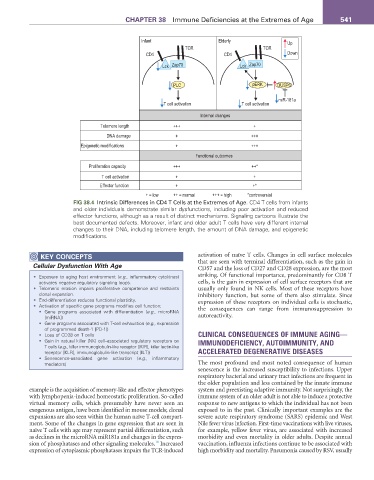
                         fIG 38.4  Intrinsic Differences in CD4 T Cells at the Extremes of Age. CD4 T cells from infants
                         and older individuals demonstrate similar dysfunctions, including poor activation and reduced
                         effector functions, although as a result of distinct mechanisms. Signaling cartoons illustrate the
                         best documented defects. Moreover, infant and older adult T cells have very different internal
                         changes to their DNA, including telomere length, the amount of DNA damage, and epigenetic
                         modifications.


               KEY CoNCEPtS                                       activation of naïve T cells. Changes in cell surface molecules
            Cellular Dysfunction With Age                         that are seen with terminal differentiation, such as the gain in
                                                                  CD57 and the loss of CD27 and CD28 expression, are the most
            •  Exposure to aging host environment (e.g., inflammatory cytokines)   striking. Of functional importance, predominantly for CD8 T
              activates negative regulatory signaling loops.      cells, is the gain in expression of cell surface receptors that are
            •  Telomeric erosion impairs proliferative competence and restraints   usually only found in NK cells. Most of these receptors have
              clonal expansion.                                   inhibitory function, but some of them also stimulate. Since
            •  End-differentiation reduces functional plasticity.  expression of these receptors on individual cells is stochastic,
            •  Activation of specific gene programs modifies cell function:  the consequences can range from immunosuppression to
              •  Gene programs associated with differentiation (e.g., microRNA
                [miRNA])                                          autoreactivity.
              •  Gene programs associated with T-cell exhaustion (e.g., expression
                of programmed death-1 [PD-1])
              •  Loss of CD28 on T cells                          CLINICAL CONSEQUENCES OF IMMUNE AGING—
              •  Gain in natural killer (NK) cell–associated regulatory receptors on   IMMUNODEFICIENCY, AUTOIMMUNITY, AND
                T cells (e.g., killer immunoglobulin-like receptor [(KIR], killer lectin-like
                receptor [KLR], immunoglobulin-like transcript [ILT])  ACCELERATED DEGENERATIVE DISEASES
              •  Senescence-associated gene activation (e.g., inflammatory
                mediators)                                        The most profound and most noted consequence of human
                                                                  senescence is the increased susceptibility to infections. Upper
                                                                  respiratory bacterial and urinary tract infections are frequent in
                                                                  the older population and less contained by the innate immune
           example is the acquisition of memory-like and effector phenotypes   system and preexisting adaptive immunity. Not surprisingly, the
           with lymphopenia-induced homeostatic proliferation. So-called   immune system of an older adult is not able to induce a protective
           virtual memory cells, which presumably have never seen an   response to new antigens to which the individual has not been
           exogenous antigen, have been identified in mouse models; clonal   exposed to in the past. Clinically important examples are the
           expansions are also seen within the human naïve T-cell compart-  severe acute respiratory syndrome (SARS) epidemic and West
           ment. Some of the changes in gene expression that are seen in   Nile fever virus infection. First-time vaccinations with live viruses,
           naïve T cells with age may represent partial differentiation, such   for example, yellow fever virus, are associated with increased
           as declines in the microRNA miR181a and changes in the expres-  morbidity and even mortality in older adults. Despite annual
                                                    18
           sion of phosphatases and other signaling molecules.  Increased   vaccination, influenza infections continue to be associated with
           expression of cytoplasmic phosphatases impairs the TCR-induced   high morbidity and mortality. Pneumonia caused by RSV, usually

