


Page 574 - Clinical Immunology_ Principles and Practice ( PDFDrive )
P. 574
CHaPTEr 39  HIV and Acquired Immunodeficiency Syndrome                   551


           activity might favor HIV infection, as shown by the upregulation    CLINICaL PEarLS
           of CCR5 by IFN-α, which can facilitate viral entry. Chemokines
           inhibit HIV infection by competing for viral binding sites. The α   Acute Infection Is an Opportunity for Early
           chemokine stromal cell–derived factor 1 (SDF-1) competes with   Human Immunodeficiency Virus (HIV) Diagnosis
           lymphotropic HIV strains for binding to CXCR4, whereas the β   •  Acute HIV infection is a nonspecific viral syndrome, often described
           chemokines macrophage inflammatory protein 1-α (MIP1-α),   as being similar to infectious mononucleosis.
           MIP1-β, and RANTES compete with macrophage-tropic strains   •  Many patients present to a clinician at this stage, but most are not
           for binding to CCR5.                                      recognized as HIV infection.
                                                                   •  Irreparable damage to the host immune system occurs during this
                                                                     stage of HIV infection resulting in chronic immune activation and the
           CLINICAL FEATURES                                         eventual collapse of the immune system.
                                                                   •  HIV viral latency is established during the acute infection as HIV DNA
           If the HIV infection is left untreated, its natural history involves   integrates with the host genome resulting. Integrated viral genetic
           the progression through four clinical phases: acute retroviral   material makes cure of HIV impossible even after prolonged viral
           syndrome, asymptomatic or latent infection, symptomatic HIV   suppression with antiretroviral therapy (ART).
           infection, and finally AIDS. Each clinical phase correlates with   •  ART initiated during the acute infection can halt the destruction of
           specific events in the interaction between HIV and the host   the body’s memory T cells in the gut-associated lymphoid tissue
                                                                     (GALT) and lead to better long-term outcomes for the patient.
           immune system. A small percentage of patients become long-term   •  The practical importance of early therapy of acute infection remains
           nonprogressors, and an even smaller percentage become elite   in question because patients who are able to achieve and maintain
           controllers (see Long-term nonprogressors/elite controllers).  undetectable viral loads on ART do well despite having commenced
                                                                     treatment long after their acute infection.
           Acute HIV Infection
           Soon after infection, unopposed by effective host immune
           responses, HIV rapidly replicates and disseminates to lymphoid
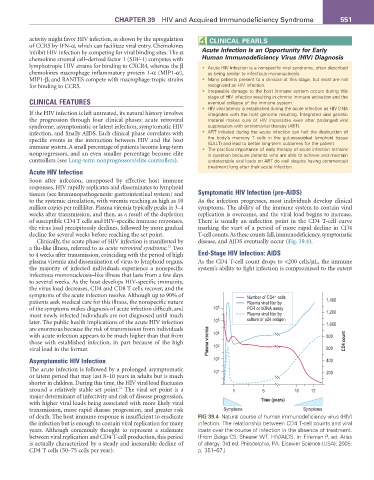
           tissues (see Immunopathogenesis: gastrointestinal system) and   Symptomatic HIV Infection (pre-AIDS)
           to the systemic circulation, with viremia reaching as high as 10   As the infection progresses, most individuals develop clinical
           million copies per milliliter. Plasma viremia typically peaks in 3–4   symptoms. The ability of the immune system to contain viral
           weeks after transmission, and then, as a result of the depletion   replication is overcome, and the viral load begins to increase.
           of susceptible CD4 T cells and HIV-specific immune responses,   There  is  usually  an  inflection  point  in  the  CD4  T-cell  curve
           the virus load precipitously declines, followed by more gradual   marking  the  start  of  a  period  of  more  rapid  decline  in  CD4
           decline for several weeks before reaching the set point.  T-cell counts. As these counts fall, immunodeficiency, symptomatic
             Clinically, the acute phase of HIV infection is manifested by   disease, and AIDS eventually occur (Fig. 39.4).
                                                        21
           a flu-like illness, referred to as acute retroviral syndrome.  Two
           to 4 weeks after transmission, coinciding with the period of high   End-Stage HIV Infection: AIDS
           plasma viremia and dissemination of virus to lymphoid organs,   As the CD4 T-cell count drops to <200 cells/µL, the immune
           the majority of infected individuals experience a nonspecific   system’s ability to fight infection is compromised to the extent
           infectious mononucleosis–like illness that lasts from a few days
           to several weeks. As the host develops HIV-specific immunity,
           the virus load decreases, CD4 and CD8 T cells recover, and the
           symptoms of the acute infection resolve. Although up to 90% of         Number of CD4  cells
                                                                                           +
           patients seek medical care for this illness, the nonspecific nature    Plasma viral titer by     1,400
           of the symptoms makes diagnosis of acute infection difficult, and   10 6  PCR or bDNA assay      1,200
           most newly infected individuals are not diagnosed until much           Plasma viral titer by
           later. The public health implications of the acute HIV infection   10 5  culture or p24 antigen  1,000
           are enormous because the risk of transmission from individuals
           with acute infection appears to be much higher than that from   10 4                             800
           those with established infection, in part because of the high   Plasma viremia  3                      CD4 count
           viral load in the former.                                   10                                   600
           Asymptomatic HIV Infection                                  10 2                                 400
           The acute infection is followed by a prolonged asymptomatic   10 1                               200
           or latent period that may last 8–10 years in adults but is much
           shorter in children. During this time, the HIV viral load fluctuates
                                        22
           around a relatively stable set point.  The viral set point is a   1         5         10    12
           major determinant of infectivity and risk of disease progression,          Time (years)
           with higher viral loads being associated with more likely viral
           transmission, more rapid disease progression, and greater risk   Symptoms                Symptoms
           of death. The host immune response is insufficient to eradicate   fIG 39.4  Natural course of human immunodeficiency virus (HIV)
           the infection but is enough to contain viral replication for many   infection. The relationship between CD4 T-cell counts and viral
           years.  Although commonly thought  to represent a stalemate   loads over the course of infection in the absence of treatment.
           between viral replication and CD4 T-cell production, this period   (From Baliga CS, Shearer WT. HIV/AIDS. In: Fireman P, ed. Atlas
           is actually characterized by a steady and inexorable decline of   of allergy. 3rd ed. Philadelphia, PA: Elsevier Science (USA); 2005:
           CD4 T cells (50–75 cells per year).                    p. 351–67.)

