


Page 570 - Clinical Immunology_ Principles and Practice ( PDFDrive )
P. 570
CHaPTEr 39  HIV and Acquired Immunodeficiency Syndrome                   547


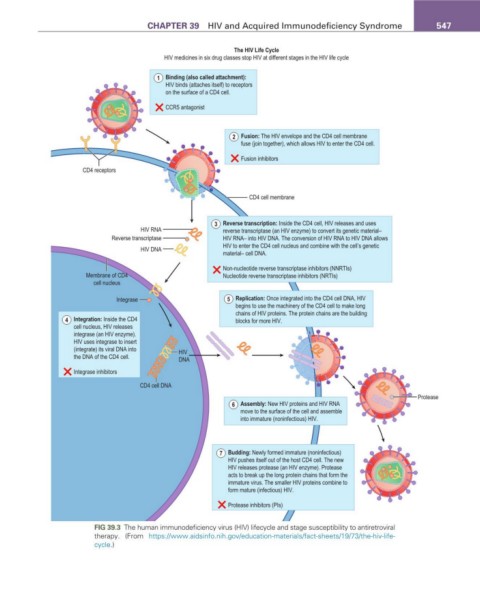
                                                             The HIV Life Cycle
                                           HIV medicines in six drug classes stop HIV at different stages in the HIV life cycle


                                         1 Binding (also called attachment):
                                           HIV binds (attaches itself) to receptors
                                           on the surface of a CD4 cell.
                                           CCR5 antagonist


                                                            2 Fusion: The HIV envelope and the CD4 cell membrane
                                                              fuse (join together), which allows HIV to enter the CD4 cell.

                                                              Fusion inhibitors
                      CD4 receptors


                                                                 CD4 cell membrane


                                                        3 Reverse transcription: Inside the CD4 cell, HIV releases and uses
                                     HIV RNA              reverse transcriptase (an HIV enzyme) to convert its genetic material–
                             Reverse transcriptase        HIV RNA– into HIV DNA. The conversion of HIV RNA to HIV DNA allows
                                                          HIV to enter the CD4 cell nucleus and combine with the cell’s genetic
                                     HIV DNA
                                                          material– cell DNA.
                                                          Non-nucleotide reverse transcriptase inhibitors (NNRTIs)
                       Membrane of CD4                    Nucleotide reverse transcriptase inhibitors (NRTIs)
                         cell nucleus

                               Integrase                   5 Replication: Once integrated into the CD4 cell DNA, HIV
                                                             begins to use the machinery of the CD4 cell to make long
                                                             chains of HIV proteins. The protein chains are the building
                  4 Integration: Inside the CD4              blocks for more HIV.
                    cell nucleus, HIV releases
                    integrase (an HIV enzyme).
                    HIV uses integrase to insert
                    (integrate) its viral DNA into  HIV
                    the DNA of the CD4 cell.   DNA

                    Integrase inhibitors
                                     CD4 cell DNA
                                                                                                            Protease
                                                            6 Assembly: New HIV proteins and HIV RNA
                                                              move to the surface of the cell and assemble
                                                              into immature (noninfectious) HIV.


                                                         7 Budding: Newly formed immature (noninfectious)
                                                           HIV pushes itself out of the host CD4 cell. The new
                                                           HIV releases protease (an HIV enzyme). Protease
                                                           acts to break up the long protein chains that form the
                                                           immature virus. The smaller HIV proteins combine to
                                                           form mature (infectious) HIV.
                                                           Protease inhibitors (PIs)

                         fIG 39.3  The human immunodeficiency virus (HIV) lifecycle and stage susceptibility to antiretroviral
                         therapy. (From  https://www.aidsinfo.nih.gov/education-materials/fact-sheets/19/73/the-hiv-life-
                         cycle.)

