


Page 575 - Clinical Immunology_ Principles and Practice ( PDFDrive )
P. 575
552          ParT fOur  Immunological Deficiencies


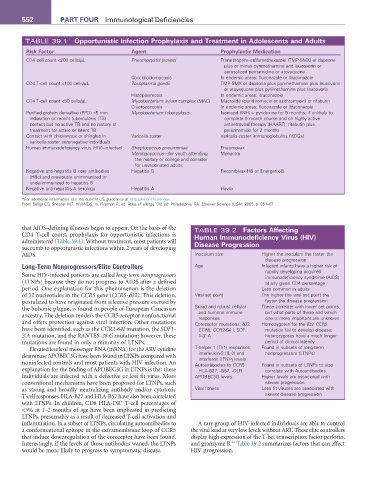
         TABLE 39.1  Opportunistic Infection Prophylaxis and Treatment in adolescents and adults*
          risk factor                       agent                        Prophylactic Medication
          CD4 cell count <200 cells/µL      Pneumocystis jiroveci        Trimethoprim–sulfamethoxazole (TMP-SMX) or dapsone
                                                                          plus or minus pyrimethamine and leucovorin or
                                                                          aerosolized pentamidine or atovaquone
                                            Coccidioidomycosis           In endemic areas: fluconazole or itraconazole
          CD4 T-cell count <100 cells/µL    Toxoplasma gondii            TMP-SMX or dapsone plus pyrimethamine plus leucovorin
                                                                          or atovaquone plus pyrimethamine plus leucovorin
                                            Histoplasmosis               In endemic areas: itraconazole
          CD4 T-cell count <50 cells/µL     Mycobacterium avium complex (MAC)  Macrolide (clarithromycin or azithromycin) or rifabutin
                                            Cryptococcosis               In endemic areas: fluconazole or itraconazole
          Purified protein derivative (PPD) >5 mm   Mycobacterium tuberculosis  Isoniazid (INH) + pyridoxine for 9 months; if unlikely to
           induration or recent tuberculosis (TB)                         complete 9 month course and on highly active
           contact but no active TB and no history of                     antiretroviral therapy (HAART): rifabutin plus
           treatment for active or latent TB                              pyrazinamide for 2 months
          Contact with chickenpox or shingles in   Varicella-zoster      Varicella-zoster immunoglobulins (VZIGs)
           varicella-zoster seronegative individuals
          Human immunodeficiency virus (HIV)–infected  Streptococcus pneumoniae  Pneumovax
                                            Meningococcus—for youth attending   Menactra
                                             the military or college and consider
                                             for unvaccinated adults
          Negative anti-hepatitis B core antibodies   Hepatitis B        Recombivax-HB or Energerix-B
           (HBc) and previously unimmunized or
           underimmunized to hepatitis B
          Negative anti-hepatitis A serology  Hepatitis A                Havrix
        *For additional information see the current US guidelines at http://AIDSinfo.nih.gov.
        From Baliga CS, Shearer WT. HIV/AIDS. In: Fireman P, ed. Atlas of allergy. 3rd ed. Philadelphia, PA: Elsevier Science (USA); 2005: p. 351–67.


        that AIDS-defining illnesses begin to appear. On the basis of the   TABLE 39.2  factors affecting
        CD4 T-cell count, prophylaxis for opportunistic infections is   Human Immunodeficiency Virus (HIV)
        administered (Table 39.1). Without treatment, most patients will   Disease Progression
        succumb to opportunistic infections within 2 years of developing
        AIDS.                                                    Inoculum size         Higher the inoculum the faster the
                                                                                        disease progression
        Long-Term Nonprogressors/Elite Controllers               Age                   Infected infants have a higher risk of
        Some HIV-infected patients are called long-term nonprogressors                  rapidly developing acquired
                                                                                        immunodeficiency syndrome (AIDS)
        (LTNPs) because they do not progress to AIDS after a defined                    at any given CD4 percentage
        period. One explanation for this phenomenon is the deletion                    Less common in adults
        of 32 nucleotides in the CCR5 gene (CCR5-δ32). This deletion,   Viral set point  The higher the viral set point the
        postulated to have originated from selective pressure exerted by                faster the disease progression
        the bubonic plague, is found in people of European Caucasian   Broad and robust cellular   These correlate with lower set points,
        ancestry. The deletion renders the CCR5 receptor nonfunctional   and humoral immune   but what parts of these and which
                                                                  responses
                                                                                        one is more important are unknown
        and offers protection against viral infection. Other mutations   Coreceptor mutations: δ32   Homozygotes for the δ32 CCR5
        have been identified, such as the CCR2-64I mutation, the SDF1-  CCR5, CCR2-64 l, SDF   mutation fail to develop disease;
        3’A mutation, and the RANTES-28 G mutation; however, these   1-3’ A             heterozygotes have a much longer
        mutations are found in only a minority of LTNPs.                                period of clinical latency
           Elevated levels of messenger RNA (mRNA) for the ARV cytidine   T-helper 1 (Th1) responses:   Found in subsets of long-term
        deaminase APOBEC3G have been found in LTNPs compared with   interleukin-2 (IL-2) and   nonprogressors (LTNPs)
                                                                  interferon (IFN)-γ levels
        noninfected controls and most patients with HIV infection. An   Autoantibodies to CCR5   Found in subsets of LTNPs to also
        explanation for the finding of APOBEC3G in LTNPs is that these   HLA-B27, -B57, -DLR  correlate with Autoantibodies
        individuals are infected with a defective or less fit virus. More   APOBEC3G levels  Higher levels are associated with
        conventional mechanisms have been proposed for LTNPs, such                      slower progression
        as strong and broadly neutralizing antibody and/or cytotoxic   Viral fitness   Less fit viruses are associated with
        T-cell responses. HLA-B27 and HLA-B57 have also been correlated                 slower disease progression
                                         +
        with LTNPs. In children, CD8 HLA-DR  T-cell percentages of
        <5% at 1–2 months of age have been implicated in predicting
        LTNPs, presumably as a result of decreased T-cell activation and
        inflammation. In a subset of LTNPs, circulating autoantibodies to   A rare group of HIV-infected individuals are able to control
        a conformational epitope in the extramembrane loop of CCR5   the viral load at very low levels without ART. These elite controllers
        that induce downregulation of the coreceptor have been found.   display high expression of the T-bet transcription factor perforin,
                                                                             22
        Interestingly, if the levels of those antibodies waned, the LTNPs   and granzyme B.  Table 39.2 summarizes factors that can affect
        would be more likely to progress to symptomatic disease.  HIV progression.

