


Page 614 - Clinical Immunology_ Principles and Practice ( PDFDrive )
P. 614
CHaPTEr 42  Urticaria, Angioedema, and Anaphylaxis                591


                                                                  Angioedema


                                                        Without wheals     With wheals


                                               Low C4                Normal C4      Diagnose and manage
                                                                                       as for urticaria


                                Type I HAE    Type II HAE      AAE                      Idiopathic

                              ↓ C1 inh      Normal C1 inh  Normal or low C1 inh        Drug induced
                              ↓ C1 inh functional  ↓ C1 inh functional  ↓ C1 inh functional  e.g., ACEi
                                                          ↓ C1q
                                                                                    Episodic angioedema
                                                                                      with eosinophilia

                              HAE: Hereditary angioedema                             HAE with normal C1
                              AAE: Acquired angioedema                              inhibitor (Type III HAE)
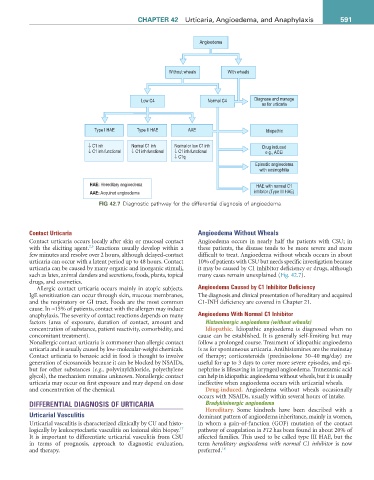
                                 fiG 42.7  Diagnostic pathway for the differential diagnosis of angioedema.


           Contact Urticaria                                      Angioedema Without Wheals
           Contact urticaria occurs locally after skin or mucosal contact   Angioedema occurs in nearly half the patients with CSU; in
                              2,3
           with the eliciting agent.  Reactions usually develop within a   these patients, the disease tends to be more severe and more
           few minutes and resolve over 2 hours, although delayed-contact   difficult to treat. Angioedema without wheals occurs in about
           urticaria can occur with a latent period up to 48 hours. Contact   10% of patients with CSU but needs specific investigation because
           urticaria can be caused by many organic and inorganic stimuli,   it may be caused by C1 inhibitor deficiency or drugs, although
           such as latex, animal danders and secretions, foods, plants, topical   many cases remain unexplained (Fig. 42.7).
           drugs, and cosmetics.
             Allergic contact urticaria occurs mainly in atopic subjects.   Angioedema Caused by C1 Inhibitor Deficiency
           IgE sensitization can occur through skin, mucous membranes,   The diagnosis and clinical presentation of hereditary and acquired
           and the respiratory or GI tract. Foods are the most common   C1-INH deficiency are covered in Chapter 21.
           cause. In ≈15% of patients, contact with the allergen may induce
           anaphylaxis. The severity of contact reactions depends on many   Angioedema With Normal C1 Inhibitor
           factors (area of exposure, duration of contact, amount and   Histaminergic angioedema (without wheals)
           concentration of substance, patient reactivity, comorbidity, and   Idiopathic.  Idiopathic angioedema is diagnosed when no
           concomitant treatment).                                cause can be established. It is generally self-limiting but may
           Nonallergic contact urticaria is commoner than allergic contact   follow a prolonged course. Treatment of idiopathic angioedema
           urticaria and is usually caused by low-molecular-weight chemicals.   is as for spontaneous urticaria. Antihistamines are the mainstay
           Contact urticaria to benzoic acid in food is thought to involve   of therapy; corticosteroids (prednisolone 30–40 mg/day) are
           generation of eicosanoids because it can be blocked by NSAIDs,   useful for up to 3 days to cover more severe episodes, and epi-
           but for other substances (e.g., polyvinylchloride, polyethylene   nephrine is lifesaving in laryngeal angioedema. Tranexamic acid
           glycol), the mechanism remains unknown. Nonallergic contact   can help in idiopathic angioedema without wheals, but it is usually
           urticaria may occur on first exposure and may depend on dose   ineffective when angioedema occurs with urticarial wheals.
           and concentration of the chemical.                       Drug-induced.  Angioedema without wheals occasionally
                                                                  occurs with NSAIDs, usually within several hours of intake.
           DIFFERENTIAL DIAGNOSIS OF URTICARIA                      Bradykininergic angioedema
                                                                    Hereditary.  Some kindreds have been described with a
           Urticarial Vasculitis                                  dominant pattern of angioedema inheritance, mainly in women,
           Urticarial vasculitis is characterized clinically by CU and histo-  in whom a gain-of-function (GOF) mutation of the contact
                                                            17
           logically by leukocytoclastic vasculitis on lesional skin biopsy.    pathway of coagulation in F12 has been found in about 20% of
           It is important to differentiate urticarial vasculitis from CSU   affected families. This used to be called type III HAE, but the
           in terms of prognosis, approach to diagnostic evaluation,     term  hereditary angioedema  with  normal C1  inhibitor  is now
           and therapy.                                           preferred. 18

