


Page 612 - Clinical Immunology_ Principles and Practice ( PDFDrive )
P. 612
CHaPTEr 42  Urticaria, Angioedema, and Anaphylaxis                589


           acute urticaria; atopic diseases are found in about half the patients
                          3
           with acute urticaria.  Most acute urticaria resolves spontaneously
           within 3 weeks, but in 10% of patients, it may progress to CSU.
             Infections are the most common identifiable cause of acute
           urticaria, with some cases resulting from foods or drugs. A specific
           cause of acute urticaria will not be found in about 50% of patients.
           Foods are the most common cause of acute urticaria in young
           children but are rarely responsible for acute urticaria in adults.
           In infancy, cow’s milk allergy may cause acute allergic urticaria.
           Drug-induced urticaria is the most common presentation of
           drug hypersensitivity, accounting for a quarter of all adverse
           drug reactions, with penicillin and NSAIDs being the most
           common causes of allergic and nonallergic drug-induced urticaria,
           respectively. Drug-induced urticaria is more likely in older adults,
           perhaps reflecting polypharmacy and age-related pharmacokinetic
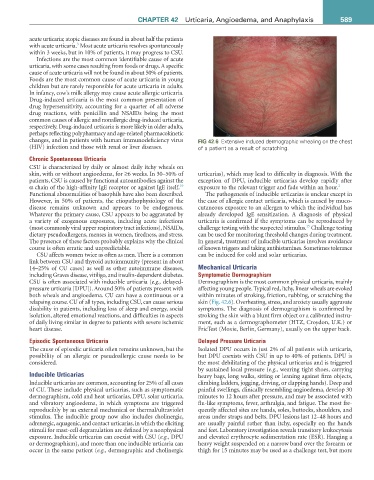
           changes, and in patients with human immunodeficiency virus   fiG 42.6  Extensive induced dermographic whealing on the chest
           (HIV) infection and those with renal or liver diseases.  of a patient as a result of scratching.

           Chronic Spontaneous Urticaria
           CSU is characterized by daily or almost daily itchy wheals on
           skin, with or without angioedema, for ≥6 weeks. In 30–50% of   urticarias), which may lead to difficulty in diagnosis. With the
           patients, CSU is caused by functional autoantibodies against the   exception of DPU, inducible urticarias develop rapidly after
                                                            10
           α chain of the high-affinity IgE receptor or against IgE itself.    exposure to the relevant trigger and fade within an hour. 2
           Functional abnormalities of basophils have also been described.   The pathogenesis of inducible urticarias is unclear except in
           However, in 50% of patients, the etiopathophysiology of the   the case of allergic contact urticaria, which is caused by muco-
           disease  remains  unknown  and  appears  to  be  endogenous.   cutaneous exposure to an allergen to which the individual has
           Whatever the primary cause, CSU appears to be aggravated by   already developed IgE sensitization.  A diagnosis of physical
           a variety of exogenous exposures, including acute infections   urticaria is confirmed if the symptoms can be reproduced by
                                                                                                     15
           (most commonly viral upper respiratory tract infections), NSAIDs,   challenge testing with the suspected stimulus.  Challenge testing
           dietary pseudoallergens, menses in women, tiredness, and stress.   can be used for monitoring threshold changes during treatment.
           The presence of these factors probably explains why the clinical   In general, treatment of inducible urticarias involves avoidance
           course is often erratic and unpredictable.             of known triggers and taking antihistamines. Sometimes tolerance
             CSU affects women twice as often as men. There is a common   can be induced for cold and solar urticarias.
           link between CSU and thyroid autoimmunity (present in about
           14–25% of CU cases) as well as other autoimmune diseases,   Mechanical Urticaria
           including Graves disease, vitiligo, and insulin-dependent diabetes.   Symptomatic Dermographism
           CSU is often associated with inducible urticaria (e.g., delayed-  Dermographism is the most common physical urticaria, mainly
           pressure urticaria [DPU]). Around 50% of patients present with   affecting young people. Typical red, itchy, linear wheals are evoked
           both wheals and angioedema. CU can have a continuous or a   within minutes of stroking, friction, rubbing, or scratching the
           relapsing course. CU of all types, including CSU, can cause serious   skin (Fig. 42.6). Overheating, stress, and anxiety usually aggravate
           disability in patients, including loss of sleep and energy, social   symptoms. The diagnosis of dermographism is confirmed by
           isolation, altered emotional reactions, and difficulties in aspects   stroking the skin with a blunt firm object or a calibrated instru-
           of daily living similar in degree to patients with severe ischemic   ment, such as a dermographometer (HTZ, Croydon, U.K.) or
           heart disease.                                         FricTest (Moxie, Berlin, Germany), usually on the upper back.

           Episodic Spontaneous Urticaria                         Delayed Pressure Urticaria
           The cause of episodic urticaria often remains unknown, but the   Isolated DPU occurs in just 2% of all patients with urticaria,
           possibility of an allergic or pseudoallergic cause needs to be   but DPU coexists with CSU in up to 40% of patients. DPU is
           considered.                                            the most debilitating of the physical urticarias and is triggered
                                                                  by sustained local pressure (e.g., wearing tight shoes, carrying
           Inducible Urticarias                                   heavy bags, long walks, sitting or leaning against firm objects,
           Inducible urticarias are common, accounting for 25% of all cases   climbing ladders, jogging, driving, or clapping hands). Deep and
           of CU. These include physical urticarias, such as symptomatic   painful swellings, clinically resembling angioedema, develop 30
           dermographism, cold and heat urticarias, DPU, solar urticaria,   minutes to 12 hours after pressure, and may be associated with
           and vibratory angioedema, in which symptoms are triggered   flu-like symptoms, fever, arthralgia, and fatigue. The most fre-
           reproducibly by an external mechanical or thermal/ultraviolet   quently affected sites are hands, soles, buttocks, shoulders, and
           stimulus. The inducible group now also includes cholinergic,   areas under straps and belts. DPU lesions last 12–48 hours and
           adrenergic, aquagenic, and contact urticarias, in which the eliciting   are  usually  painful  rather  than  itchy,  especially  on  the  hands
           stimuli for mast-cell degranulation are defined by a nonphysical   and feet. Laboratory investigation reveals transitory leukocytosis
           exposure. Inducible urticarias can coexist with CSU (e.g., DPU   and elevated erythrocyte sedimentation rate (ESR). Hanging a
           or dermographism), and more than one inducible urticaria can   heavy weight suspended on a narrow band over the forearm or
           occur in the same patient (e.g., dermographic and cholinergic   thigh for 15 minutes may be used as a challenge test, but more

