


Page 609 - Clinical Immunology_ Principles and Practice ( PDFDrive )
P. 609
586          ParT fivE  Allergic Diseases


                                                                                        Allergen


                                                                                     IgE
                                                                                                   Substance P
                                                                    Anti-FceRI
                                                                                                      Stem cell factor

                                                                                                       C5a

                                                                                                       Codine
                                                                  Anti-IgE
                                                                            IgE

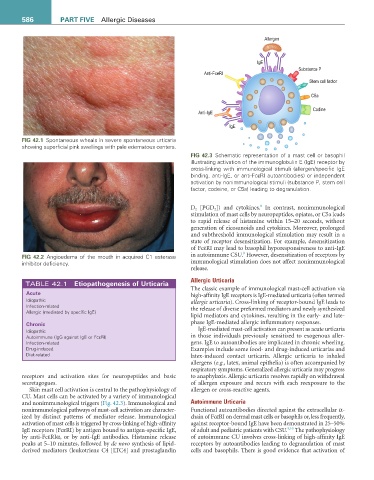
        fiG 42.1  Spontaneous wheals in severe spontaneous urticaria
        showing superficial pink swellings with pale edematous centers.
                                                               fiG 42.3  Schematic representation of a mast cell or basophil
                                                               illustrating activation of the immunoglobulin E (IgE) receptor by
                                                               cross-linking with immunological stimuli (allergen/specific IgE
                                                               binding, anti-IgE, or anti-FcεRI autoantibodies) or independent
                                                               activation by nonimmunological stimuli (substance P, stem cell
                                                               factor, codeine, or C5a) leading to degranulation.


                                                                                      8
                                                               D 2  [PGD 2 ]) and cytokines.  In contrast, nonimmunological
                                                               stimulation of mast cells by neuropeptides, opiates, or C5a leads
                                                               to rapid release of histamine within 15–20 seconds, without
                                                               generation of eicosanoids and cytokines. Moreover, prolonged
                                                               and subthreshold immunological stimulation may result in a
                                                               state of receptor desensitization. For example, desensitization
                                                               of FcεRI may lead to basophil hyporesponsiveness to anti-IgE
                                                                                 9
        fiG 42.2  Angioedema of the mouth in acquired C1 esterase   in autoimmune CSU.  However, desensitization of receptors by
        inhibitor deficiency.                                  immunological stimulation does not affect nonimmunological
                                                               release.

         TABLE 42.1  Etiopathogenesis of Urticaria             Allergic Urticaria
                                                               The classic example of immunological mast-cell activation via
          acute                                                high-affinity IgE receptors is IgE-mediated urticaria (often termed
          Idiopathic                                           allergic urticaria). Cross-linking of receptor-bound IgE leads to
          Infection-related                                    the release of diverse preformed mediators and newly synthesized
          Allergic (mediated by specific IgE)
                                                               lipid mediators and cytokines, resulting in the early- and late-
          Chronic                                              phase IgE-mediated allergic inflammatory responses.
          Idiopathic                                              IgE-mediated mast-cell activation can present as acute urticaria
          Autoimmune (IgG against IgE or FcεRI)                in those  individuals previously sensitized to exogenous aller-
          Infection-related                                    gens. IgE to autoantibodies are implicated in chronic wheeling.
          Drug-induced                                         Examples include some food- and drug-induced urticarias and
          Diet-related                                         latex-induced contact urticaria.  Allergic urticaria to inhaled
                                                               allergens (e.g., latex, animal epithelia) is often accompanied by
                                                               respiratory symptoms. Generalized allergic urticaria may progress
        receptors and activation sites for neuropeptides and basic   to anaphylaxis. Allergic urticaria resolves rapidly on withdrawal
        secretagogues.                                         of allergen exposure and recurs with each reexposure to the
           Skin mast cell activation is central to the pathophysiology of   allergen or cross-reactive agents.
        CU. Mast cells can be activated by a variety of immunological
        and nonimmunological triggers (Fig. 42.3). Immunological and   Autoimmune Urticaria
        nonimmunological pathways of mast-cell activation are character-  Functional autoantibodies directed against the extracellular α-
        ized by distinct patterns of mediator release. Immunological   chain of FcεRI on dermal mast cells or basophils or, less frequently,
        activation of mast cells is triggered by cross-linking of high-affinity   against receptor-bound IgE have been demonstrated in 25–50%
                                                                                               9,10
        IgE receptors (FcεRI) by antigen bound to antigen-specific IgE,   of adult and pediatric patients with CSU.  The pathophysiology
        by anti-FcεRIα, or by anti-IgE antibodies. Histamine release   of autoimmune CU involves cross-linking of high-affinity IgE
        peaks at 5–10 minutes, followed by de novo synthesis of lipid-  receptors by autoantibodies leading to degranulation of mast
        derived mediators (leukotriene C4 [LTC4] and prostaglandin   cells and basophils. There is good evidence that activation of

