


Page 611 - Clinical Immunology_ Principles and Practice ( PDFDrive )
P. 611
588          ParT fivE  Allergic Diseases


        reflex-mediated flare-up. Histamine is also the main mediator   Aspirin and NSAIDs can trigger acute urticaria as well as
        of itch in urticaria. However, histamine-induced wheals are   causing flare-ups of preexisting chronic spontaneous (but not
        short-lived in contrast to urticarial lesions that may persist up   physical) urticaria.  Aspirin-induced exacerbations have been
                                                                                                  13
        to 24 hours, implying that other proinflammatory mediators   reported in 20–40% of patients with CSU.  In some patients,
        and/or cellular infiltrates contribute to CSU pathogenesis.  aspirin can act as a cofactor in food- or exercise-induced
                                                               anaphylaxis.
        Mast Cell–Independent Mechanisms of Urticaria             Urticaria can develop from a few minutes to 24 hours after
        Pseudoallergy (Intolerance)                            aspirin ingestion but usually within 1–2 hours. Angioedema of
        Pseudoallergy, or nonallergic hypersensitivity, mimics immediate-  the lips and tongue, impaired swallowing, and laryngeal edema
        type allergic reactions clinically without evidence of underlying   develop occasionally. Aspirin-induced skin symptoms usually
                                12
        immunological mechanisms.  The most common triggers of   subside 24–48 hours after discontinuing the drug. However, severe
        pseudoallergic reactions are aspirin and other nonsteroidal   exacerbations of CSU caused by aspirin and other NSAIDs can
        antiinflammatory drugs (NSAIDs), as well as some food ingre-  last from several days to several weeks after aspirin intake. 13
        dients and additives, such as salicylates, benzoates, and tartrazine.   There are no skin tests or reliable in vitro diagnostic techniques
        These reactions do not involve IgE sensitization and can, therefore,   for patients with aspirin-induced urticaria, and the diagnosis
        occur  on  first  exposure.  Pseudoallergic  reactions  are  dose-  can only be established by challenge tests. Patients should avoid
        dependent and usually occur with chemically nonrelated sub-  aspirin and other NSAIDs, but COX-2 inhibitors (coxibs) are
        stances. The diagnosis is difficult because skin tests and serology   usually well tolerated and can probably be used safely.
        are uninformative. Diagnosis of nonallergic hypersensitivity is
        based on a distinctive clinical pattern, time course, clinical signs,   Food-Induced Pseudoallergic Reactions in CSU
        and response to elimination of the cause. In the appropriate   Pseudoallergic food reactions appear to be important in some
        clinical context, pseudoallergy can be confirmed with oral chal-  patients with CSU. Pseudoallergic food triggers include natural
        lenge tests.                                           salicylates in fruit and vegetables and artificial food additives in
                                                               processed foods, such as benzoates and tartrazine. Low-molecular-
        NSAIDs                                                 weight aromatic compounds in tomatoes, white wine, and herbs
                                                                                     14
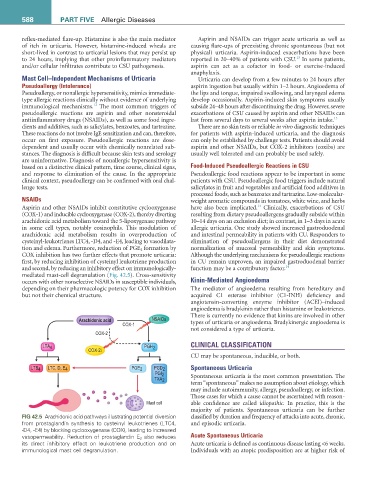
        Aspirin and other NSAIDs inhibit constitutive cyclooxygenase   have also been implicated.  Clinically, exacerbations of CSU
        (COX-1) and inducible cyclooxygenase (COX-2), thereby diverting   resulting from dietary pseudoallergens gradually subside within
        arachidonic acid metabolism toward the 5-lipoxygenase pathway   10–14 days on an exclusion diet; in contrast, in 1–3 days in acute
        in some cell types, notably eosinophils. This modulation of   allergic urticaria. One study showed increased gastroduodenal
        arachidonic acid metabolism results in overproduction of   and intestinal permeability in patients with CU. Responders to
        cysteinyl-leukotrienes LTC4, -D4, and -E4, leading to vasodilata-  elimination of pseudoallergens in their diet demonstrated
        tion and edema. Furthermore, reduction of PGE 2  formation by   normalization of mucosal permeability and skin symptoms.
        COX inhibition has two further effects that promote urticaria:   Although the underlying mechanisms for pseudoallergic reactions
        first, by reducing inhibition of cysteinyl leukotriene production   in CU remain unproven, an impaired gastroduodenal barrier
        and second, by reducing an inhibitory effect on immunologically-  function may be a contributory factor. 14
        mediated mast-cell degranulation (Fig. 42.5). Cross-sensitivity
        occurs with other nonselective NSAIDs in susceptible individuals,   Kinin-Mediated Angioedema
        depending on their pharmacologic potency for COX inhibition   The mediator of angioedema resulting from hereditary and
        but not their chemical structure.                      acquired C1 esterase inhibitor (C1-INH) deficiency and
                                                               angiotensin-converting enzyme inhibitor (ACEI)–induced
                                                               angioedema is bradykinin rather than histamine or leukotrienes.
                                                               There is currently no evidence that kinins are involved in other
                           Arachidonic acid        NSAIDs      types of urticaria or angioedema. Bradykinergic angioedema is
                                         COX-1
                                                               not considered a type of urticaria.
                                COX-2
               LTA 4                            PGH 2          CLINICAL CLASSIFICATION
                              COX-2i
                                                               CU may be spontaneous, inducible, or both.
           LTB 4  LTC, D, E 4               PGE 2  PGD 2       Spontaneous Urticaria
                                                    PGI 2
                                                    TXA 2      Spontaneous urticaria is the most common presentation. The
                                                               term “spontaneous” makes no assumption about etiology, which
                                                               may include autoimmunity, allergy, pseudoallergy, or infection.
                                                               Those cases for which a cause cannot be ascertained with reason-
                                                 Mast cell     able confidence are called  idiopathic. In practice, this is  the
                                                               majority of patients. Spontaneous urticaria can be further
        fiG 42.5  Arachidonic acid pathways illustrating potential diversion   classified by duration and frequency of attacks into acute, chronic,
        from prostaglandin synthesis to cysteinyl leukotrienes (LTC4,   and episodic urticaria.
        -D4, -E4) by blocking cyclooxygenase (COX), leading to increased
        vasopermeability. Reduction of prostaglandin E 2  also reduces   Acute Spontaneous Urticaria
        its direct inhibitory effect on leukotriene production and on   Acute urticaria is defined as continuous disease lasting <6 weeks.
        immunological mast cell degranulation.                 Individuals with an atopic predisposition are at higher risk of

