


Page 660 - Clinical Immunology_ Principles and Practice ( PDFDrive )
P. 660
634          Part five  Allergic Diseases


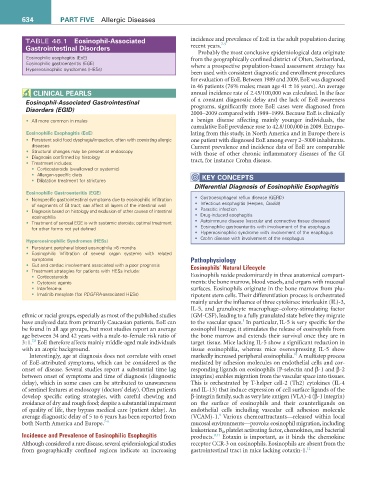
         TABLE 46.1 eosinophil-associated                      incidence and prevalence of EoE in the adult population during
                                                                         7-9
         Gastrointestinal Disorders                            recent years.
                                                                  Probably the most conclusive epidemiological data originate
          Eosinophilic esophagitis (EoE)                       from the geographically confined district of Olten, Switzerland,
          Eosinophilic gastroenteritis (EGE)                   where a prospective population-based assessment strategy has
          Hypereosinophilic syndromes (HESs)
                                                               been used with consistent diagnostic and enrollment procedures
                                                               for evaluation of EoE. Between 1989 and 2009, EoE was diagnosed
                                                               in 46 patients (76% males; mean age 41 ± 16 years). An average
            CLiNiCaL PearLS                                    annual incidence rate of 2.45/100,000 was calculated. In the face
         Eosinophil-Associated Gastrointestinal                of a constant diagnostic delay and the lack of EoE awareness
         Disorders (EGID)                                      programs, significantly more EoE cases were diagnosed from
                                                               2000–2009 compared with 1989–1999. Because EoE is clinically
          •  All more common in males                          a benign disease affecting mainly younger individuals, the
                                                               cumulative EoE prevalence rose to 42.8/100,000 in 2009. Extrapo-
          eosinophilic esophagitis (eoe)                       lating from this study, in North America and in Europe there is
          •  Persistent solid food dysphagia/impaction, often with coexisting allergic   one patient with diagnosed EoE among every 2–3000 inhabitants.
           diseases                                            Current prevalence and incidence data of EoE are comparable
          •  Structural changes may be present at endoscopy    with those of other chronic inflammatory diseases of the GI
          •  Diagnosis confirmed by histology                  tract, for instance Crohn disease.
          •  Treatment includes:
           •  Corticosteroids (swallowed or systemic)
           •  Allergen-specific diets                              KeY CONCePtS
           •  Dilatation treatment for strictures
                                                                 Differential Diagnosis of Eosinophilic Esophagitis
          eosinophilic Gastroenteritis (eGe)
          •  Nonspecific gastrointestinal symptoms due to eosinophilic infiltration   •  Gastroesophageal reflux disease (GERD)
           of segments of GI tract; can affect all layers of the intestinal wall  •  Infectious esophagitis (Herpes, Candida)
          •  Diagnosis based on histology and exclusion of other causes of intestinal   •  Parasitic infection
           eosinophilia                                          •  Drug-induced esophagitis
          •  Treatment of serosal EGE is with systemic steroids; optimal treatment   •  Autoimmune disease (vascular and connective tissue diseases)
           for other forms not yet defined                       •  Eosinophilic gastroenteritis with involvement of the esophagus
                                                                 •  Hypereosinophilic syndrome with involvement of the esophagus
                                                                 •  Crohn disease with involvement of the esophagus
          Hypereosinophilic Syndromes (HeSs)
          •  Persistent peripheral blood eosinophilia >6 months
          •  Eosinophilic infiltration of several organ systems with related
           symptoms                                            Pathophysiology
          •  Gut and cardiac involvement associated with a poor prognosis  Eosinophils’ Natural Lifecycle
          •  Treatment strategies for patients with HESs include:
           •  Corticosteroids                                  Eosinophils reside predominantly in three anatomical compart-
           •  Cytotoxic agents                                 ments: the bone marrow, blood vessels, and organs with mucosal
           •  Interferon-α                                     surfaces. Eosinophils originate in the bone marrow from plu-
           •  Imatinib mesylate (for PDGFRA-associated HESs)   ripotent stem cells. Their differentiation process is orchestrated
                                                               mainly under the influence of three cytokines: interleukin (IL)-3,
                                                               IL-5, and granulocyte macrophage–colony-stimulating factor
        ethnic or racial groups, especially as most of the published studies   (GM-CSF), leading to a fully granulated state before they migrate
                                                                                1
        have analyzed data from primarily Caucasian patients. EoE can   to the vascular space.  In particular, IL-5 is very specific for the
        be found in all age groups, but most studies report an average   eosinophil lineage; it stimulates the release of eosinophils from
        age between 34 and 42 years with a male-to-female risk ratio of   the bone marrow and extends their survival once they are in
           7,8
        3 : 1.  EoE therefore affects mainly middle-aged male individuals   target tissue. Mice lacking IL-5 show a significant reduction in
        with an atopic background.                             tissue  eosinophilia, whereas mice  overexpressing  IL-5  show
                                                                                                 10
           Interestingly, age at diagnosis does not correlate with onset   markedly increased peripheral eosinophilia.  A multistep process
        of EoE-attributed symptoms, which can be considered as the   mediated by adhesion molecules on endothelial cells and cor-
        onset of disease. Several studies report a substantial time lag   responding ligands on eosinophils (P-selectin and β-1 and β-2
        between onset of symptoms and time of diagnosis (diagnostic   integrins) enables migration from the vascular space into tissues.
        delay), which in some cases can be attributed to unawareness   This is orchestrated by T-helper cell-2 (Th2) cytokines (IL-4
        of sentinel features at endoscopy (doctors’ delay). Often patients   and IL-13) that induce expression of cell surface ligands of the
        develop specific eating strategies, with careful chewing and   β-integrin family, such as very late antigen (VLA)-4 (β-1 integrin)
        avoidance of dry and rough food; despite a substantial impairment   on the surface of eosinophils and their counterligands on
        of quality of life, they bypass medical care (patient delay). An   endothelial cells including vascular cell adhesion molecule
                                                                         9
        average diagnostic delay of 5 to 6 years has been reported from   (VCAM)-1.  Various chemoattractants—released within local
        both North America and Europe. 7-9                     mucosal environments—provoke eosinophil migration, including
                                                               leukotriene B 4 , platelet activating factor, chemokines, and bacterial
        Incidence and Prevalence of Eosinophilic Esophagitis   products. 9,11  Eotaxin is important, as it binds the chemokine
        Although considered a rare disease, several epidemiological studies   receptor CCR-3 on eosinophils. Eosinophils are absent from the
        from geographically confined regions indicate an increasing   gastrointestinal tract in mice lacking eotaxin-1. 12

