


Page 661 - Clinical Immunology_ Principles and Practice ( PDFDrive )
P. 661
CHaPter 46  Eosinophil-Associated Gastrointestinal Disorders               635


                                                                       Environment    Genes
           The Role of IgE in Eosinophilic Esophagitis                  Food and aero  TSLP
           In up to 70% of EoE patients, there is a history of concomitant   allergens  Eotaxin-3
           atopic diseases such as allergic rhinitis, bronchial asthma, and
           atopic dermatitis; elevated total serum immunoglobulin E (IgE)       Epithelial cell  Eotaxin-3
                                               7-9
           levels are found in about 70% of EoE patients.  Therefore both          IL-13
           food and airborne allergens have been implicated as factors in   Th 2  cell
                                                            13
           inducing and maintaining the eosinophilic inflammation.                    IL-5
           Children with esophageal eosinophilia not responding to phar-
           macological and/or surgical antireflux therapy showed marked       IL-4         Eosinophil     Fibrosis
                                                       7-9
           improvements after being given elemental formulas.  This   APC     IL-13                 TGF-β  remodeling
           observation suggests that EoE could represent an IgE-mediated                   IL-5
           allergic disease in which food proteins play an important role.
             On the other hand, clinical trials of targeted food elimination   B cell  IgE
           diets, or treatment with IgE-blocking agents, have failed to show                     Mast cell
                                  7-9
           an IgE-mediated mechanism.  Moreover, the identification of
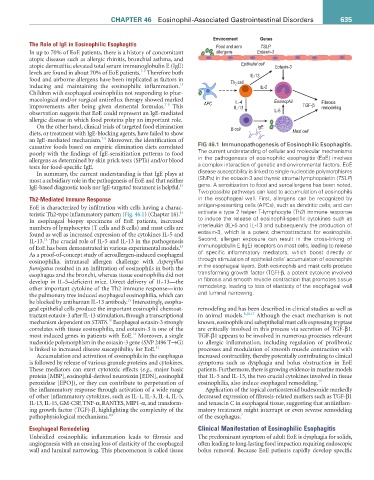
           causative foods based on empiric elimination diets correlated   fiG 46.1  Immunopathogenesis of Eosinophilic Esophagitis.
           poorly with the findings of IgE-sensitization patterns to food   The current understanding of cellular and molecular mechanisms
           allergens as determined by skin prick tests (SPTs) and/or blood   in the pathogenesis of eosinophilic esophagitis (EoE) involves
           tests for food-specific IgE.                           a complex interaction of genetic and environmental factors. EoE
             In summary, the current understanding is that IgE plays at   disease susceptibility is linked to single nucleotide polymorphisms
           most a subsidiary role in the pathogenesis of EoE and that neither   (SNPs) in the eotaxin-3 and thymic stromal lymphopoietin (TSLP)
           IgE-based diagnostic tools nor IgE-targeted treatment is helpful. 13  gene. A sensitization to food and aeroallergens has been noted.
                                                                  Two possible pathways can lead to accumulation of eosinophils
           Th2-Mediated Immune Response                           in the esophageal wall. First, allergens can be recognized by
           EoE is characterized by infiltration with cells having a charac-  antigen-presenting cells (APCs), such as dendritic cells, and can
                                                            14
           teristic Th2-type inflammatory pattern (Fig. 46.1) (Chapter 16).    activate a type 2 helper T-lymphocyte (Th2) immune response
           In esophageal biopsy specimens of EoE patients, increased   to induce the release of eosinophil-specific cytokines such as
           numbers of lymphocytes (T cells and B cells) and mast cells are   interleukin (IL)-5 and IL-13 and subsequently the production of
           found as well as increased expression of the cytokines IL-5 and   eotaxin-3, which is a potent chemoattractant for eosinophils.
               14
           IL-13.  The crucial role of IL-5 and IL-13 in the pathogenesis   Second, allergen exposure can result in the cross-linking of
                                                            15
           of EoE has been demonstrated in various experimental models.    immunoglobulin E (IgE) receptors on mast cells, leading to release
           As a proof-of-concept study of aeroallergen-induced esophageal   of specific inflammatory mediators, which boost directly or
           eosinophilia, intranasal allergen challenge with  Aspergillus   through stimulation of epithelial cells’ accumulation of eosinophils
           fumigatus resulted in an infiltration of eosinophils in both the   in the esophageal layers. Both eosinophils and mast cells produce
           esophagus and the bronchi, whereas tissue eosinophilia did not   transforming growth factor (TGF)-β, a potent cytokine involved
           develop in IL-5–deficient mice. Direct delivery of IL-13—the   in fibrosis and smooth muscle contraction that promotes tissue
           other important cytokine of the Th2 immune response—into   remodeling, leading to loss of elasticity of the esophageal wall
           the pulmonary tree induced esophageal eosinophilia, which can   and luminal narrowing.
                                           15
           be blocked by antihuman IL-13 antibody.  Interestingly, esopha-
           geal epithelial cells produce the important eosinophil chemoat-  remodeling and has been described in clinical studies as well as
           tractant eotaxin-3 after IL-13 stimulation, through a transcriptional   in animal models. 8,16,17  Although the exact mechanism is not
                                    10
           mechanism dependent on STAT6.  Esophageal eotaxin-3 strongly   known, eosinophils and subepithelial mast cells expressing tryptase
           correlates with tissue eosinophilia, and eotaxin-3 is one of the   are critically involved in this process via secretion of TGF-β1.
                                            12
           most induced genes in patients with EoE.  Moreover, a single   TGF-β1 appears to be involved in numerous processes relevant
           nucleotide polymorphism in the eotaxin-3 gene (SNP 2496 T→G)   to allergic inflammation, including regulation of profibrotic
           is linked to increased disease susceptibility for EoE. 12  processes and modulation of smooth muscle contraction with
             Accumulation and activation of eosinophils in the esophagus   increased contractility, thereby potentially contributing to clinical
           is followed by release of various granule proteins and cytokines.   symptoms such as dysphagia and bolus obstruction in EoE
           These mediators can exert cytotoxic effects (e.g., major basic   patients. Furthermore, there is growing evidence in murine models
           protein [MBP], eosinophil-derived neurotoxin [EDN], eosinophil   that IL-5 and IL-13, the two crucial cytokines involved in tissue
           peroxidase [EPO]), or they can contribute to perpetuation of   eosinophilia, also induce esophageal remodeling. 17
           the inflammatory response through activation of a wide range   Application of the topical corticosteroid budesonide markedly
           of other inflammatory cytokines, such as IL-1, IL-3, IL-4, IL-5,   decreased expression of fibrosis-related markers such as TGF-β1
           IL-13, IL-15, GM-CSF, TNF-α, RANTES, MIP1-α, and transform-  and tenascin C in esophageal tissue, suggesting that antiinflam-
           ing growth factor (TGF)-β, highlighting the complexity of the   matory treatment might interrupt or even reverse remodeling
           pathophysiological mechanisms. 8,9                     of the esophagus. 7

           Esophageal Remodeling                                  Clinical Manifestation of Eosinophilic Esophagitis
           Unbridled eosinophilic inflammation leads to fibrosis and   The predominant symptom of adult EoE is dysphagia for solids,
           angiogenesis with an ensuing loss of elasticity of the esophageal   often leading to long-lasting food impaction requiring endoscopic
           wall and luminal narrowing. This phenomenon is called tissue   bolus removal. Because EoE patients rapidly develop specific

