


Page 662 - Clinical Immunology_ Principles and Practice ( PDFDrive )
P. 662
636          Part five  Allergic Diseases


           A                                                  B


           C                                                  D
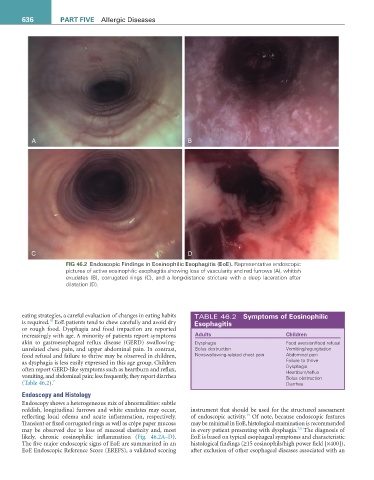
                       fiG 46.2  Endoscopic Findings in Eosinophilic Esophagitis (EoE). Representative endoscopic
                       pictures of active eosinophilic esophagitis showing loss of vascularity and red furrows (A), whitish
                       exudates (B), corrugated rings (C), and a long-distance stricture with a deep laceration after
                       dilatation (D).


        eating strategies, a careful evaluation of changes in eating habits   TABLE 46.2  Symptoms of eosinophilic
                 18
        is required.  EoE patients tend to chew carefully and avoid dry   esophagitis
        or rough food. Dysphagia and food impaction are reported
        increasingly with age. A minority of patients report symptoms   adults                 Children
        akin to gastroesophageal reflux disease (GERD) swallowing-  Dysphagia                  Food aversion/food refusal
        unrelated chest pain, and upper abdominal pain. In contrast,   Bolus obstruction       Vomiting/regurgitation
        food refusal and failure to thrive may be observed in children,   Nonswallowing-related chest pain  Abdominal pain
        as dysphagia is less easily expressed in this age group. Children                      Failure to thrive
        often report GERD-like symptoms such as heartburn and reflux,                          Dysphagia
                                                                                               Heartburn/reflux
        vomiting, and abdominal pain; less frequently, they report diarrhea                    Bolus obstruction
        (Table 46.2). 7                                                                        Diarrhea
        Endoscopy and Histology
        Endoscopy shows a heterogeneous mix of abnormalities: subtle
        reddish, longitudinal furrows and white exudates may occur,   instrument that should be used for the structured assessment
                                                                                  19
        reflecting local edema and acute inflammation, respectively.   of endoscopic activity.  Of note, because endoscopic features
        Transient or fixed corrugated rings as well as crêpe paper mucosa   may be minimal in EoE, histological examination is recommended
                                                                                                  7,8
        may be observed due to loss of mucosal elasticity and, most   in every patient presenting with dysphagia.  The diagnosis of
        likely, chronic eosinophilic inflammation (Fig. 46.2A–D).     EoE is based on typical esophageal symptoms and characteristic
        The five major endoscopic signs of EoE are summarized in an   histological findings (≥15 eosinophils/high power field [×400]),
        EoE Endoscopic Reference Score (EREFS), a validated scoring   after exclusion of other esophageal diseases associated with an

