


Page 663 - Clinical Immunology_ Principles and Practice ( PDFDrive )
P. 663
CHaPter 46  Eosinophil-Associated Gastrointestinal Disorders               637


                                                4
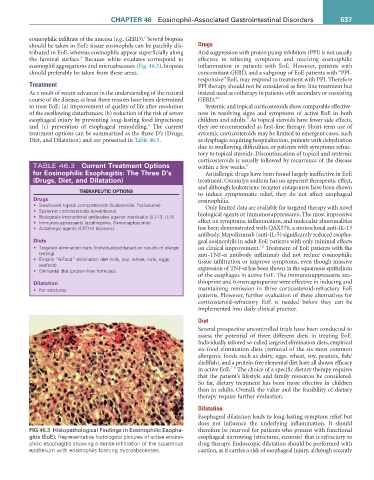
           eosinophilic infiltrate of the mucosa (e.g., GERD).  Several biopsies
           should be taken in EoE: tissue eosinophils can be patchily dis-  Drugs
           tributed in EoE, whereas eosinophils appear superficially along   Acid suppression with proton pump inhibitors (PPI) is not usually
                           4
           the luminal  surface.  Because white exudates correspond to   effective in relieving symptoms and resolving eosinophilic
           eosinophil aggregations and microabscesses (Fig. 46.3), biopsies   inflammation in patients with  EoE. However, patients with
           should preferably be taken from these areas.           concomitant GERD, and a subgroup of EoE patients with “PPI-
                                                                  responsive” EoE, may respond to treatment with PPI. Therefore
           Treatment                                              PPI therapy should not be considered as first-line treatment but
           As a result of recent advances in the understanding of the natural   instead used as cotherapy in patients with secondary or coexisting
           course of the disease, at least three reasons have been determined   GERD. 4,8
           to treat EoE: (a) improvement of quality of life after resolution   Systemic and topical corticosteroids show comparable effective-
           of the swallowing disturbances; (b) reduction of the risk of severe   ness in resolving signs and symptoms of active EoE in both
                                                                                  8
           esophageal injury by preventing long-lasting food impactions;   children and adults.  As topical steroids have fewer side effects,
                                                 8
           and  (c)  prevention  of  esophageal  remodeling.   The  current   they are recommended as first-line therapy. Short-term use of
           treatment options can be summarized as the three D’s (Drugs,   systemic corticosteroids may be limited to emergent cases, such
           Diet, and Dilatation) and are presented in Table 46.3.  as dysphagia requiring hospitalization, patients with dehydration
                                                                  due to swallowing difficulties, or patients with symptoms refrac-
                                                                  tory to topical steroids. Discontinuation of topical and systemic
                                                                  corticosteroids is usually followed by recurrence of the disease
            TABLE 46.3  Current treatment Options                 within a few weeks. 8
            for eosinophilic esophagitis: the three D’s             Antiallergic drugs have been found largely ineffective in EoE
            (Drugs, Diet, and Dilatation)                         treatment. Cromolyn sodium has no apparent therapeutic effect,
                                                                  and although leukotriene receptor antagonists have been shown
                           tHeraPeUtiC OPtiONS                    to induce symptomatic relief, they do not affect esophageal
            Drugs                                                 eosinophilia.
            •  Swallowed topical corticosteroids (budesonide, fluticasone)  Only limited data are available for targeted therapy with novel
            •  Systemic corticosteroids (prednisone)
            •  Biologicals (monoclonal antibodies against interleukin [IL]-13, IL-5)  biological agents or immunosuppressants. The most impressive
            •  Immunosuppressants (azathioprine, 6-mercaptopurine)  effect on symptoms, inflammation, and molecular abnormalities
            •  Antiallergic agents (CRTH2 blockers)               has been demonstrated with QAX576, a monoclonal anti-IL-13
                                                                  antibody. Mepolizumab (anti-IL-5) significantly reduced esopha-
            Diets                                                 geal eosinophils in adult EoE patients with only minimal effects
                                                                                      7,8
            •  Targeted elimination diets (individualized based on results of allergic   on clinical improvement.  Treatment of EoE patients with the
              testing)                                            anti-TNF-α antibody infliximab did not reduce eosinophilic
            •  Empiric “6-Food” elimination diet (milk, soy, wheat, nuts, eggs,   tissue infiltration or improve symptoms, even though massive
              seafood)
            •  Elemental diet (protein-free formulas)             expression of TNF-α has been shown in the squamous epithelium
                                                                  of the esophagus in active EoE. The immunosuppressants aza-
            Dilatation                                            thioprine and 6-mercaptopurine were effective in inducing and
            •  For strictures                                     maintaining remission in three corticosteroid-refractory EoE
                                                                  patients. However, further evaluation of these alternatives for
                                                                  corticosteroid-refractory EoE is needed before they can be
                                                                  implemented into daily clinical practice.

                                                                  Diet
                                                                  Several prospective uncontrolled trials have been conducted to
                                                                  assess  the  potential  of  three  different  diets  in  treating  EoE.
                                                                  Individually tailored so-called targeted elimination diets, empirical
                                                                  six-food elimination diets (removal of the six most common
                                                                  allergenic foods such as dairy, eggs, wheat, soy, peanuts, fish/
                                                                  shellfish), and a protein-free elemental diet have all shown efficacy
                                                                             7-9
                                                                  in active EoE.  The choice of a specific dietary therapy requires
                                                                  that the patient’s lifestyle and family resources be considered.
                                                                  So far, dietary treatment has been more effective in children
                                                                  than in adults. Overall, the value and the feasibility of dietary
                                                                  therapy require further evaluation.
                                                                  Dilatation
                                                                  Esophageal dilatation leads to long-lasting symptom relief but
                                                                  does not influence the underlying inflammation. It should
           fiG 46.3  Histopathological Findings in Eosinophilic Esopha-  therefore be reserved for patients who present with functional
           gitis (EoE). Representative histological pictures of active eosino-  esophageal narrowing (strictures, stenosis) that is refractory to
           philic esophagitis showing a dense infiltration of the squamous   drug therapy. Endoscopic dilatation should be performed with
           epithelium with eosinophils forming microabscesses.    caution, as it carries a risk of esophageal injury, although recently

