


Page 671 - Clinical Immunology_ Principles and Practice ( PDFDrive )
P. 671
644          ParT fivE  Allergic Diseases


        VERNAL KERATOCONJUNCTIVITIS
        VKC is a serious ocular allergy of childhood, comprising 0.1–0.5%
        of ocular disease in the developed world but more common and
        much more severe in hot, dry countries, especially the Middle
        East, West Africa, and the Mediterranean. In the United Kingdom,
        VKC is an unusual, self-limiting, often seasonal ocular allergy
        that affects children and young adults, especially males (85%)
        many of whom have a personal or family history of atopy. The
        link with atopy and seasonality is less clearly defined in cooler
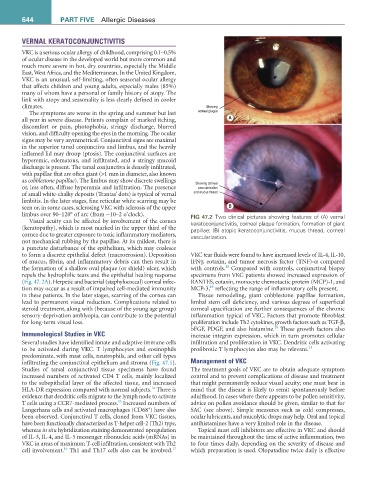
        climates.                                                   Showing
           The symptoms are worse in the spring and summer but last   corneal plaque
        all year in severe disease. Patients complain of marked itching,    A
        discomfort or pain, photophobia, stringy discharge, blurred
        vision, and difficulty opening the eyes in the morning. The ocular
        signs may be very asymmetrical. Conjunctival signs are maximal
        in the superior tarsal conjunctiva and limbus, and the heavily
        inflamed lid may droop (ptosis). The conjunctival surfaces are
        hyperemic,  edematous,  and  infiltrated,  and  a  stringy  mucoid
        discharge is present. The tarsal conjunctiva is densely infiltrated,
        with papillae that are often giant (>1 mm in diameter, also known
        as cobblestone papillae). The limbus may show discrete swellings   Showing corneal
        or, less often, diffuse hyperemia and infiltration. The presence   vascularization
        of small white-chalky deposits (Trantas’ dots) is typical of vernal   and mucus thread
        limbitis. In the later stages, fine reticular white scarring may be
        seen or, in some cases, sclerosing VKC with sclerosis of the upper   B
        limbus over 90–120° of arc (from ~10–2 o’clock).       fiG 47.2  Two clinical pictures showing features of (A) vernal
           Visual acuity can be affected by involvement of the cornea   keratoconjunctivitis, corneal plaque formation, formation of giant
        (keratopathy), which is most marked in the upper third of the   papillae; (B) atopic keratoconjunctivitis, mucus thread, corneal
        cornea due to greater exposure to toxic inflammatory mediators,   vascularization.
        not mechanical rubbing by the papillae. At its mildest, there is
        a punctate disturbance of the epithelium, which may coalesce
        to form a discrete epithelial defect (macroerosion). Deposition   VKC tear fluids were found to have increased levels of IL-4, IL-10,
        of mucus, fibrin, and inflammatory debris can then result in   IFNγ, eotaxin, and tumor necrosis factor (TNF)-α compared
                                                                           18
        the formation of a shallow oval plaque (or shield) ulcer, which     with controls.  Compared with controls, conjunctival biopsy
        repels the hydrophilic tears and the epithelial healing response   specimens from VKC patients showed increased expression of
        (Fig. 47. 2A). Herpetic and bacterial (staphylococcal) corneal infec-  RANTES, eotaxin, monocyte chemotactic protein (MCP)-1, and
                                                                      19
        tion may occur as a result of impaired cell-mediated immunity   MCP-3,  reflecting the range of inflammatory cells present.
        in these patients. In the later stages, scarring of the cornea can   Tissue remodeling, giant cobblestone papillae formation,
        lead to permanent visual reduction. Complications related to   limbal stem cell deficiency, and various degrees of superficial
        steroid treatment, along with (because of the young age group)   corneal opacification are further consequences of the chronic
        sensory-deprivation amblyopia, can contribute to the potential   inflammation typical of VKC. Factors that promote fibroblast
        for long-term visual loss.                             proliferation include Th2 cytokines, growth factors such as TGF-β,
                                                                                           20
                                                               bFGF, PDGF, and also histamine.  These growth factors also
        Immunological Studies in VKC                           increase integrin expression, which in turn promotes cellular
        Several studies have identified innate and adaptive immune cells   infiltration and proliferation in VKC. Dendritic cells activating
        to be activated during  VKC. T lymphocytes and eosinophils   profibrotic T lymphocytes also may be relevant. 21
        predominate, with mast cells, neutrophils, and other cell types
        infiltrating the conjunctival epithelium and stroma (Fig. 47.1).   Management of VKC
        Studies  of  tarsal  conjunctival  tissue  specimens  have  found   The treatment goals of VKC are to obtain adequate symptom
        increased numbers of activated CD4 T cells, mainly localized   control and to prevent complications of disease and treatment
        to the subepithelial layer of the affected tissue, and increased   that might permanently reduce visual acuity; one must bear in
                                                   14
        HLA-DR expression compared with normal subjects.  There is   mind that the disease is likely to remit spontaneously before
        evidence that dendritic cells migrate to the lymph node to activate   adulthood. In cases where there appears to be pollen sensitivity,
                                        15
        T cells using a CCR7-mediated process.  Increased numbers of   advice on pollen avoidance should be given, similar to that for
                                                 +
        Langerhans cells and activated macrophages (CD68 ) have also   SAC (see above). Simple measures such as cold compresses,
        been observed. Conjunctival T cells, cloned from VKC tissues,   ocular lubricants, and mucolytic drops may help. Oral and topical
        have been functionally characterized as T-helper cell-2 (Th2) type,   antihistamines have a very limited role in the disease.
        whereas in situ hybridization staining demonstrated upregulation   Topical mast cell inhibitors are effective in VKC and should
        of IL-3, IL-4, and IL-5 messenger ribonucleic acids (mRNAs) in   be maintained throughout the time of active inflammation, two
        VKC in areas of maximum T-cell infiltration, consistent with Th2   to four times daily, depending on the severity of disease and
                      16
                                                         17
        cell involvement.  Th1 and Th17 cells also can be involved.    which preparation is used. Olopatadine twice daily is effective

