


Page 676 - Clinical Immunology_ Principles and Practice ( PDFDrive )
P. 676
48


                                                                            Drug Hypersensitivity


                                                                       Mariana Castells, Rafael Bonamichi-Santos


           Reactions to drugs are an important source of morbidity and    KEY CONCEPT
           mortality and constitute a major hazard in the practice of
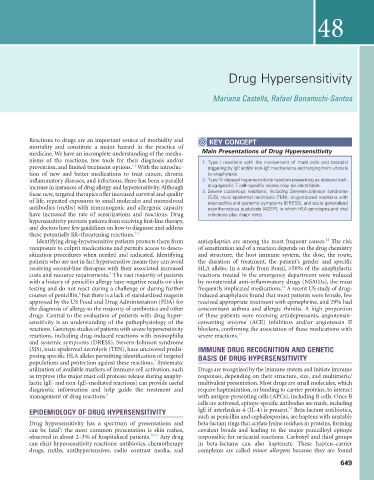
           medicine. We have an incomplete understanding of the mecha-  Main Presentations of Drug Hypersensitivity
           nisms of the reactions, few tools for their diagnosis and/or   1. Type I  reactions  with  the involvement of  mast cells  and  basophil
                                            1,2
           prevention, and limited treatment options.  With the introduc-  triggering by IgE and/or non-IgE mechanisms and ranging from urticaria
           tion of new and better medications to treat cancer, chronic   to anaphylaxis
           inflammatory diseases, and infections, there has been a parallel   2. Type IV delayed hypersensitivity reaction presenting as delayed rash;
           increase in instances of drug allergy and hypersensitivity. Although   drug-specific T cell–specific clones may be identifiable
           these new, targeted therapies offer increased survival and quality   3. Severe  cutaneous  reactions,  including  Stevens-Johnson  syndrome
                                                                     (SJS), toxic epidermal necrolysis (TEN), drug-induced reactions with
           of life, repeated exposures to small molecules and monoclonal   eosinophilia and systemic symptoms (DRESS), and acute generalized
           antibodies (mAbs) with immunogenic and allergenic capacity   exanthematous pustulosis (AGEP), in which HLA genotypes and viral
           have increased the rate of sensitizations and reactions. Drug   infections play major roles
           hypersensitivity prevents patients from receiving first-line therapy,
           and doctors have few guidelines on how to diagnose and address
           these potentially life-threatening reactions. 3,4
                                                                                                            11
             Identifying drug-hypersensitive patients protects them from   antiepileptics are among the most frequent causes.  The risk
           reexposure to culprit medications and permits access to desen-  of sensitization and of a reaction depends on the drug chemistry
           sitization procedures when needed and indicated. Identifying   and structure, the host immune system, the dose, the route,
           patients who are not in fact hypersensitive means they can avoid   the duration of treatment, the patient’s gender and specific
           receiving second-line therapies with their associated increased   HLA alleles. In a study from Brazil, >50% of the anaphylactic
                                     5
           costs and resource requirements.  The vast majority of patients   reactions treated in the emergency department were induced
           with a history of penicillin allergy have negative results on skin   by nonsteroidal anti-inflammatory drugs (NSAIDs), the most
                                                                                             12
           testing and do not react during a challenge or during further   frequently implicated medications.  A recent US study of drug-
                           6
           courses of penicillin,  but there is a lack of standardized reagents   induced anaphylaxis found that most patients were female, few
           approved by the US Food and Drug Administration (FDA) for   received appropriate treatment with epinephrine, and 29% had
           the diagnosis of allergy to the majority of antibiotics and other   concomitant asthma and allergic rhinitis.  A high proportion
           drugs. Central to the evaluation of patients with drug hyper-  of these patients were receiving antidepressants, angiotensin-
           sensitivity is an understanding of the pathophysiology of the   converting enzyme (ACE) inhibitors and/or angiotensin II
           reactions. Genotype studies of patients with severe hypersensitivity   blockers, confirming the association of these medications with
           reactions, including drug-induced reactions with eosinophilia   severe reactions. 13
           and systemic symptoms (DRESS), Stevens-Johnson syndrome
           (SJS), toxic epidermal necrolysis (TEN), have uncovered predis-  IMMUNE DRUG RECOGNITION AND GENETIC
           posing specific HLA alleles permitting identification of targeted   BASIS OF DRUG HYPERSENSITIVITY
                                                   7
           populations and protection against these reactions.  Systematic
           utilization of available markers of immune cell activation, such   Drugs are recognized by the immune system and initiate immune
           as tryptase (the major mast cell protease release during anaphy-  responses, depending on their structure, size, and multimeric/
           lactic IgE- and non-IgE–mediated reactions) can provide useful   multivalent presentation. Most drugs are small molecules, which
           diagnostic information and help guide the treatment and   require haptenization, or binding to carrier proteins, to interact
           management of drug reactions. 8                        with antigen-presenting cells (APCs), including B cells. Once B
                                                                  cells are activated, epitope-specific antibodies are made, including
                                                                                               14
           EPIDEMIOLOGY OF DRUG HYPERSENSITIVITY                  IgE if interleukin-4 (IL-4) is present.  Beta-lactam antibiotics,
                                                                  such as penicillin and cephalosporins, are haptens with unstable
           Drug hypersensitivity has a spectrum of presentations and   beta-lactam rings that acylate lysine residues in proteins, forming
                    9
           can be fatal : the most common presentation is skin rashes,   covalent bonds and leading to the major penicilloyl epitope
           observed in about 2–3% of hospitalized patients. 10,11  Any drug   responsible for urticarial reactions. Carboxyl and thiol groups
           can elicit hypersensitivity reactions: antibiotics, chemotherapy   in beta-lactams can  also haptenate. These  hapten–carrier
           drugs, mAbs, antihypertensives, radio contrast media, and   complexes  are called  minor  allergens  because  they  are found

                                                                                                                649

