


Page 673 - Clinical Immunology_ Principles and Practice ( PDFDrive )
P. 673
646          ParT fivE  Allergic Diseases


                                                               keratitis, which is more common and severe in AKC, can be
        Immunological Studies in AKC                           potentiated by topical steroids. Topical tacrolimus is more potent
                                                                                                    26
        In AKC the predominant cell types infiltrating the conjunctival   than topical cyclosporine and well tolerated.  Facial and lid
        tissues are T cells, eosinophils, and neutrophils (Fig. 47.1). As   dermatitis should be actively managed, if necessary in conjunction
        observed in VKC, increased numbers of activated CD4 T cells,   with a dermatologist, whereas lid margin inflammation (blepha-
        HLA-DR expression, and cells of the monocyte/macrophage   ritis) should be treated with hot compresses followed by lid
                                                         14
        lineage are found in conjunctival biopsy specimens in AKC,    hygiene, topical antibiotic, and/or steroid preparations and
        as well as mRNA expression of IL-3, IL-4, and IL-5 in the stroma.   systemic  low-dose antibiotics  (especially  tetracyclines), all of
        However, in AKC there is a significant increase in the expression of   which will lessen the need for antiinflammatory and immunosup-
        IL-2 mRNA and in the numbers of IFN-γ–expressing T cells, sug-  pressive therapy.
                                                  16
        gesting a Th1-mediated inflammation in this disease.  Collagen   Systemic therapy can be necessary in severe cases, particularly
        deposition and conjunctival tissue remodeling are considerable in   when surgical therapy is undertaken, and includes steroids,
        VKC and AKC, so the production of proinflammatory cytokines   cyclosporine, and sometimes other immunosuppressive agents
        by infiltrating cells may be the mechanism whereby tissue-resident   such as mycophenolate mofetil. All of these carry risks of serious
        cells such as conjunctival fibroblasts become involved.  side effects and also affect the general atopic picture, so consulta-
                                                               tion with the patient’s physician is advisable.
        Experimental Model of AKC                                 A significant number of patients require ocular surgery, either
        To investigate the immunopathogenic mechanisms involved   as a consequence of the disease or because of associated kera-
        during AKC, a new clinically more severe model of EAC has   toconus. Surgery for AKC includes both elective procedures and
                     25
        been developed.  In this model, EAC was induced in C57BL/6   emergency interventions and may consist of corneal gluing, patch
        mice by systemic immunization and topical daily challenge     grafts, corneal transplants (partial or full thickness), conjunctival
        with ovalbumin (OVA). OVA-challenged mice exhibited more   reconstruction, amniotic membrane grafts, and limbal trans-
        severe clinical symptoms compared with other mouse models   plantation. These are generally high-risk procedures and often
        described above, with chemosis and hyperemia. Because this   require support with systemic immunosuppression.
        model demonstrated clinical symptoms similar to AKC, it has   In summary, allergic disorders of the eye range in severity
        been used to show that mast cell, CD4 T cell, and dendritic   and duration. Recent studies have increased our understanding
        cell numbers are increased during disease, while IL-9, a growth   of the molecular mechanisms involved. VKC and AKC require
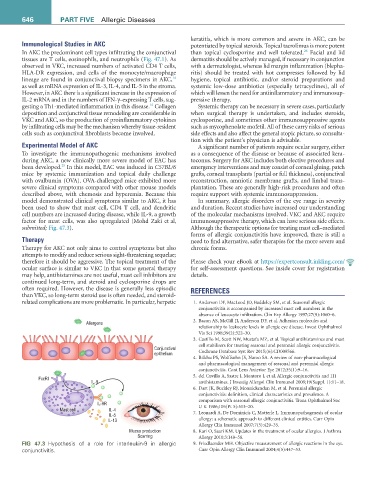
        factor for mast cells, was also upregulated (Mohd Zaki et al,   immunosuppressive therapy, which can have serious side effects.
        submitted; Fig. 47.3).                                 Although the therapeutic options for treating mast cell–mediated
                                                               forms of allergic conjunctivitis have improved, there is still a
        Therapy                                                need to find alternative, safer therapies for the more severe and
        Therapy for AKC not only aims to control symptoms but also   chronic forms.
        attempts to modify and reduce serious sight-threatening sequelae;
        therefore it should be aggressive. The topical treatment of the   Please check your eBook at https://expertconsult.inkling.com/
        ocular surface is similar to VKC in that some general therapy   for self-assessment questions. See inside cover for registration
        may help, antihistamines are not useful, mast cell inhibitors are   details.
        continued long-term, and steroid and cyclosporine drops are
        often required. However, the disease is generally less episodic   REFERENCES
        than VKC, so long-term steroid use is often needed, and steroid-
        related complications are more problematic. In particular, herpetic   1.  Anderson DF, MacLeod JD, Baddeley SM, et al. Seasonal allergic
                                                                  conjunctivitis is accompanied by increased mast cell numbers in the
                                                                  absence of leucocyte infiltration. Clin Exp Allergy 1997;27(9):1060–6.
                             Allergens                          2.  Bacon AS, McGill JI, Anderson DF, et al. Adhesion molecules and
                                                                  relationship to leukocyte levels in allergic eye disease. Invest Ophthalmol
                                                                  Vis Sci 1998;39(2):322–30.
                                                                3.  Castillo M, Scott NW, Mustafa MZ, et al. Topical antihistamines and mast
                                                                  cell stabilisers for treating seasonal and perennial allergic conjunctivitis.
                                                   Conjunctival
                                                   epithelium     Cochrane Database Syst Rev 2015;(6):CD009566.
                                                                4.  Bilkhu PS, Wolffsohn JS, Naroo SA. A review of non-pharmacological
                                                                  and pharmacological management of seasonal and perennial allergic
                                                                  conjunctivitis. Cont Lens Anterior Eye 2012;35(1):9–16.
                                                                5.  del Cuvillo A, Sastre J, Montoro J, et al. Allergic conjunctivitis and H1
              Fc RI
                               IL-9                               antihistamines. J Investig Allergol Clin Immunol 2009;19(Suppl. 1):11–18.
                                                                6.  Dart JK, Buckley RJ, Monnickendan M, et al. Perennial allergic
                                                                  conjunctivitis: definition, clinical characteristics and prevalence. A
                                                                  comparison with seasonal allergic conjunctivitis. Trans Ophthalmol Soc
                                 IL-9R
                     Mast cell       IL-4                         U K 1986;105(Pt 5):513–20.
                                     IL-5                       7.  Leonardi A, De Dominicis C, Motterle L. Immunopathogenesis of ocular
                                    IL-13                         allergy: a schematic approach to different clinical entities. Curr Opin
                                                                  Allergy Clin Immunol 2007;7(5):429–35.
                                           Mucus production     8.  Kari O, Saari KM. Updates in the treatment of ocular allergies. J Asthma
                                              Scarring            Allergy 2010;3:149–58.
        fiG 47.3  Hypothesis of a role for interleukin-9 in allergic   9.  Friedlaender MH. Objective measurement of allergic reactions in the eye.
        conjunctivitis.                                           Curr Opin Allergy Clin Immunol 2004;4(5):447–53.

