


Page 677 - Clinical Immunology_ Principles and Practice ( PDFDrive )
P. 677
650          ParT FivE  Allergic diseases


        in only a small proportion of cases; they have been implicated   for processing and generating haptenated peptides recognized
                                                    15
        in anaphylactic IgE-mediated reactions to penicillin.  Large   by T cells as neoantigens. In the p-I model, small drug molecules
        molecules, such as succinylcholine, which has quaternary   bind directly to the HLA molecule or T-cell receptor (TCR) in
        ammonium epitopes, can act as complete allergens. Epitope-  a noncovalent manner and stimulate T cells. In the altered
        specific antibodies can elicit type I, II, and III hypersensitivity   repertoire model, small molecules bind directly to the MHC-
        reactions (see below). Type IV (T cell–mediated) reactions can   binding  cleft  to  alter  the  specificity  of  peptide  binding.  This
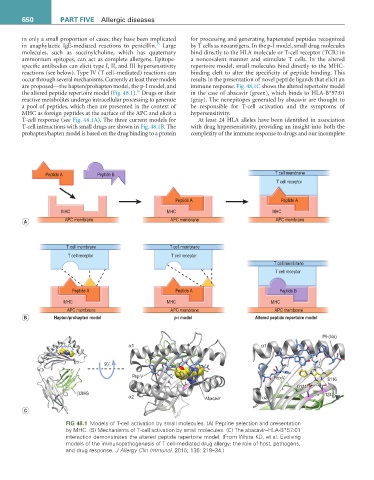
        occur through several mechanisms. Currently at least three models   results in the presentation of novel peptide ligands that elicit an
        are proposed—the hapten/prohapten model, the p-I model, and   immune response. Fig. 48.1C shows the altered repertoire model
                                              16
        the altered peptide repertoire model (Fig. 48.1).  Drugs or their   in the case of abacavir (green), which binds to HLA-B*57:01
        reactive metabolites undergo intracellular processing to generate   (gray). The neoepitopes generated by abacavir are thought to
        a pool of peptides, which then are presented in the context of   be responsible for T-cell activation and the symptoms of
        MHC as foreign peptides at the surface of the APC and elicit a   hypersensitivity.
        T-cell response (see Fig. 48.1A). The three current models for   At least 24 HLA alleles have been identified in association
        T-cell interactions with small drugs are shown in Fig. 48.1B. The   with drug hypersensitivity, providing an insight into both the
        prohapten/hapten model is based on the drug binding to a protein   complexity of the immune response to drugs and our incomplete


                Peptide A        Peptide B                                                 T cell membrane
                                                                                           T cell receptor


                                                          Peptide A                          Peptide A
                     MHC                                MHC                               MHC

         A            APC membrane                       APC membrane                      APC membrane


                       T cell membrane                   T cell membrane
                       T cell receptor                   T cell receptor
                                                                                           T cell membrane
                                                                                           T cell receptor


                         Peptide A                        Peptide A                         Peptide B
                      MHC                               MHC                               MHC
                       APC membrane                      APC membrane                      APC membrane
         B         Hapten/prohapten model                 p-i model                 Altered peptide repertoire model


                                                                                                           P9 (Val)
                                           α1                                         α1


                                   90˚
                                            Pep-V                                          Pep-V            S116
                                                                                             V
                                                                                           Pe Pe Pe P P P Pep-V
                                                                                            p
                                                                                             V
                                                                                             V
                                                                                                  D11 1 4 4 4 4 4
                                                                                                  D114
                                                                                                  D114
                                                                                                  D11
                          β2MG                                                                             I124 4 4 4
                                                                                                           12 12 124
                                                                                                            2
                                           α2                       Abacavir           α2
         C
                       FiG 48.1  Models of T-cell activation by small molecules. (A) Peptide selection and presentation
                       by MHC. (B) Mechanisms of T-cell activation by small molecules. (C) The abacavir–HLA-B*57:01
                       interaction demonstrates the altered peptide repertoire model. (From White KD, et al. Evolving
                       models of the immunopathogenesis of T cell-mediated drug allergy: the role of host, pathogens,
                       and drug response. J Allergy Clin Immunol. 2015; 136: 219–34.)

