


Page 697 - Clinical Immunology_ Principles and Practice ( PDFDrive )
P. 697
670          ParT fivE  Allergic Diseases


         TABLE 49.1  Summary of the Most frequently Encountered Occupational agents Causing
         Occupational asthma (Oa)
          agents                                             Occupation/industry
          High-Molecular-Weight agents
          Immunoglobulin E (IgE)–Dependent Causes
          Cereals, flour                                     Flour mills, bakers, pastry makers
          Animal-derived allergens: laboratory animals       Laboratory workers, farmers
          Enzymes: α-amylase, maxatase, alcalase, papain, bromelain,   Baking product production, bakers, detergent production, pharmaceutical
           pancreatin                                          industry, food industry
          Seafood                                            Seafood processing
          Latex                                              Health care workers, laboratory technicians
          Low-Molecular-Weight agents
          IgE-Dependent Causes
          Acid anhydrides, phthalic, trimellitic, tetrachlorophthalic anhydrides  Epoxy resin workers
          Platinum salts                                     Platinum refining
          Other Potential immunological Mechanisms
          Diisocyanates: toluene diisocyanate (TDI), methylene diphenyl-  Polyurethane production, plastic industry, insulation, molding, spray painting
           diisocyanate (MDI), hexamethylene diisocyanate (HDI)
          Wood dusts: western red cedar, iroko, obeche, oak, and others  Sawmill workers, carpenters, cabinet and furniture makers
          Amines and epoxy resins                            Rubber industry, cosmetics, hair dye manufacturing, fur industry, rubber
                                                               additives
          Colophony                                          Electronic industry (flux)
          Acrylates: cyanoacrylates, methacrylates, di- and triacrylates  Adhesives, dental and orthopedic materials, sculptured fingernails, printing
                                                               inks, paints and coatings
          Pharmaceutical products                            Pharmaceutical industry
          Formaldehyde, glutaraldehyde, biocides             Health care workers, cleaners
          Persulfate salts: hair bleach                      Hairdressers
          Reactive dyes: reactive black 5, pyrazolone derivatives, vinyl sulfones,   Textile workers, food industry workers
           carmine
          Metals: chromium, nickel, cobalt                   Metal refinery, metal alloy production, electroplating, welding


        isocyanate-induced asthma. Murine models of toluene diisocya-  inhibitory factor [MIF], monocyte chemoattractant protein-1
        nate “asthma” have shown a dependence of airway hyperrespon-  [MCP-1]). Furthermore, repetitive antigenic stimulation of
        siveness (AHR) and Th2-type inflammation on both CD4 and   peripheral blood mononuclear cells from patients with diiso-
        CD8 cells, but primarily the former. IL-4 and IL-13 are major   cyanate asthma induced the synthesis of tumor necrosis factor
        determinants of the pathobiology. Recent studies have suggested   (TNF)-α and MCP-1, but not IL-4 or IL-5. The bioactive lipid
        a role for innate lymphoid (lineage negative) cells to contribute   lysophosphatidic acid is released from lung epithelial cells by
        to type 2 cytokine production in the airways in response to   allergen or isocyanate and has the potential to contribute to the
        nonallergenic stimuli. Although few in number, these type 2   pathogenesis of asthma through a number of biological effects.
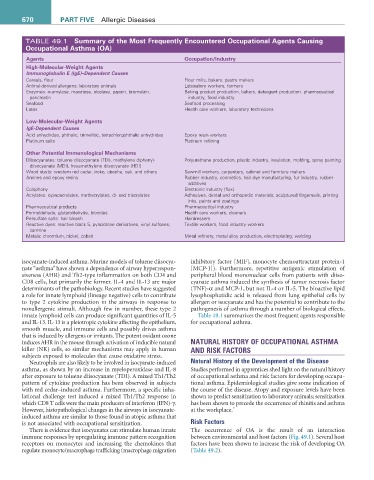
        innate lymphoid cells can produce significant quantities of IL-5   Table 49.1 summarizes the most frequent agents responsible
        and IL-13. IL-13 is a pleiotropic cytokine affecting the epithelium,   for occupational asthma.
        smooth muscle, and immune cells and possibly drives asthma
        that is induced by allergens or irritants. The potent oxidant ozone
        induces AHR in the mouse through activation of inducible natural   NATURAL HISTORY OF OCCUPATIONAL ASTHMA
        killer (NK) cells, so similar mechanisms may apply in human   AND RISK FACTORS
        subjects exposed to molecules that cause oxidative stress.
           Neutrophils are also likely to be involved in isocyanate-induced   Natural History of the Development of the Disease
        asthma, as shown by an increase in myeloperoxidase and IL-8   Studies performed in apprentices shed light on the natural history
        after exposure to toluene diisocyanate (TDI). A mixed Th1/Th2   of occupational asthma and risk factors for developing occupa-
        pattern of cytokine production has been observed in subjects   tional asthma. Epidemiological studies give some indication of
        with red cedar–induced asthma. Furthermore, a specific inha-  the course of the disease. Atopy and exposure levels have been
        lational challenge test induced a mixed Th1/Th2 response in   shown to predict sensitization to laboratory animals; sensitization
        which CD8 T cells were the main producers of interferon (IFN)-γ.   has been shown to precede the occurrence of rhinitis and asthma
        However, histopathological changes in the airways in isocyanate-  at the workplace. 7
        induced asthma are similar to those found in atopic asthma that
        is not associated with occupational sensitization.     Risk Factors
           There is evidence that isocyanates can stimulate human innate   The occurrence of OA is the result of an interaction
        immune responses by upregulating immune pattern recognition   between environmental and host factors (Fig. 49.1). Several host
        receptors on monocytes and increasing the chemokines that   factors have been shown to increase the risk of developing OA
        regulate monocyte/macrophage trafficking (macrophage migration   (Table 49.2).

