


Page 698 - Clinical Immunology_ Principles and Practice ( PDFDrive )
P. 698
CHaPTEr 49  Occupational Respiratory Allergies              671


                                                                  Therefore, and not surprisingly, atopy is also a risk factor for
                                                                  developing OA to HMW agents, since subjects who develop OA
                       Level of exposure to occupational agents   need to be sensitized to a specific agent to develop an asthmatic
                                                                  reaction  on  exposure. Atopy  has  been  associated  with  OA  to
                                                                  several different HMW agents, including OA caused by flour,
                                                                  laboratory animals, latex, snow crab, detergent enzymes, and
                                                   Smoking        α-amylase. It seems that the sensitization to specific allergen
                             Genetic predisposition               occurs mainly in the first 1–2 years after the beginning of
                                                                         8
                                  Atopy                           exposure.  However, atopy does not seem to influence the timing
                              Occupational rhinitis               of onset of OA symptoms. 9
                                                                    Pathophysiology.  The predisposition to atopy has increased
                            Airway hyperresponsiveness            markedly in recent years. The explanation for the increase is
                                                                  considered to be largely environmental but has not been fully
                                                                  identified, although airborne particulates have been shown to
                                                                  have adjuvant effects and may, therefore, play a part. The hygiene
                                                                  hypothesis has led to evidence of protective effects of certain
                                                                  environments, such as the farm. A fundamental question remains
                                                                  as to why T-cell differentiation into Th2 cells occurs in the airways.
                                                                  Multiple stimuli within the airway environment have been shown
                                                                  to promote a Th2 phenotype when interacting with DCs, including
                              Occupational asthma                 IL-4, thymic stromal lymphopoietin (TSLP), eosinophil-derived
                                                                  neurotoxin, and cysteinyl leukotrienes. Interaction of antigens
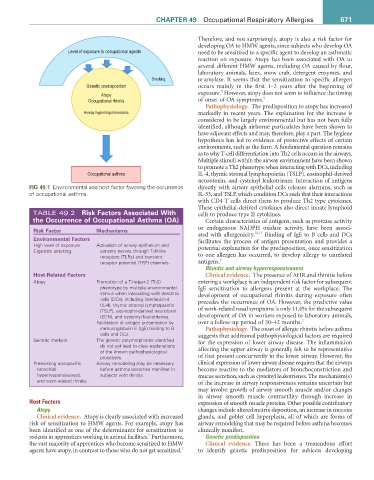
           fiG 49.1  Environmental and host factor favoring the occurrence   directly with airway epithelial cells releases alarmins, such as
           of occupational asthma.                                IL-33, and TSLP, which condition DCs such that their interactions
                                                                  with CD4 T cells direct them to produce Th2 type cytokines.
                                                                  These epithelial-derived cytokines also direct innate lymphoid
            TABLE 49.2  risk factors associated With              cells to produce type II cytokines.
            the Occurrence of Occupational asthma (Oa)              Certain characteristics of antigens, such as protease activity
            risk factor          Mechanisms                       or endogenous NADPH oxidase activity, have been associ-
                                                                  ated with allergenicity. 10,11  Binding of IgE to B cells and DCs
            Environmental factors                                 facilitates the process of antigen presentation and provides a
            High level of exposure  Activation of airway epithelium and   potential explanation for the predisposition, once sensitization
            Cigarette smoking     sensory nerves through Toll-like
                                  receptors (TLRs) and transient   to one allergen has occurred, to develop allergy to unrelated
                                                                         6
                                  receptor potential (TRP) channels.  antigens.
                                                                    Rhinitis and airway hyperresponsiveness
            Host-related factors                                    Clinical evidence.  The presence of AHR and rhinitis before
            Atopy                Promotion of a T-helper-2 (Th2)   entering a workplace is an independent risk factor for subsequent
                                  phenotype by multiple environmental   IgE sensitization to allergens present at the workplace. The
                                  stimuli when interacting with dendritic   development  of occupational  rhinitis  during  exposure  often
                                  cells (DCs), including interleukin-4   precedes the occurrence of OA. However, the predictive value
                                  (IL-4), thymic stromal lymphopoietin
                                  (TSLP), eosinophil-derived neurotoxin   of work-related nasal symptoms is only 11.4% for the subsequent
                                  (EDN), and cysteinyl leukotrienes.  development of OA in workers exposed to laboratory animals,
                                 Facilitation of antigen presentation by   over a follow-up period of 30–42 months. 2
                                  immunoglobulin E (IgE) binding to B   Pathophysiology.  The onset of allergic rhinitis before asthma
                                  cells and DCs                   suggests that additional pathophysiological factors are required
            Genetic markers      The genetic polymorphisms identified   for the expression of lower airway disease. The inflammation
                                  do not yet lead to clear explanations
                                  of the known pathophysiological   affecting the upper airway is generally felt to be representative
                                  processes.                      of that present concurrently in the lower airway. However, the
            Preexisting nonspecific   Airway remodeling may be necessary   clinical expression of lower airway disease requires that the airways
             bronchial            before asthma becomes manifest in   become reactive to the mediators of bronchoconstriction and
             hyperresponsiveness   subjects with rhinitis.        mucus secretion, such as cysteinyl leukotrienes. The mechanism(s)
             and work-related rhinitis                            of the increase in airway responsiveness remains uncertain but
                                                                  may involve growth of airway smooth muscle and/or changes
                                                                  in airway smooth muscle contractility through increase in
           Host Factors                                           expression of smooth muscle proteins. Other possible contributory
             Atopy                                                changes include altered matrix deposition, an increase in mucous
             Clinical evidence.  Atopy is clearly associated with increased   glands, and goblet cell hyperplasia, all of which are forms of
           risk of sensitization to HMW agents. For example, atopy has   airway remodeling that may be required before asthma becomes
           been identified as one of the determinants for sensitization to   clinically manifest.
                                                  7
           rodents in apprentices working in animal facilities.  Furthermore,   Genetic predisposition
           the vast majority of apprentices who become sensitized to HMW   Clinical evidence.  There has been a tremendous effort
                                                            7
           agents have atopy, in contrast to those who do not get sensitized.    to identify genetic predisposition for subjects developing

