


Page 693 - Clinical Immunology_ Principles and Practice ( PDFDrive )
P. 693
666          ParT FivE  Allergic diseases


                                                                   ON THE HOriZON
                                 Drug    Monomeric/low drug allergen
                                allergen  decreased cross-linking  •  There is a need for a new mechanistic approach and categorization
                    Subclinical                                    of delayed hypersensitivity reactions, better diagnostic tools, and a
            Inhibitory  mediator    IgE                            standardized approach to desensitization protocols.
            receptors  release                                   •  Modulation and treatment of hypersensitivity reactions will include
          LILRB4                    FcεRI                          the use of anti–IgE and other mAbs as well as small molecules to
                                                                   inhibit signal transduction.
                                                                 •  Prevention of hypersensitivity reactions will include the identification
             ITIM          ITAM  ITAM   ITAM   ITAM                of patients at risk by HLA genotyping.
                            P    P  P  P
                                       Syk                       •  Drug desensitization should be more widely available. Patients with
                    Degranulation          Syk degradation         allergies can then be treated with first-line therapies, which will improve
                SHP-1                                              quality of life and reduce both costs and risks.
                            Internalization of
                            antigen/IgE/FcεRla

                                                               11.  Bigby M, Jick S, Jick H, et al. Drug-induced cutaneous reactions. A report
            Cumulative drug concentration  Threshold for anaphylaxis  12.  Aun MV, Blanca M, Garro LS, et al. Nonsteroidal anti-inflammatory
                                                      Target
                                                                  from the Boston Collaborative Drug Surveillance Program on 15,438
                                                      dose
                                                                  consecutive inpatients, 1975 to 1982. JAMA 1986;256:3358–63.
                                                                  drugs are major causes of drug-induced anaphylaxis. J Allergy Clin
                                                                  Immunol Pract 2014;2:414–20.
                                Desensitization
                                                               13.  Banerji A, Rudders S, Clark S, et al. Retrospective study of drug-induced
                                                                  anaphylaxis treated in the emergency department or hospital: patient
                                                                  characteristics, management, and 1-year follow-up. J Allergy Clin
                                                                  Immunol Pract 2014;2:46–51.
                                                                  cytokine signals and the functions of epsilon germline transcripts. Curr
                                Dose                           14.  Oettgen HC. Regulation of the IgE isotype switch: new insights on
                                                                  Opin Immunol 2000;12:618–23.
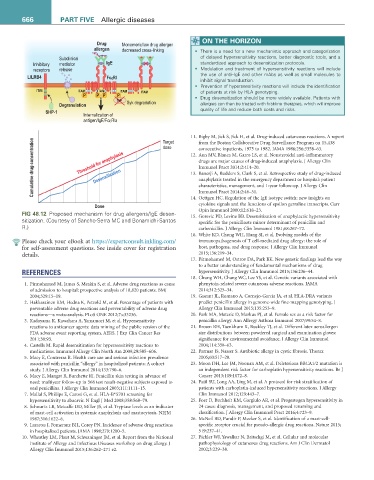
        FiG 48.12  Proposed mechanism for drug allergens/IgE desen-  15.  Gorevic PD, Levine BB. Desensitization of anaphylactic hypersensitivity
        sitization. (Courtesy of Sancho-Serra MC and Bonamichi-Santos   specific for the penicilloate minor determinant of penicillin and
        R.)                                                       carbenicillin. J Allergy Clin Immunol 1981;68:267–72.
                                                               16.  White KD, Chung WH, Hung SI, et al. Evolving models of the
        Please check your eBook at https://expertconsult.inkling.com/   immunopathogenesis of T cell-mediated drug allergy: the role of
        for self-assessment questions. See inside cover for registration   host, pathogens, and drug response. J Allergy Clin Immunol
        details.                                                  2015;136:219–34.
                                                               17.  Pirmohamed M, Ostrov DA, Park BK. New genetic findings lead the way
                                                                  to a better understanding of fundamental mechanisms of drug
        REFERENCES                                                hypersensitivity. J Allergy Clin Immunol 2015;136:236–44.
                                                               18.  Chung WH, Chang WC, Lee YS, et al. Genetic variants associated with
         1.  Pirmohamed M, James S, Meakin S, et al. Adverse drug reactions as cause   phenytoin-related severe cutaneous adverse reactions. JAMA
           of admission to hospital: prospective analysis of 18,820 patients. BMJ   2014;312:525–34.
           2004;329:15–19.                                     19.  Gueant JL, Romano A, Cornejo-Garcia JA, et al. HLA-DRA variants
         2.  Hakkarainen KM, Hedna K, Petzold M, et al. Percentage of patients with   predict penicillin allergy in genome-wide fine-mapping genotyping. J
           preventable adverse drug reactions and preventability of adverse drug   Allergy Clin Immunol 2015;135:253–9.
           reactions—a meta-analysis. PLoS ONE 2012;7:e33236.  20.  Park MA, Matesic D, Markus PJ, et al. Female sex as a risk factor for
         3.  Kadoyama K, Kuwahara A, Yamamori M, et al. Hypersensitivity    penicillin allergy. Ann Allergy Asthma Immunol 2007;99:54–8.
           reactions to anticancer agents: data mining of the public version of the   21.  Brown RH, Taenkhum K, Buckley TJ, et al. Different latex aeroallergen
           FDA adverse event reporting system, AERS. J Exp Clin Cancer Res   size distributions between powdered surgical and examination gloves:
           2011;30:93.                                            significance for environmental avoidance. J Allergy Clin Immunol
         4.  Castells M. Rapid desensitization for hypersensitivity reactions to   2004;114:358–63.
           medications. Immunol Allergy Clin North Am 2009;29:585–606.  22.  Parmar JS, Nasser S. Antibiotic allergy in cystic fibrosis. Thorax
         5.  Macy E, Contreras R. Health care use and serious infection prevalence   2005;60:517–20.
           associated with penicillin “allergy” in hospitalized patients: A cohort   23.  Moon DH, Lee JM, Noonan AM, et al. Deleterious BRCA1/2 mutation is
           study. J Allergy Clin Immunol 2014;133:790–6.          an independent risk factor for carboplatin hypersensitivity reactions. Br J
         6.  Macy E, Mangat R, Burchette RJ. Penicillin skin testing in advance of   Cancer 2013;109:1072–8.
           need: multiyear follow-up in 568 test result-negative subjects exposed to   24.  Patil SU, Long AA, Ling M, et al. A protocol for risk stratification of
           oral penicillins. J Allergy Clin Immunol 2003;111:1111–15.  patients with carboplatin-induced hypersensitivity reactions. J Allergy
         7.  Mallal S, Phillips E, Carosi G, et al. HLA-B*5701 screening for   Clin Immunol 2012;129:443–7.
           hypersensitivity to abacavir. N Engl J Med 2008;358:568–79.  25.  Foer D, Buchheit KM, Gargiulo AR, et al. Progestogen hypersensitivity in
         8.  Schwartz LB, Metcalfe DD, Miller JS, et al. Tryptase levels as an indicator   24 cases: diagnosis, management, and proposed renaming and
           of mast-cell activation in systemic anaphylaxis and mastocytosis. NEJM   classification. J Allergy Clin Immunol Pract 2016;4:723–9.
           1987;316:1622–6.                                    26.  McNeil BD, Pundir P, Meeker S, et al. Identification of a mast-cell-
         9.  Lazarou J, Pomeranz BH, Corey PN. Incidence of adverse drug reactions   specific receptor crucial for pseudo-allergic drug reactions. Nature 2015;
           in hospitalized patients. JAMA 1998;279:1200–5.        519:237–41.
        10.  Wheatley LM, Plaut M, Schwaninger JM, et al. Report from the National   27.  Pichler WJ, Yawalkar N, Britschgi M, et al. Cellular and molecular
           Institute of Allergy and Infectious Diseases workshop on drug allergy. J   pathophysiology of cutaneous drug reactions. Am J Clin Dermatol
           Allergy Clin Immunol 2015;136:262–271 e2.              2002;3:229–38.

