


Page 695 - Clinical Immunology_ Principles and Practice ( PDFDrive )
P. 695
CHaPTEr 48  Drug Hypersensitivity          667.e1


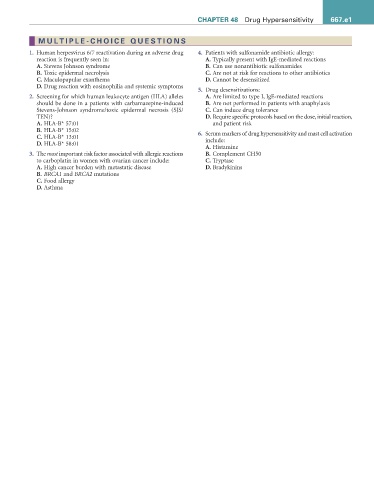
              MULT i PLE-CHO i CE QUEST i ONS

           1.  Human herpesvirus 6/7 reactivation during an adverse drug   4.  Patients with sulfonamide antibiotic allergy:
             reaction is frequently seen in:                         A. Typically present with IgE-mediated reactions
              A. Stevens Johnson syndrome                            B. Can use nonantibiotic sulfonamides
              B. Toxic epidermal necrolysis                          C. Are not at risk for reactions to other antibiotics
              C. Maculopapular exanthema                             D. Cannot be desensitized
              D. Drug reaction with eosinophilia and systemic symptoms
                                                                  5.  Drug desensitizations:
           2.  Screening for which human leukocyte antigen (HLA) alleles    A. Are limited to type I, IgE-mediated reactions
             should be done in a patients with carbamazepine-induced    B. Are not performed in patients with anaphylaxis
             Stevens-Johnson syndrome/toxic epidermal necrosis (SJS/   C. Can induce drug tolerance
             TEN)?                                                   D. Require specific protocols based on the dose, initial reaction,
              A. HLA-B* 57:01                                          and patient risk
              B. HLA-B* 15:02
              C. HLA-B* 13:01                                     6.  Serum markers of drug hypersensitivity and mast cell activation
              D. HLA-B* 58:01                                       include:
                                                                     A. Histamine
           3.  The most important risk factor associated with allergic reactions    B. Complement CH50
             to carboplatin in women with ovarian cancer include:    C. Tryptase
              A. High cancer burden with metastatic disease          D. Bradykinins
              B. BRCA1 and BRCA2 mutations
              C. Food allergy
              D. Asthma

