


Page 717 - Clinical Immunology_ Principles and Practice ( PDFDrive )
P. 717
690          Part SIX  Systemic Immune Diseases


        surprising that genes encoding integrins, NGAL, CD40 ligand,   healthy  donors  shows  that  the  frequency  of  germinal  centers
                                                                       +
        IFN-γ receptor, and IL-6 are among the hypomethylated genes   with 9G4  cells is less than 1%, implying that negative selection
        in SLE. Mechanisms for hypomethylation remain unclear;   of autoreactive cells occurs at the transition of naïve to germinal
        decreased efficacy of DNA methyltransferases (DNMTs) and   center B cells. In contrast, tonsillar biopsies from SLE patients
        overexpression of microRNAs (miRNA) that interfere with DNMT   demonstrate that 15–20% of germinal centers are positive for
        activity have been proposed. 26                        autoreactive 9G4 B cells. This study, as well as others, suggests
           Vitamin D has been shown to contribute to the regulation   that checkpoints exist for entry into and exodus from the germinal
        of the epigenome. Vitamin D levels are low in many lupus patients,   center response and that these may be altered in SLE.
        but the relationship of vitamin D levels to disease risk or disease   For example, it is clear that some pathogenic autoantibodies
        severity remains controversial. 27                     are not derived from natural autoantibodies. Back mutation of
        Inflammation itself may alter the epigenome; some studies suggest   several anti-DNA antibodies to their germline-encoded precursors
        that the metabolic modulator metformin can reverse some of   has identified nonautoreactive precursors. The failure of censoring
        the inflammation-induced alterations. Recent studies show that   mechanisms in germinal centers to prevent the maturation of
        metformin can reduce murine lupus, although the mechanism   autoreactive cells may reflect intrinsic B-cell abnormalities or
        for this therapeutic effect is not completely clear.   abnormalities in costimulatory molecules, cytokines (such as B
                                                               cell–activating factor [BAFF]; see below), follicular DCs, or T-cell,
        B Cells                                                B-cell interactions.
        B-Cell Selection
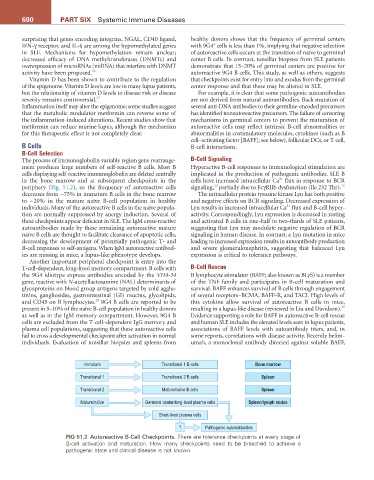
        The process of immunoglobulin variable region gene rearrange-  B-Cell Signaling
        ment produces large numbers of self-reactive B cells. Most B   Hyperactive B-cell responses to immunological stimulation are
        cells displaying self-reactive immunoglobulin are deleted centrally   implicated in the production of pathogenic antibodies. SLE B
                                                                                            2+
        in the bone marrow and at subsequent checkpoints in the   cells have increased intracellular Ca  flux in response to BCR
                                                                       29
        periphery (Fig. 51.2), so the frequency of autoreactive cells   signaling,  partially due to FcγRIIb dysfunction (Ile 232 Thr). 15
        decreases from ~75% in immature B cells in the bone marrow   The intracellular protein tyrosine kinase Lyn has both positive
        to ~20% in the mature naïve B-cell population in healthy   and negative effects on BCR signaling. Decreased expression of
                                                                                               2+
        individuals. Many of the autoreactive B cells in the naïve popula-  Lyn results in increased intracellular Ca  flux and B-cell hyper-
        tion are normally suppressed by anergy induction. Several of   activity. Correspondingly, Lyn expression is decreased in resting
        these checkpoints appear deficient in SLE. The IgM cross-reactive   and activated B cells in one-half to two-thirds of SLE patients,
        autoantibodies made by these remaining autoreactive mature   suggesting that Lyn may modulate negative regulation of BCR
        naïve B cells are thought to facilitate clearance of apoptotic cells,   signaling in human disease. In contrast, a Lyn mutation in mice
        decreasing the development of potentially pathogenic T- and   leading to increased expression results in autoantibody production
        B-cell responses to self-antigens. When IgM autoreactive antibod-  and severe glomerulonephritis, suggesting that balanced Lyn
        ies are missing in mice, a lupus-like phenotype develops.  expression is critical to tolerance pathways.
           Another important peripheral checkpoint is entry into the
        T-cell-dependent, long-lived memory compartment. B cells with   B-Cell Rescue
        the 9G4 idiotype express antibodies encoded by the  VH4-34   B lymphocyte stimulator (BAFF; also known as BLyS) is a member
        gene, reactive with N-acetyllactosamine (NAL) determinants of   of the TNF family and participates in B-cell maturation and
        glycoproteins on blood group antigens targeted by cold agglu-  survival. BAFF enhances survival of B cells through engagement
        tinins, gangliosides, gastrointestinal (GI) mucins, glycolipids,   of several receptors–BCMA, BAFF-R, and TACI. High levels of
                                28
        and CD45 on B lymphocytes.  9G4 B cells are reported to be   this cytokine allow survival of autoreactive B cells in mice,
                                                                                                                 30
        present in 5–10% of the naïve B-cell population in healthy donors   resulting in a lupus-like disease (reviewed in Liu and Davidson).
        as well as in the IgM memory compartment. However, 9G4 B   Evidence supporting a role for BAFF in autoreactive B-cell rescue
        cells are excluded from the T-cell–dependent IgG memory and   and human SLE includes the elevated levels seen in lupus patients,
        plasma cell populations, suggesting that these autoreactive cells   associations of BAFF levels with autoantibody titers, and, in
        fail to cross a developmental checkpoint after activation in normal   some reports, correlations with disease activity. Recently belim-
        individuals. Evaluation of tonsillar biopsies and spleens from   umab, a monoclonal antibody directed against soluble BAFF,


                            Immature                  Transitional 1 B cells        Bone marrow
                           Transitional 1             Transitional 2 B cells           Spleen

                           Transitional 2             Mature/naïve B cells             Spleen
                           Mature/naïve          Germinal center/long-lived plasma cells  Spleen/lymph nodes

                                                     Short-lived plasma cells
                                                            ?       Pathogenic autoantibodies
                       FIG 51.2  Autoreactive B-Cell Checkpoints. There are tolerance checkpoints at every stage of
                       B-cell activation and maturation. How many checkpoints need to be breached to achieve a
                       pathogenic state and clinical disease is not known.

