


Page 765 - Clinical Immunology_ Principles and Practice ( PDFDrive )
P. 765
CHaPTEr 54  Sjögren Syndrome               737


               CLiNiCaL PEarLS
            •  Chronic fatigue is a prominent presenting feature of Sjögren syndrome
              (SS).
            •  Autonomic nervous system involvement and peripheral nervous system
              involvement are often underrecognized.
            •  Mimics of SS include immunoglobulin G4 (IgG4)–related disease
              (Mikulicz disease), hepatitis C infection, sarcoidosis, and human
              T-lymphotropic virus (HTLV) infection.
            •  Presence of joint erosions and complement control protein (CCP)
              antibody  is indicative of  secondary SS  caused by  rheumatoid
              arthritis.
            •  Prolonged use of topical ophthalmic nonsteroidal antiinflammatory
              drugs (NSAIDs) and steroid preparations should be avoided to reduce
              the risk for local complications.
            •  Sudden normalization of previously elevated rheumatoid factor should
              prompt evaluation for development of lymphoma.
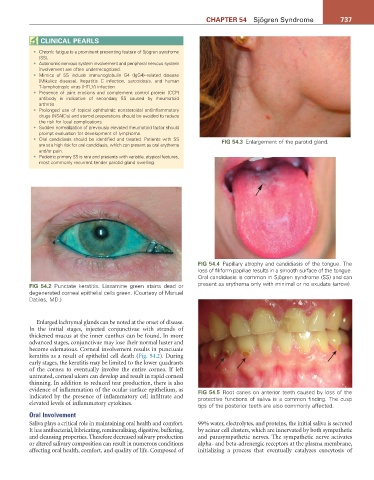
            •  Oral candidiasis should be identified and treated. Patients with SS   FiG 54.3  Enlargement of the parotid gland.
              are at a high risk for oral candidiasis, which can present as oral erythema
              and/or pain.
            •  Pediatric primary SS is rare and presents with variable, atypical features,
              most commonly recurrent tender parotid gland swelling.


                                                                  FiG 54.4  Papillary atrophy and candidiasis of the tongue. The
                                                                  loss of filiform papillae results in a smooth surface of the tongue.
                                                                  Oral candidiasis is common in Sjögren syndrome (SS) and can
           FiG 54.2  Punctate keratitis. Lissamine green stains dead or   present as erythema only with minimal or no exudate (arrow).
           degenerated corneal epithelial cells green. (Courtesy of Manuel
           Datiles, MD.)


             Enlarged lachrymal glands can be noted at the onset of disease.
           In  the initial stages, injected conjunctivae  with  strands  of
           thickened mucus at the inner canthus can be found. In more
           advanced stages, conjunctivae may lose their normal luster and
           become edematous. Corneal involvement results in punctuate
           keratitis as a result of epithelial cell death (Fig. 54.2). During
           early stages, the keratitis may be limited to the lower quadrants
           of the cornea to eventually involve the entire cornea. If left
           untreated, corneal ulcers can develop and result in rapid corneal
           thinning. In addition to reduced tear production, there is also
           evidence of inflammation of the ocular surface epithelium, as   FiG 54.5  Root caries on anterior teeth caused by loss of the
           indicated by the presence of inflammatory cell infiltrate and   protective functions of saliva is a common finding. The cusp
           elevated levels of inflammatory cytokines.             tips of the posterior teeth are also commonly affected.
           Oral Involvement
           Saliva plays a critical role in maintaining oral health and comfort.   99% water, electrolytes, and proteins, the initial saliva is secreted
           It has antibacterial, lubricating, remineralizing, digestive, buffering,   by acinar cell clusters, which are innervated by both sympathetic
           and cleansing properties. Therefore decreased salivary production   and parasympathetic nerves. The sympathetic nerve activates
           or altered salivary composition can result in numerous conditions   alpha- and beta-adrenergic receptors at the plasma membrane,
           affecting oral health, comfort, and quality of life. Composed of   initializing  a  process  that  eventually  catalyzes  exocytosis  of

