


Page 769 - Clinical Immunology_ Principles and Practice ( PDFDrive )
P. 769
CHaPTEr 54  Sjögren Syndrome               741


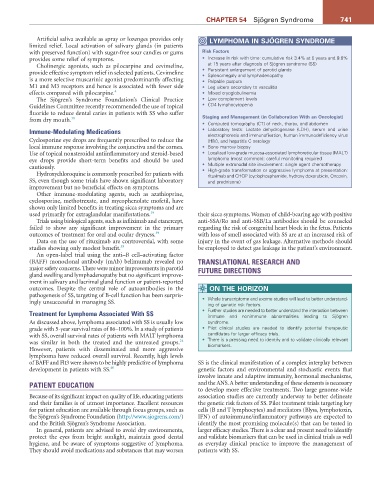
             Artificial saliva available as spray or lozenges provides only    LYMPHOMa iN SJÖGrEN SYNDrOME
           limited relief. Local activation of salivary glands (in patients
           with preserved function) with sugar-free sour candies or gums   risk Factors
           provides some relief of symptoms.                       •  Increase in risk with time: cumulative risk 3.4% at 5 years and 9.8%
             Cholinergic agonists, such as pilocarpine and cevimeline,   at 15 years after diagnosis of Sjögren syndrome (SS)
           provide effective symptom relief in selected patients. Cevimeline   •  Persistent enlargement of parotid glands
                                                                   •  Splenomegaly and lymphadenopathy
           is a more selective muscarinic agonist predominantly affecting   •  Palpable purpura
           M1 and M3 receptors and hence is associated with fewer side   •  Leg ulcers secondary to vasculitis
           effects compared with pilocarpine. 4                    •  Mixed cryoglobulinemia
             The Sjögren’s Syndrome Foundation’s Clinical Practice   •  Low complement levels
           Guidelines Committee recently recommended the use of topical   •  CD4 lymphocytopenia
           fluoride to reduce dental caries in patients with SS who suffer
           from dry mouth. 38                                      Staging and Management (in Collaboration With an Oncologist)
                                                                   •  Computed tomography (CT) of neck, thorax, and abdomen
           Immune-Modulating Medications                           •  Laboratory  tests:  Lactate  dehydrogenase  (LDH),  serum  and  urine
                                                                     electrophoresis and immunofixation, human immunodeficiency virus
           Cyclosporine eye drops are frequently prescribed to reduce the   (HIV), and hepatitis C serology
           local immune response involving the conjunctiva and the cornea.   •  Bone marrow biopsy
           Use of topical nonsteroidal antiinflammatory and steroid-based   •  Localized low-grade mucosa-associated lymphoreticular tissue (MALT)
           eye drops provide short-term benefits and should be used   lymphoma (most common): careful monitoring required
           cautiously.                                             •  Multiple extranodal site involvement: single agent chemotherapy
                                                                   •  High-grade transformation or aggressive lymphoma at presentation:
             Hydroxychloroquine is commonly prescribed for patients with   rituximab and CHOP (cyclophosphamide, hydroxy doxorubicin, Oncovin,
           SS, even though some trials have shown significant laboratory   and prednisone)
           improvement but no beneficial effects on symptoms.
             Other immune-modulating agents, such as azathioprine,
           cyclosporine, methotrexate, and mycophenolate mofetil, have
           shown only limited benefits in treating sicca symptoms and are
           used primarily for extraglandular manifestations. 39   their sicca symptoms. Women of child-bearing age with positive
             Trials using biological agents, such as infliximab and etanercept,   anti-SSA/Ro and anti-SSB/La antibodies should be counseled
           failed to show any significant improvement in the primary   regarding the risk of congenital heart block in the fetus. Patients
           outcomes of treatment for oral and ocular dryness. 39  with loss of smell associated with SS are at an increased risk of
             Data on the use of rituximab are controversial, with some   injury in the event of gas leakage. Alternative methods should
           studies showing only modest benefit. 39                be employed to detect gas leakage in the patient’s environment.
             An open-label trial using the anti–B cell–activating factor
           (BAFF) monoclonal antibody (mAb) belimumab revealed no   TRANSLATIONAL RESEARCH AND
           major safety concerns. There were minor improvements in parotid   FUTURE DIRECTIONS
           gland swelling and lymphadenopathy but no significant improve-
           ment in salivary and lacrimal gland function or patient-reported
           outcomes.  Despite  the  central  role of  autoantibodies  in the    ON THE HOriZON
           pathogenesis of SS, targeting of B-cell function has been surpris-
           ingly unsuccessful in managing SS.                      •  Whole transcriptome and exome studies will lead to better understand-
                                                                     ing of genetic risk factors.
           Treatment for Lymphoma Associated With SS               •  Further studies are needed to better understand the interaction between
                                                                     immune and nonimmune abnormalities  leading to Sjögren
           As discussed above, lymphoma associated with SS is usually low   syndrome.
           grade with 5-year survival rates of 86–100%. In a study of patients   •  Pilot clinical studies are needed to identify potential therapeutic
           with SS, overall survival rates of patients with MALT lymphoma   candidates for larger efficacy trials.
                                                            24
           was similar in both  the treated and  the untreated groups.    •  There is a pressing need to identify and to validate clinically relevant
                                                                     biomarkers.
           However, patients with disseminated and more aggressive
           lymphoma have reduced overall survival. Recently, high levels
           of BAFF and Flt3 were shown to be highly predictive of lymphoma   SS is the clinical manifestation of a complex interplay between
           development in patients with SS. 40                    genetic factors and environmental and stochastic events that
                                                                  involve innate and adaptive immunity, hormonal mechanisms,
           PATIENT EDUCATION                                      and the ANS. A better understanding of these elements is necessary
                                                                  to develop more effective treatments. Two large genome-wide
           Because of its significant impact on quality of life, educating patients   association studies are currently underway to better delineate
           and their families is of utmost importance. Excellent resources   the genetic risk factors of SS. Pilot treatment trials targeting key
           for patient education are available through focus groups, such as   cells (B and T lymphocytes) and mediators (Blyss, lymphotoxin,
           the Sjögren’s Syndrome Foundation (http://www.sjogrens.com/)   IFN) of autoimmune/inflammatory pathways are expected to
           and the British Sjögren’s Syndrome Association.        identify the most promising molecule(s) that can be tested in
             In general, patients are advised to avoid dry environments,   larger efficacy studies. There is a clear and present need to identify
           protect the eyes from bright sunlight, maintain good dental   and validate biomarkers that can be used in clinical trials as well
           hygiene, and be aware of symptoms suggestive of lymphoma.   as everyday clinical practice to improve the management of
           They should avoid medications and substances that may worsen   patients with SS.

