


Page 768 - Clinical Immunology_ Principles and Practice ( PDFDrive )
P. 768
740          ParT Six  Systemic Immune Diseases


           Patients presenting with sicca symptoms suggestive of SS   The reasons for this increased interest mainly stems from recogni-
        should  undergo  specialized  testing  to  confirm  the  diagnosis.   tion of the master regulatory roles they play in normal and
        Lachrymal function can be assessed by using the Schirmer test   altered physiological states and also their stability compared with
        to quantify the amount of tear production, whereas corneal and   mRNAs, a characteristic that allows them to be readily isolated
        conjunctival damage caused by dryness can be measured by   from archived samples, such as formalin-fixed paraffin-embedded
        fluorescein and lissamine green staining. Salivary gland evaluation   (FFPE) tissues or frozen saliva. 32-34
        is done by collection of unstimulated saliva or by performing   The role of miRNAs in primary SS is being investigated by
        salivary scintigraphy. Laboratory workup should include testing   several groups worldwide not only for their effects on immune
        for autoantibodies to SSA/Ro and SSB/La antigens, which are   cells but also on the target organs, such as the salivary glands. 35-37
        detected in sera of 45–70% and 20–50%, respectively, in patients   Rheumatoid factor is commonly positive in patients with SS
        with SS. However, the AECG criteria have been criticized for   and is part of the new ACR criteria for the diagnosis of SS.
        including subjective symptoms and physiological tests lacking   Recently, anticentromere antibodies were found to be present
        specificity and for using alternative tests that are diagnostically   in up to 13% of patients with SS.
        nonequivalent. In addition, with the potential use of biological
        agents to treat SS, more standardized, clear, and highly specific   TREATMENT
        criteria are needed.
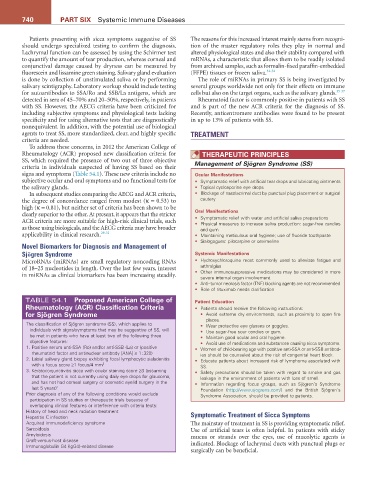
           To address these concerns, in 2012 the American College of
        Rheumatology (ACR) proposed new classification criteria for    THEraPEUTiC PriNCiPLES
        SS, which required the presence of two out of three objective   Management of Sjögren Syndrome (SS)
        criteria in individuals suspected of having SS based on their
        signs and symptoms (Table 54.1). These new criteria include no   Ocular Manifestations
        subjective ocular and oral symptoms and no functional tests for   •  Symptomatic relief with artificial tear drops and lubricating ointments
        the salivary glands.                                     •  Topical cyclosporine eye drops
           In subsequent studies comparing the AECG and ACR criteria,   •  Blockage of nasolacrimal duct by punctual plug placement or surgical
        the degree of concordance ranged from modest (κ = 0.53) to   cautery
        high (κ = 0.81), but neither set of criteria has been shown to be
        clearly superior to the other. At present, it appears that the stricter   Oral Manifestations
        ACR criteria are more suitable for high-risk clinical trials, such   •  Symptomatic relief with water and artificial saliva preparations
                                                                 •  Physical measures to increase saliva production: sugar-free candies
        as those using biologicals, and the AECG criteria may have broader   and gum
        applicability in clinical research. 29-31                •  Maintaining meticulous oral hygiene; use of fluoride toothpaste
                                                                 •  Sialogogues: pilocarpine or cevimeline
        Novel Biomarkers for Diagnosis and Management of
        Sjӧgren Syndrome                                         Systemic Manifestations
        MicroRNAs (miRNAs) are small regulatory noncoding RNAs   •  Hydroxychloroquine most commonly used to alleviate fatigue and
        of 18–25 nucleotides in length. Over the last few years, interest   arthralgias
        in miRNAs as clinical biomarkers has been increasing steadily.   •  Other immunosuppressive medications may be considered in more
                                                                   severe internal organ involvement
                                                                 •  Anti–tumor necrosis factor (TNF) blocking agents are not recommended
                                                                 •  Role of rituximab needs clarification
         TABLE 54.1  Proposed american College of                Patient Education
         rheumatology (aCr) Classification Criteria              •  Patients should receive the following instructions:
         for Sjögren Syndrome                                      •  Avoid extreme dry environments, such as proximity to open fire
                                                                    places.
          The classification of Sjögren syndrome (SS), which applies to   •  Wear protective eye glasses or goggles.
           individuals with signs/symptoms that may be suggestive of SS, will   •  Use sugar-free sour candies or gum.
           be met in patients who have at least two of the following three   •  Maintain good ocular and oral hygiene.
           objective features:                                     •  Avoid use of medications and substances causing sicca symptoms.
          1. Positive serum anti-SSA (Ro) and/or anti-SSB (La) or (positive   •  Women of child-bearing age with positive anti-SSA or anti-SSB antibod-
           rheumatoid factor and antinuclear antibody [ANA] ≥ 1 : 320)  ies should be counseled about the risk of congenital heart block.
          2. Labial salivary gland biopsy exhibiting focal lymphocytic sialadenitis   •  Educate patients about increased risk of lymphoma associated with
           with a focus score ≥1 focus/4 mm 2                      SS.
          3. Keratoconjunctivitis sicca with ocular staining score ≥3 (assuming   •  Safety precautions should be taken with regard to smoke and gas
           that the patient is not currently using daily eye drops for glaucoma,   leakage in the environment of patients with loss of smell.
           and has not had corneal surgery or cosmetic eyelid surgery in the   •  Information  regarding  focus  groups,  such  as  Sjögren’s  Syndrome
           last 5 years) 3                                         Foundation (http://www.sjogrens.com/) and the British Sjögren’s
          Prior diagnosis of any of the following conditions would exclude   Syndrome Association, should be provided to patients.
           participation in SS studies or therapeutic trials because of
           overlapping clinical features or interference with criteria tests:
          History of head and neck radiation treatment
          Hepatitis C infection                                Symptomatic Treatment of Sicca Symptoms
          Acquired immunodeficiency syndrome                   The mainstay of treatment in SS is providing symptomatic relief.
          Sarcoidosis                                          Use of artificial tears is often helpful. In patients with sticky
          Amyloidosis                                          mucus or strands over the eyes, use of mucolytic agents is
          Graft-versus-host disease
          Immunoglobulin G4 (IgG4)–related disease             indicated. Blockage of lachrymal ducts with punctual plugs or
                                                               surgically can be beneficial.

