


Page 766 - Clinical Immunology_ Principles and Practice ( PDFDrive )
P. 766
738          ParT Six  Systemic Immune Diseases


                              Parasympathetic nerve               Chronic xerostomia necessitates the use of fluids throughout
                                                               the day and night. It is not uncommon for patients with SS to
                                                               wake up at night to drink fluids to relieve dryness and also to
                                      DAG                      require the use of fluids to be able to speak, chew, and swallow.
                                 PIP2
                       M3R                                     A burning sensation along with taste alterations and decreased
                    ACh
                                                               tolerance to spicy foods is described by a significant percentage
               Na +        PLC                   +  Interstitium  of patients.
                                                                  Head and neck examination often reveals dry and chapped
                                          K +                  lips, angular cheilitis, and swollen major salivary glands (Fig.
                                                               54.3), which may be recurrent or chronic. Intraoral findings
                    G g /G 11                                  include decreased salivary pooling under the tongue and a
                                IP 3                           depapillated tongue surface often associated with erythematous
                                STIM1                          candidiasis (Fig. 54.4). Vasculitis can also manifest in the oral
                        IP3R                                   cavity and lead to tissue breakdown. Teeth often exhibit an
                                     Ca 2+                     increased rate of caries with characteristic decay affecting the
                                                  Ca 2+        roots and cusp tips (Fig. 54.5).
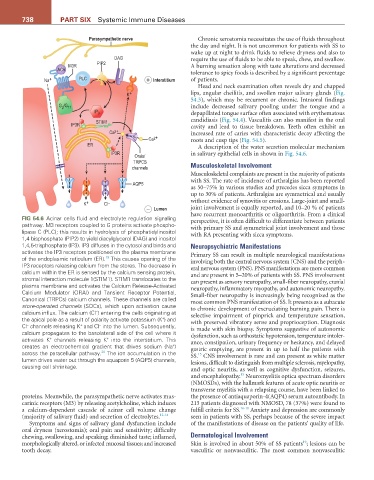
                              ER                                  A description of the water secretion molecular mechanism
                                     IP3R                      in salivary epithelial cells in shown in Fig. 54.6.
                                             Orais/
                                             TRPCS
                                            channels           Musculoskeletal Involvement
                                                               Musculoskeletal complaints are present in the majority of patients
                                                               with SS. The rate of incidence of arthralgias has been reported
                                            AQP5
                                                               as 50–75% in various studies and precedes sicca symptoms in
                                                               up to 30% of patients. Arthralgias are symmetrical and usually
                            K +    Cl –                        without evidence of synovitis or erosions. Large-joint and small-
                                                 −  Lumen      joint involvement is equally reported, and 10–20 % of patients
                                                               have recurrent monoarthritis or oligoarthritis. From a clinical
        FiG 54.6  Acinar cells fluid and electrolyte regulation signaling   perspective, it is often difficult to differentiate between patients
        pathway. M3 receptors coupled to G proteins activate phospho-  with primary SS and symmetrical joint involvement and those
        lipase C (PLC); this results in hydrolysis of phosphatidylinositol   with RA presenting with sicca symptoms.
        1,4 bisphosphate (PIP2) to yield diacylglycerol (DAG) and inositol
        1,4,5-trisphosphate (IP3). IP3 diffuses in the cytosol and binds and   Neuropsychiatric Manifestations
        activates the IP3 receptors positioned on the plasma membrane   Primary SS can result in multiple neurological manifestations
        of the endoplasmic reticulum (ER).  This causes opening of the   involving both the central nervous system (CNS) and the periph-
                                    19
        IP3 receptors releasing calcium from the stores. The decrease in   eral nervous system (PNS). PNS manifestations are more common
        calcium within the ER is sensed by the calcium sensing protein,   and are present in 5–20% of patients with SS. PNS involvement
        stromal interaction molecule 1(STIM1). STIM1 translocates to the   can present as sensory neuropathy, small-fiber neuropathy, cranial
        plasma membrane and activates the Calcium Release-Activated   neuropathy, inflammatory myopathy, and autonomic neuropathy.
        Calcium  Modulator  (ORAI)  and Tansient  Receptor  Potential,   Small-fiber neuropathy is increasingly being recognized as the
        Canonical (TRPCs) calcium channels. These channels are called   most common PNS manifestation of SS. It presents as a subacute
        store-operated channels (SOCs), which upon activation cause   to chronic development of excruciating burning pain. There is
                                −
        calcium influx. The calcium (Cl ) entering the cells originating at   selective impairment of pinprick and temperature sensation,
                                                      +
        the apical pole as a result of polarity activate potassium (K ) and   with preserved vibratory sense and proprioception. Diagnosis
                                 −
                           +
          −
        Cl  channels releasing K  and Cl  into the lumen. Subsequently,   is made with skin biopsy. Symptoms suggestive of autonomic
        calcium propagates to the basolateral side of the cell where it   dysfunction, such as orthostatic hypotension, temperature intoler-
                                    +
                 +
        activates K  channels releasing K  into the interstitium. This   ance, constipation, urinary frequency or hesitancy, and delayed
                                                          +
        creates an electrochemical gradient that drives sodium (Na )   gastric emptying,  are  present  in up  to  half  the  patients  with
                                  20
        across the paracellular pathway.  The ion accumulation in the   SS.  CNS involvement is rare and can present as white matter
                                                                  15
        lumen drives water out through the aquaporin 5 (AQP5) channels,   lesions, difficult to distinguish from multiple sclerosis, myelopathy,
        causing cell shrinkage.
                                                               and optic neuritis, as well as cognitive dysfunction, seizures,
                                                                                15
                                                               and encephalopathy.  Neuromyelitis optica spectrum disorders
                                                               (NMOSDs), with the hallmark features of acute optic neuritis or
                                                               transverse myelitis with a relapsing course, have been linked to
        proteins. Meanwhile, the parasympathetic nerve activates mus-  the presence of antiaquaporin-4(AQP4) serum autoantibody. In
        carinic receptors (M3) by releasing acetylcholine, which induces   213 patients diagnosed with NMOSD, 78 (37%) were found to
        a calcium-dependent cascade of acinar cell volume change   fulfill criteria for SS. 16-18  Anxiety and depression are commonly
        (majority of salivary fluid) and secretion of electrolytes. 12-14  seen in patients with SS, perhaps because of the severe impact
           Symptoms and signs of salivary gland dysfunction include   of the manifestations of disease on the patients’ quality of life.
        oral dryness (xerostomia); oral pain and sensitivity; difficulty
        chewing, swallowing, and speaking; diminished taste; inflamed,   Dermatological Involvement
                                                                                                    19
        morphologically altered, or infected mucosal tissues; and increased   Skin is involved in about 50% of SS patients ; lesions can be
        tooth decay.                                           vasculitic or nonvasculitic. The most common nonvasculitic

