


Page 805 - Clinical Immunology_ Principles and Practice ( PDFDrive )
P. 805
776          Part six  Systemic Immune Diseases


               20
        systems.  This is clearly an area where more work needs to    CLINICAL FEATURES
        be done.
                                                               Ankylosing Spondylitis
        PATHOLOGY OF SPA                                       Musculoskeletal Symptoms
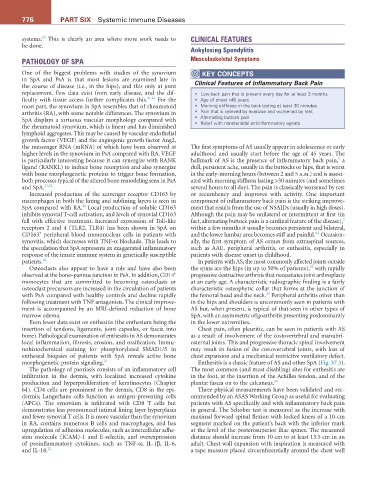
        One of the biggest problems with studies of the synovium    KEY CONCEPts
        in SpA and PsA is that most lesions are examined late in   Clinical Features of Inflammatory Back Pain
        the course of disease (i.e., in the hips), and this only at joint
        replacement.  Few  data exist  from early  disease, and  the dif-  •  Low-back pain that is present every day for at least 3 months
        ficulty with tissue access further complicates this. 21,22  For the   •  Age of onset <45 years
        most part, the synovium in SpA resembles that of rheumatoid   •  Morning stiffness in the back lasting at least 30 minutes
        arthritis (RA), with some notable differences. The synovium in   •  Pain that is relieved by exercise and worsened by rest
        SpA displays a tortuous vascular morphology compared with   •  Alternating buttock pain
                                                                 •  Relief with nonsteroidal antiinflammatory agents
        the rheumatoid synovium, which is linear and has diminished
        lymphoid aggregates. This may be caused by vascular endothelial
        growth factor (VEGF) and the angiogenic growth factor Ang2,
        the messenger RNA (mRNA) of which have been observed at   The first symptoms of AS usually appear in adolescence or early
        higher levels in the synovium in PsA compared with RA. VEGF   adulthood and usually start before the age of 45 years. The
                                                                                                                5
        is particularly interesting because it can synergize with RANK   hallmark of AS is the presence of inflammatory back pain,  a
        ligand (RANKL) to induce bone resorption and also synergize   dull, persistent ache, usually in the buttocks or hips, that is worst
        with bone morphogenetic proteins to trigger bone formation,   in the early-morning hours (between 2 and 5 a.m.) and is associ-
        both processes typical of the altered bone remodeling seen in PsA     ated with morning stiffness lasting >30 minutes (and sometimes
        and SpA. 21,22                                         several hours to all day). The pain is classically worsened by rest
           Increased production of the scavenger receptor CD163 by   or recumbency and improves with activity. One important
        macrophages in both the lining and sublining layers is seen in   component of inflammatory back pain is the striking improve-
                            20
        SpA compared with RA.  Local production of soluble CD163   ment that results from the use of NSAIDs (usually in high doses).
        inhibits synovial T-cell activation, and levels of synovial CD163   Although the pain may be unilateral or intermittent at first (in
                                                                                                                 5
        fall with effective treatment. Increased expression of Toll-like   fact, alternating buttock pain is a cardinal feature of the disease),
        receptors 2 and 4 (TLR2, TLR4) has been shown in SpA on   within a few months it usually becomes persistent and bilateral,
              +
                                                                                                        4,5
        CD163  peripheral blood mononuclear cells in patients with   and the lower lumbar area becomes stiff and painful.  Occasion-
        synovitis, which decreases with TNF-α blockade. This leads to   ally, the first symptom of AS comes from extraspinal sources,
        the speculation that SpA represents an exaggerated inflammatory   such as  AAU, peripheral arthritis, or enthesitis, especially in
        response of the innate immune system in genetically susceptible   patients with disease onset in childhood.
        patients. 22                                              In patients with AS, the most commonly affected joints outside
                                                                                                      22
           Osteoclasts also appear to have a role and have also been   the spine are the hips (in up to 50% of patients),  with rapidly
                                                          +
        observed at the bone–pannus junction in PsA. In addition, CD14    progressive destructive arthritis that necessitates joint arthroplasty
        monocytes  that  are  committed  to  becoming  osteoclasts  or   at an early age. A characteristic radiographic finding is a fairly
        osteoclast precursors are increased in the circulation of patients   characteristic osteophytic collar that forms at the junction of
                                                                                        23
        with PsA compared with healthy controls and decline rapidly   the femoral head and the neck.  Peripheral arthritis other than
        following treatment with TNF antagonists. The clinical improve-  in the hips and shoulders is uncommonly seen in patients with
        ment is accompanied by an MRI-defined reduction of bone   AS but, when present, is typical of that seen in other types of
        marrow edema.                                          SpA, with an asymmetric oligoarthritis presenting predominantly
           Even fewer data exist on enthesitis (the enthesium being the   in the lower extremities.
        insertion of tendons, ligaments, joint capsules, or fascia into   Chest pain, often pleuritic, can be seen in patients with AS
        bone). Pathological examination of enthesitis in AS demonstrates   as a result of involvement of the costovertebral and manubri-
        local inflammation, fibrosis, erosion, and ossification. Immu-  osternal joints. This and progressive thoracic spinal involvement
        nohistochemical staining for phosphorylated SMAD1/5 in   may result in fusion of the costovertebral joints, with loss of
        entheseal biopsies of patients with SpA reveals active bone   chest expansion and a mechanical restrictive ventilatory defect.
        morphogenetic protein signaling. 21                       Enthesitis is a classic feature of AS and other SpA (Fig. 57.3).
           The pathology of psoriasis consists of an inflammatory cell   The most common (and most disabling) sites for enthesitis are
        infiltration in the dermis, with localized increased cytokine   in the foot, at the insertion of the Achilles tendon, and of the
        production  and  hyperproliferation  of  keratinocytes  (Chapter   plantar fascia on to the calcaneus. 24
        64). CD4 cells are prominent in the dermis, CD8 in the epi-  Three physical measurements have been validated and rec-
        dermis; Langerhans cells function as antigen-presenting cells   ommended by an ASAS Working Group as useful for evaluating
        (APCs).  The  synovium  is  infiltrated  with  CD8  T  cells  but   patients with AS specifically and with inflammatory back pain
        demonstrates less pronounced intimal lining layer hyperplasia   in general. The Schober test is measured as the increase with
        and fewer synovial T cells. It is more vascular than the synovium   maximal forward spinal flexion with locked knees of a 10-cm
        in RA, contains numerous B cells and macrophages, and has   segment marked on the patient’s back with the inferior mark
        upregulation of adhesion molecules, such as intercellular adhe-  at the level of the posterosuperior iliac spines. The measured
        sion molecule (ICAM)-1 and E-selectin, and overexpression   distance should increase from 10 cm to at least 13.5 cm in an
        of proinflammatory cytokines, such as TNF-α, IL-1β, IL-6,     adult. Chest wall expansion with inspiration is measured with
        and IL-18. 22                                          a tape measure placed circumferentially around the chest wall

