


Page 875 - Clinical Immunology_ Principles and Practice ( PDFDrive )
P. 875
CHaPter 62  Immunohematological Disorders                 847


           (haptoglobin, hemopexin, albumin), resulting in hemoglobinuria.   Antibody-coated red cells from patient  Reagent anti-IgG
           Because hemoglobin is toxic to the renal tubular epithelium,
           renal function may become impaired. RBC membrane fragments
           released by massive intravascular hemolysis are a rich source of
           procoagulant phosphatidylserine and can precipitate disseminated
           intravascular coagulation.                                                           +
             In contrast, the consequences of extravascular hemolysis (i.e.,
           via phagocytosis in the reticuloendothelial system of the liver
           and the spleen) are much less severe. In macrophages, iron is
           removed from the hemoglobin and recycled to the circulation
           to support a compensatory reticulocytosis and the heme porphyrin
           is metabolized to bilirubin.
             Patients with immune-mediated anemia have an increased
           incidence of venous thromboembolism, and detection of a lupus           Visible red cell agglutination
           anticoagulant in these patients places them at a particularly high
           risk for this complication. 14
           Diagnosis
           With few exceptions, if the mechanism of hemolysis is immune
           mediated, an anti-RBC antibody can be demonstrated, either
                                            1,2
           on the RBC surface, in serum, or both.  With  autoimmune
           hemolysis, IgG or IgM and/or complement components can be
           identified by a direct antibody test (DAT), originally known as
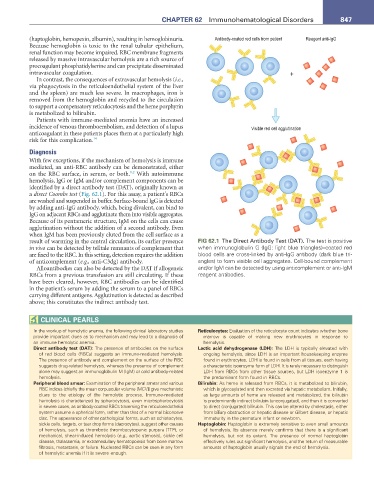
           a direct Coombs test (Fig. 62.1). For this assay, a patient’s RBCs
           are washed and suspended in buffer. Surface-bound IgG is detected
           by adding anti-IgG antibody, which, being divalent, can bind to
           IgG on adjacent RBCs and agglutinate them into visible aggregates.
           Because of its pentameric structure, IgM on the cells can cause
           agglutination without the addition of a second antibody. Even
           when IgM has been previously eluted from the cell surface as a
           result of warming in the central circulation, its earlier presence   FIG 62.1  The Direct Antibody Test (DAT). The test is positive
           in vivo can be detected by telltale remnants of complement that   when immunoglobulin G (IgG: light blue triangles)–coated red
           are fixed to the RBC. In this setting, detection requires the addition   blood cells are cross-linked by anti-IgG antibody (dark blue tri-
           of anticomplement (e.g., anti-C3dg) antibody.          angles) to form visible cell aggregates. Cell-bound complement
             Alloantibodies can also be detected by the DAT if allogeneic   and/or IgM can be detected by using anticomplement or anti-IgM
           RBCs from a previous transfusion are still circulating. If these   reagent antibodies.
           have been cleared, however, RBC antibodies can be identified
           in the patient’s serum by adding the serum to a panel of RBCs
           carrying different antigens. Agglutination is detected as described
           above; this constitutes the indirect antibody test.

               CLInICaL PearLS

            In the workup of hemolytic anemia, the following clinical laboratory studies   reticulocytes: Evaluation of the reticulocyte count indicates whether bone
            provide important clues as to mechanism and may lead to a diagnosis of   marrow is capable of making new erythrocytes in response to
            an immune hemolytic anemia.                             hemolysis.
            Direct antibody test (Dat): The presence of antibodies on the surface   Lactic acid dehydrogenase (LDH): The LDH is typically elevated with
              of red blood cells (RBCs) suggests an immune-mediated hemolysis.   ongoing hemolysis, since LDH is an important housekeeping enzyme
              The presence of antibody and complement on the surface of the RBC   found in erythrocytes. LDH is found in cells from all tissues, each having
              suggests drug-related hemolysis, whereas the presence of complement   a characteristic isoenzyme form of LDH. It is rarely necessary to distinguish
              alone may suggest an immunoglobulin M (IgM) or cold antibody-related   LDH from RBCs from other tissue sources, but LDH isoenzyme 1 is
              hemolysis.                                            the predominant form found in RBCs.
            Peripheral blood smear: Examination of the peripheral smear and various   Bilirubin: As heme is released from RBCs, it is metabolized to bilirubin,
              RBC indices (chiefly the mean corpuscular volume [MCV]) give mechanistic   which is glycosylated and then excreted via hepatic metabolism. Initially,
              clues to the etiology of the hemolytic process. Immune-mediated   as large amounts of heme are released and metabolized, the bilirubin
              hemolysis is characterized by spherocytosis, even microspherocytosis   is predominantly indirect bilirubin (unconjugated), and then it is converted
              in severe cases, as antibody-coated RBCs traversing the reticuloendothelial   to direct (conjugated) bilirubin. This can be altered by cholestasis, either
              system assume a spherical form, rather than that of a normal biconcave   from biliary obstruction or hepatic disease or Gilbert disease, or hepatic
              disc. The appearance of other pathological forms, such as schistocytes,   immaturity in the premature infant or newborn.
              sickle cells, targets, or tear drop forms (dacrocytes), suggest other causes   Haptoglobin: Haptoglobin is extremely sensitive to even small amounts
              of hemolysis, such as thrombotic thrombocytopenic purpura (TTP), or   of hemolysis. Its absence merely confirms that there is a significant
              mechanical, shear-induced hemolysis (e.g., aortic stenosis), sickle cell   hemolysis, but not its extent. The presence of normal haptoglobin
              disease, thalassemia, or extramedullary hematopoiesis from bone marrow   effectively rules out significant hemolysis, and the return of measurable
              fibrosis, metastasis, or failure. Nucleated RBCs can be seen in any form   amounts of haptoglobin usually signals the end of hemolysis.
              of hemolytic anemia if it is severe enough.

