


Page 928 - Clinical Immunology_ Principles and Practice ( PDFDrive )
P. 928
896          Part Seven  Organ-Specific Inflammatory Disease


        of cortical lesions have been described: leukocortical (which span
        gray and white matter), intracortical, and subpial. All of these
        lesions show demyelination and oligodendrocyte loss, microglial
        activation, neuritic transections, neuronal death, and reduced
        presynaptic terminals. Subpial lesions are the most common.
        They can cover long distances of the cortical ribbon and usually
        extend to the cortical layer III or IV. Cortical lesions are not
        visible on conventional MRI scans and require special staining
        to be appreciated in CNS tissue sections. This explains why they
        were not recognized as common features of MS until recently.
        In fact, cortical demyelination and gray matter atrophy are evident
        from the earliest stages of disease, even before a clinically definite
        diagnosis can be made, and continue to advance at an increasing
        rate throughout the disease course. Extensive cortical demyelin-
        ation is evident in the forebrain and cerebellum during progressive
        MS. Gray matter atrophy in individuals with MS correlates
        strongly with cognitive deficits and clinical disability. 36

        Meningeal Inflammation
        White blood cell (WBC) counts tend to be within normal limits
        or only slightly elevated in the CSF of most patients with MS.
        Nonetheless, there is growing recognition that low-grade diffuse
        meningeal inflammation and focal perivascular meningeal
        inflammation are common. Meningeal inflammation is most
        prominent in progressive forms of MS but is prevalent in early
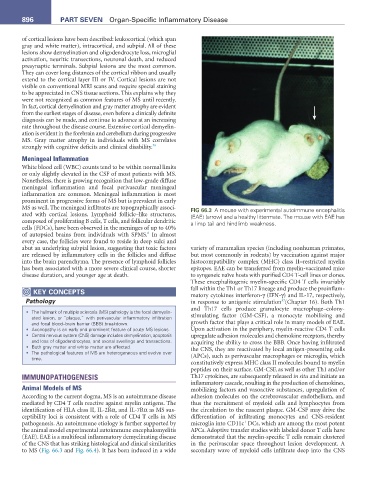
        MS as well. The meningeal infiltrates are topographically associ-  FIG 66.3  A mouse with experimental autoimmune encephalitis
        ated with cortical lesions. Lymphoid follicle–like structures,   (EAE) (arrow) and a healthy littermate. The mouse with EAE has
        composed of proliferating B cells, T cells, and follicular dendritic   a limp tail and hindlimb weakness.
        cells (FDCs), have been observed in the meninges of up to 40%
                                                 6
        of autopsied brains from individuals with SPMS.  In almost
        every case, the follicles were found to reside in deep sulci and
        abut an underlying subpial lesion, suggesting that toxic factors   variety of mammalian species (including nonhuman primates,
        are released by inflammatory cells in the follicles and diffuse   but most commonly in rodents) by vaccination against major
        into the brain parenchyma. The presence of lymphoid follicles   histocompatibility complex (MHC) class II–restricted myelin
        has been associated with a more severe clinical course, shorter   epitopes. EAE can be transferred from myelin-vaccinated mice
        disease duration, and younger age at death.            to syngeneic naïve hosts with purified CD4 T-cell lines or clones.
                                                               These encephalitogenic myelin-specific CD4 T cells invariably
            KeY COnCePtS                                       fall within the Th1 or Th17 lineage and produce the proinflam-
                                                               matory cytokines interferon-γ (IFN-γ) and IL-17, respectively,
         Pathology                                             in response to antigenic stimulation (Chapter 16). Both Th1
                                                                                             37
                                                               and Th17 cells produce granulocyte macrophage–colony-
          •  The hallmark of multiple sclerosis (MS) pathology is the focal demyelin-
           ated lesion, or “plaque,” with perivascular inflammatory infiltration   stimulating factor (GM-CSF), a monocyte mobilizing and
           and focal blood–brain barrier (BBB) breakdown.      growth factor that plays a critical role in many models of EAE.
          •  Axonopathy is an early and prominent feature of acute MS lesions.  Upon activation in the periphery, myelin-reactive CD4 T cells
          •  Central nervous system (CNS) damage includes demyelination, apoptosis   upregulate adhesion molecules and chemokine receptors, thereby
           and loss of oligodendrocytes, and axonal swellings and transections.  acquiring the ability to cross the BBB. Once having infiltrated
          •  Both gray matter and white matter are affected.   the CNS, they are reactivated by local antigen-presenting cells
          •  The pathological features of MS are heterogeneous and evolve over
           time.                                               (APCs), such as perivascular macrophages or microglia, which
                                                               constitutively express MHC class II molecules bound to myelin
                                                               peptides on their surface. GM-CSF, as well as other Th1 and/or
        IMMUNOPATHOGENESIS                                     Th17 cytokines, are subsequently released in situ and initiate an
                                                               inflammatory cascade, resulting in the production of chemokines,
        Animal Models of MS                                    mobilizing factors and vasoactive substances, upregulation of
        According to the current dogma, MS is an autoimmune disease   adhesion molecules on the cerebrovascular endothelium, and
        mediated by CD4 T cells reactive against myelin antigens. The   thus the recruitment of myeloid cells and lymphocytes from
        identification of HLA class II, IL-2Rα, and IL-7Rα as MS sus-  the circulation to the nascent plaque. GM-CSF may drive the
        ceptibility loci is consistent with a role of CD4 T cells in MS   differentiation of infiltrating monocytes and CNS-resident
                                                                                 +
        pathogenesis. An autoimmune etiology is further supported by   microglia into CD11c  DCs, which are among the most potent
        the animal model experimental autoimmune encephalomyelitis   APCs. Adoptive transfer studies with labeled donor T cells have
        (EAE). EAE is a multifocal inflammatory demyelinating disease   demonstrated that the myelin-specific T cells remain clustered
        of the CNS that has striking histological and clinical similarities   in the perivascular space throughout lesion development.  A
        to MS (Fig. 66.3 and Fig. 66.4). It has been induced in a wide   secondary wave of myeloid cells infiltrate deep into the CNS

