


Page 927 - Clinical Immunology_ Principles and Practice ( PDFDrive )
P. 927
CHaPter 66  Multiple Sclerosis            895


           Sex Hormones
           MS relapse rates decline during pregnancy, particularly in the
           third trimester, and rebound in the first 3 months post partum
           before returning to the prepregnancy rate. This has led to the
           hypothesis that certain female sex hormones may play a protective
           role in RRMS. Estriol is an estrogen unique to pregnancy. It is
           synthesized by the fetoplacental unit and reaches its highest levels
           in the last trimester. A randomized, double-blinded, placebo-
           controlled phase II trial of estriol in combination with glatiramer
           acetate (GA) versus placebo plus GA showed a reduction in the
                                                            32
           annualized relapse rate at 2 years in the estriol-treated group.
           Animal model studies have indicated that estrogens, including
           estriol, have antiinflammatory and neuroprotective effects through
           engagement of the estrogen receptors expressed on leukocytes
           and CNS resident cells, respectively.
             Testosterone has neuroprotective effects in animal models of
           MS, and decreased testosterone levels in males with MS were
                                          33
           reported to be associated with disability.  In a small, open-label,
           phase II clinical trial, testosterone treatment appeared to arrest
           loss of gray matter (and even to reverse atrophy of gray matter
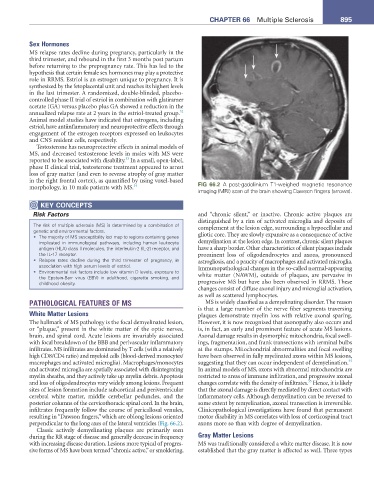
           in the right frontal cortex), as quantified by using voxel-based   FIG 66.2  A post-gadolinium T1-weighed magnetic resonance
           morphology, in 10 male patients with MS. 34
                                                                  imaging (MRI) scan of the brain showing Dawson fingers (arrows).
               KeY COnCePtS
            Risk Factors                                          and  “chronic silent,” or inactive. Chronic active plaques are
                                                                  distinguished by a rim of activated microglia and deposits of
            The risk of multiple sclerosis (MS) is determined by a combination of   complement at the lesion edge, surrounding a hypocellular and
            genetic and environmental factors.
            •  The majority of MS susceptibility loci map to regions containing genes   gliotic core. They are slowly expansive as a consequence of active
              implicated in immunological pathways, including human leukocyte   demyelination at the lesion edge. In contrast, chronic silent plaques
              antigen (HLA) class II molecules, the interleukin-2 (IL-2) receptor, and   have a sharp border. Other characteristics of silent plaques include
              the IL-17 receptor.                                 prominent loss of oligodendrocytes and axons, pronounced
            •  Relapse rates decline during the third trimester of pregnancy, in   astrogliosis, and a paucity of macrophages and activated microglia.
              association with high serum levels of estriol.      Immunopathological changes in the so-called normal-appearing
            •  Environmental risk factors include low vitamin D levels, exposure to
              the Epstein-Barr virus (EBV) in adulthood, cigarette smoking, and   white  matter  (NAWM), outside  of  plaques,  are  pervasive  in
              childhood obesity.                                  progressive MS but have also been observed in RRMS. These
                                                                  changes consist of diffuse axonal injury and microglial activation,
                                                                  as well as scattered lymphocytes.
           PATHOLOGICAL FEATURES OF MS                              MS is widely classified as a demyelinating disorder. The reason
                                                                  is that a large number of the nerve fiber segments traversing
           White Matter Lesions                                   plaques demonstrate myelin loss with relative axonal sparing.
           The hallmark of MS pathology is the focal demyelinated lesion,   However, it is now recognized that axonopathy also occurs and
           or “plaque,” present in the white matter of the optic nerves,   is, in fact, an early and prominent feature of acute MS lesions.
           brain, and spinal cord. Acute lesions are invariably associated   Axonal damage results in dysmorphic mitochondria, focal swell-
           with focal breakdown of the BBB and perivascular inflammatory   ings, fragmentation, and frank transections with terminal bulbs
           infiltrates. MS infiltrates are dominated by T cells (with a relatively   at the stumps. Mitochondrial abnormalities and focal swelling
           high CD8/CD4 ratio) and myeloid cells (blood-derived monocytes/  have been observed in fully myelinated axons within MS lesions,
                                                                                                                   35
           macrophages and activated microglia). Macrophages/monocytes   suggesting that they can occur independent of demyelination.
           and activated microglia are spatially associated with disintegrating   In animal models of MS, axons with abnormal mitochondria are
           myelin sheaths, and they actively take up myelin debris. Apoptosis   restricted to areas of immune infiltration, and progressive axonal
                                                                                                      35
           and loss of oligodendrocytes vary widely among lesions. Frequent   changes correlate with the density of infiltrates.  Hence, it is likely
           sites of lesion formation include subcortical and periventricular   that the axonal damage is directly mediated by direct contact with
           cerebral white matter, middle cerebellar peduncles, and the   inflammatory cells. Although demyelination can be reversed to
           posterior columns of the cervicothoracic spinal cord. In the brain,   some extent by remyelination, axonal transection is irreversible.
           infiltrates frequently follow the course of pericallosal venules,   Clinicopathological investigations have found that permanent
           resulting in “Dawson fingers,” which are oblong lesions oriented   motor disability in MS correlates with loss of corticospinal tract
           perpendicular to the long axes of the lateral ventricles (Fig. 66.2).  axons more so than with degree of demyelination.
             Classic actively demyelinating plaques are primarily seen
           during the RR stage of disease and generally decrease in frequency   Gray Matter Lesions
           with increasing disease duration. Lesions more typical of progres-  MS was traditionally considered a white matter disease. It is now
           sive forms of MS have been termed “chronic active,” or smoldering,   established that the gray matter is affected as well. Three types

