


Page 929 - Clinical Immunology_ Principles and Practice ( PDFDrive )
P. 929
CHaPter 66  Multiple Sclerosis            897


                                          EAE                                CONTROL


                           MBP
                           DAPI
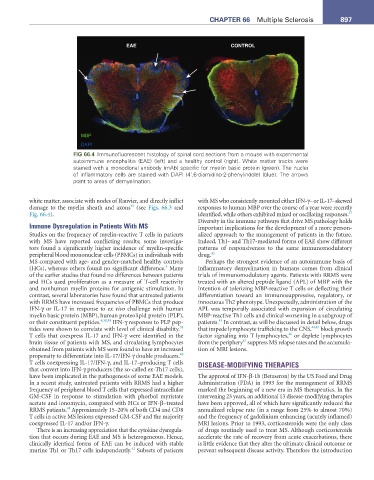
                         FIG 66.4  Immunofluorescent histology of spinal cord sections from a mouse with experimental
                         autoimmune  encephalitis  (EAE)  (left)  and  a  healthy  control  (right).  White  matter  tracks  were
                         stained with a monoclonal antibody (mAb) specific for myelin basic protein (green). The nuclei
                         of inflammatory cells are stained with DAPI (4’,6-diamidino-2-phenylindole) (blue). The arrows
                         point to areas of demyelination.


           white matter, associate with nodes of Ranvier, and directly inflict   with MS who consistently mounted either IFN-γ– or IL-17–skewed
                                            35
           damage to the myelin sheath and axons  (see Figs. 66.3 and     responses to human MBP over the course of a year were recently
                                                                                                                   37
           Fig. 66.4).                                            identified, while others exhibited mixed or oscillating responses.
                                                                  Diversity in the immune pathways that drive MS pathology holds
           Immune Dysregulation in Patients With MS               important implications for the development of a more person-
           Studies on the frequency of myelin-reactive T cells in patients   alized approach to the management of patients in the future.
           with MS have reported conflicting results; some investiga-  Indeed, Th1- and Th17-mediated forms of EAE show different
           tors  found  a  significantly  higher  incidence  of  myelin-specific   patterns of responsiveness to the same immunomodulatory
           peripheral blood mononuclear cells (PBMCs) in individuals with   drug. 42
           MS compared with age- and gender-matched healthy controls   Perhaps the strongest evidence of an autoimmune basis of
                                                       5
           (HCs), whereas others found no significant difference.  Many   inflammatory demyelination in humans  comes  from clinical
           of the earlier studies that found no differences between patients   trials of immunomodulatory agents. Patients with RRMS were
           and HCs used proliferation as a measure of T-cell reactivity   treated with an altered peptide ligand (APL) of MBP with the
           and nonhuman myelin proteins for antigenic stimulation. In   intention of tolerizing MBP-reactive T cells or deflecting their
           contrast, several laboratories have found that untreated patients   differentiation toward an immunosuppressive, regulatory, or
           with RRMS have increased frequencies of PBMCs that produce   innocuous Th2 phenotype. Unexpectedly, administration of the
           IFN-γ or IL-17 in response to ex vivo challenge with human   APL was temporally associated with expansion of circulating
           myelin basic protein (MBP), human proteolipid protein (PLP),   MBP-reactive Th1 cells and clinical worsening in a subgroup of
                                                                         43
           or their constituent peptides. 4,38,39  IFN-γ responses to PLP pep-  patients.  In contrast, as will be discussed in detail below, drugs
                                                            38
           tides were shown to correlate with level of clinical disability.    that impede lymphocyte trafficking to the CNS, 44,45  block growth
                                                                                               46
           T cells that coexpress IL-17 and IFN-γ were identified in the   factor signaling into T lymphocytes,  or deplete lymphocytes
                                                                                47
           brain tissue of patients with MS, and circulating lymphocytes   from the periphery  suppress MS relapse rates and the accumula-
           obtained from patients with MS were found to have an increased   tion of MRI lesions.
                                                            40
           propensity to differentiate into IL-17/IFN-γ double producers.
           T cells coexpressing IL-17/IFN-γ, and IL-17–producing T cells   DISEASE-MODIFYING THERAPIES
           that convert into IFN-γ producers (the so-called ex-Th17 cells),
           have been implicated in the pathogenesis of some EAE models.   The approval of IFN-β-1b (Betaseron) by the US Food and Drug
           In a recent study, untreated patients with RRMS had a higher   Administration (FDA) in 1993 for the management of RRMS
           frequency of peripheral blood T cells that expressed intracellular   marked the beginning of a new era in MS therapeutics. In the
           GM-CSF in response to stimulation with phorbol myristate   intervening 23 years, an additional 13 disease-modifying therapies
           acetate and ionomycin, compared with HCs or IFN-β–treated   have been approved, all of which have significantly reduced the
                       41
           RRMS patients.  Approximately 15–20% of both CD4 and CD8   annualized relapse rate (in a range from 25% to almost 70%)
           T cells in active MS lesions expressed GM-CSF and the majority    and the frequency of gadolinium enhancing (acutely inflamed)
           coexpressed IL-17 and/or IFN-γ.                        MRI lesions. Prior to 1993, corticosteroids were the only class
             There is an increasing appreciation that the cytokine dysregula-  of drugs routinely used to treat MS. Although corticosteroids
           tion that occurs during EAE and MS is heterogeneous. Hence,   accelerate the rate of recovery from acute exacerbations, there
           clinically identical forms of EAE can be induced with stable   is little evidence that they alter the ultimate clinical outcome or
                                            42
           murine Th1 or Th17 cells independently.  Subsets of patients   prevent subsequent disease activity. Therefore the introduction

