


Page 945 - Clinical Immunology_ Principles and Practice ( PDFDrive )
P. 945
912          Part Seven  Organ-Specific Inflammatory Disease


        Patients with more severe cholinergic impairment have higher-titer
        antibodies against ganglionic AChRs. Some of these symptoms
        can be passively transferred to mice injected with the patient’s
        IgG, suggesting that these antibodies may be pathogenic. Further,
        rabbits immunized with a fragment of ganglionic AChR protein
                                                   37
        exhibit autonomic failure, similar to the human disease.  Because
        ganglionic AChRs have also been found in small cell lung car-
        cinoma cell lines, cancer may be a potential initiator of ganglionic
        AChR autoimmunity.

                                                                  A
        MONONEUROPATHY MULTIPLEX AND
        LOCALIZED, ISOLATED VASCULITIS OF THE
        PERIPHERAL NERVES

        Polyneuropathy is a common manifestation of systemic vasculitis.
        It occurs in patients with polyarteritis nodosa; connective tissue                               HLA-DR,
        diseases, such as rheumatoid arthritis or Sjögren syndrome;                                      Macrophages,
        hypersensitivity vasculitis; Churg-Strauss syndrome; temporal                                    CD8 T cells
        arteritis; and viral infections, such as those with HIV, human
        T-lymphocyte virus (HTLV)-1, and hepatitis B and C viruses.
        It classically presents as mononeuritis multiplex affecting several
        individual nerves with painful weakness and paresthesias caused   B
        by ischemia and infarcts caused by inflammation of endoneurial
        blood vessels. There is, however, a distinct vasculitic entity local-
        ized only to the peripheral nerve, known as isolated peripheral
        nerve vasculitis (PNV). PNV involves the small and medium-sized
        arteries of the epineurium and perineurium and causes ischemic
        changes within the peripheral nerve. The presentation is similar
        to the vasculitic neuropathy seen in systemic vasculitis—the only
        difference is the lack of systemic organ involvement, slower onset
        and progression, and negative serology. The diagnosis is confirmed
        with nerve biopsy of the sural, superficial peroneal, or superficial
        radial nerve. When nerve biopsy is combined with muscle biopsy,   C
        the  diagnostic  yield  is  higher.  PNV  has  a  better  prognosis
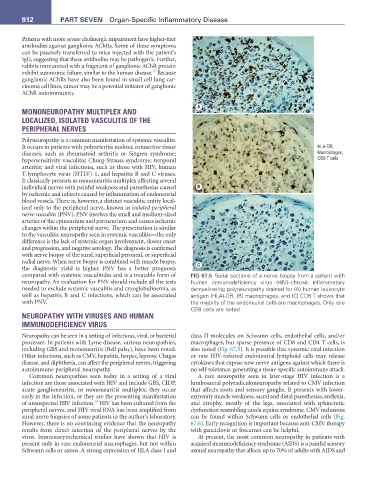
        compared with systemic vasculitides and is a treatable form of   FIG 67.5  Serial sections of a nerve biopsy from a patient with
        neuropathy. An evaluation for PNV should include all the tests   human  immunodeficiency  virus (HIV)–chronic  inflammatory
        needed to exclude systemic vasculitis and cryoglobulinemia, as   demyelinating polyneuropathy stained for (A) human leukocyte
        well as hepatitis B and C infections, which can be associated   antigen (HLA)-DR, (B) macrophages, and (C) CD8 T shows that
        with PNV.                                              the majority of the endoneurial cells are macrophages. Only rare
                                                               CD8 cells are noted.
        NEUROPATHY WITH VIRUSES AND HUMAN
        IMMUNODEFICIENCY VIRUS

        Neuropathy can be seen in a setting of infectious, viral, or bacterial   class II molecules on Schwann cells, endothelial cells, and/or
        processes. In patients with Lyme disease, various neuropathies,   macrophages, but sparse presence of CD8 and CD4 T cells, is
        including GBS and mononeuritis (Bell palsy), have been noted.   also noted (Fig. 67.5). It is possible that systemic viral infection
        Other infections, such as CMV, hepatitis, herpes, leprosy, Chagas   or  rare  HIV-infected  endoneurial  lymphoid  cells  may  release
        disease, and diphtheria, can affect the peripheral nerves, triggering   cytokines that expose new nerve antigens against which there is
        autoimmune peripheral neuropathy.                      no self-tolerance, generating a tissue-specific autoimmune attack.
           Common neuropathies seen today in a setting of a viral   A rare neuropathy seen in later-stage HIV infection is a
        infection are those associated with HIV and include GBS, CIDP,   lumbosacral polyradiculoneuropathy related to CMV infection
        acute  ganglioneuritis, or  mononeuritis  multiplex;  they  occur   that affects roots and sensory ganglia. It presents with lower-
        early in the infection, or they are the presenting manifestation   extremity muscle weakness, sacral and distal paresthesias, areflexia,
                                38
        of unsuspected HIV infection.  HIV has been cultured from the   and atrophy, mostly of the legs, associated with sphincteric
        peripheral nerves, and HIV viral RNA has been amplified from   dysfunction resembling cauda equina syndrome. CMV inclusions
        sural nerve biopsies of some patients in the author’s laboratory.   can be found within Schwann cells or endothelial cells (Fig.
        However, there is no convincing evidence that the neuropathy   67.6). Early recognition is important because anti-CMV therapy
        results  from  direct  infection  of  the  peripheral  nerves  by  the   with ganciclovir or foscarnet can be helpful.
        virus. Immunocytochemical studies have shown that  HIV is   At present, the most common neuropathy in patients with
        present only in rare endoneurial macrophages, but not within   acquired immunodeficiency syndrome (AIDS) is a painful sensory
        Schwann cells or axons. A strong expression of HLA class I and   axonal neuropathy that affects up to 70% of adults with AIDS and

