


Page 940 - Clinical Immunology_ Principles and Practice ( PDFDrive )
P. 940
CHaPter 67  Autoimmune Peripheral Neuropathies                 907


           CHRONIC INFLAMMATORY DEMYELINATING                     a relapsing course, with spontaneous remissions necessitating
           POLYNEUROPATHY                                         the need to periodically evaluate the usefulness of continuing
                                                                  immunotherapeutic interventions. Because the demyelination
           CIDP is the most common form of chronic APN with prevalence   is multifocal, affecting spinal roots, plexuses, and proximal nerve
           as high as 9/100 000. 2,3,11,12  It is also the most gratifying chronic   trunks, 3,13  the clinicopathological picture may be variable,
           autoimmune neuropathy because it is treatable in the majority   accounting for the different manifestation of symptoms and
           of the cases. It can be considered the chronic counterpart of GBS   signs. 2,3,11,12  The most notable CIDP variants include the asym-
           because of the various clinical, electrophysiological, histological,   metrical, unifocal or multifocal, motor–sensory form (Lewis-
           and laboratory similarities. CIDP differs from GBS predominantly   Sumner syndrome); the pure motor form; the pure sensory form;
           by its tempo, mode of evolution, prognosis, and responsiveness   the sensory ataxic form; and the pure distal form.
           to steroids. First described as a “steroid-responding relapsing
           polyneuropathy,” CIDP shares with GBS a variety of common   Diagnosis
           autoimmune features.                                   In CIDP, CSF protein is elevated, up to sixfold, without pleocytosis
                                                                  (except if an infection coexists). Nerve biopsy shows demyelination
           Clinical Features and Disease Variants                 and remyelination, occasional epineurial or endoneurial T cells,
           The typical CIDP is characterized by a progressive, symmetrical,   and several macrophages that are either scattered or in small
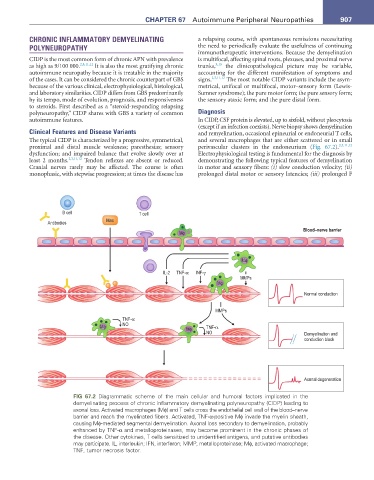
           proximal  and distal  muscle weakness; paresthesias; sensory   perivascular clusters in the endoneurium (Fig. 67.2). 2,3,11,12
           dysfunction; and impaired balance that evolve slowly over at   Electrophysiological testing is fundamental for the diagnosis by
           least 2 months. 2,3,11,12  Tendon reflexes are absent or reduced.   demonstrating the following typical features of demyelination
           Cranial nerves rarely may be affected. The course is often   in motor and sensory fibers: (i) slow conduction velocity; (ii)
           monophasic, with stepwise progression; at times the disease has   prolonged distal motor or sensory latencies; (iii) prolonged F


                     B cell                   T cell
                                    Mac
                 Antibodies
                                                                                                    Blood–nerve barrier
                                                            Mφ


                                                                                Mφ

                                                      IL-2  TNF-α  INF-γ
                                                                                MMPs
                                                                        Mφ
                                                                                                     Normal conduction


                                                                       MMPs
                                         TNF-α
                                  Mφ     NO                         TNF-α
                                                              Mφ
                                                                    NO                               Demyelination and
                                                                                                     conduction block


                                                                                                     Axonal degeneration

                         FIG 67.2  Diagrammatic scheme of the main cellular and humoral factors implicated in the
                         demyelinating process of chronic inflammatory demyelinating polyneuropathy (CIDP) leading to
                         axonal loss. Activated macrophages (Mϕ) and T cells cross the endothelial cell wall of the blood–nerve
                         barrier and reach the myelinated fibers. Activated, TNF-α-positive Mϕ invade the myelin sheath,
                         causing Mϕ-mediated segmental demyelination. Axonal loss secondary to demyelination, probably
                         enhanced by TNF-α and metalloproteinases, may become prominent in the chronic phases of
                         the disease. Other cytokines, T cells sensitized to unidentified antigens, and putative antibodies
                         may participate. IL, interleukin; IFN, interferon; MMP, metalloproteinase; Mϕ, activated macrophage;
                         TNF, tumor necrosis factor.

