


Page 943 - Clinical Immunology_ Principles and Practice ( PDFDrive )
P. 943
910          Part Seven  Organ-Specific Inflammatory Disease


                  SGPG            GM1             GD1a            GD1b              GT1b             GQ1b

                                    Gal             Gal              Gal              Gal    NeuAc  -  Gal
                   Gal                      NeuAc  -                          NeuAc  -         NeuAc  -
            cUA                                        GlcNAc     -     GlcNAc           GlcNAc            GlcNAc
             -       GlcNAc             GlcNAc               NeuAc                 -                -
                                    -              -                -         NeuAc   -        NeuAc   -
                -        Gal   NeuAc    Gal   NeuAc    Gal      NeuAc   Gal      NeuAc    Gal     NeuAc    Gal
               SO 3
                         Glc            Glc            Glc              Glc               Glc              Glc


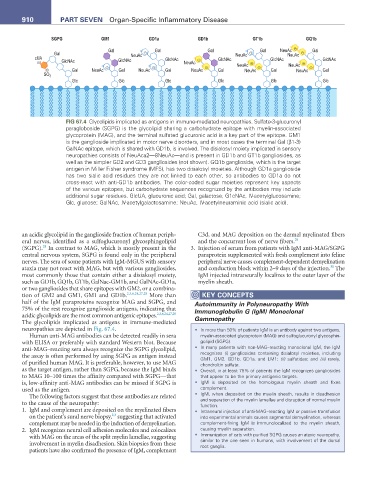
                       FIG 67.4  Glycolipids implicated as antigens in immune-mediated neuropathies. Sulfate-3-glucuronyl
                       paragloboside (SGPG) is the glycolipid sharing a carbohydrate epitope with myelin-associated
                       glycoprotein (MAG), and the terminal sulfated glucuronic acid is a key part of the epitope. GM1
                       is the ganglioside implicated in motor nerve disorders, and in most cases the terminal Gal (β1-3)
                       GalNAc epitope, which is shared with GD1b, is involved. The disialosyl moiety implicated in sensory
                       neuropathies consists of NeuAca2—8NeuAc—and is present in GD1b and GT1b gangliosides, as
                       well as the simpler GD2 and GD3 gangliosides (not shown). GQ1b ganglioside, which is the target
                       antigen in Miller Fisher syndrome (MFS), has two disialosyl moieties. Although GD1a ganglioside
                       has two sialic acid residues they are not linked to each other, so antibodies to GD1a do not
                       cross-react with anti-GD1b antibodies. The color-coded sugar moieties represent key aspects
                       of the various epitopes, but carbohydrate sequences recognized by the antibodies may include
                       additional sugar residues. GlcUA, glucuronic acid; Gal, galactose; G1cNAc, N-acetylglucosamine;
                       Glc, glucose; GalNAc, N-acetylgalactosamine; NeuAc, N-acetylneuraminic acid (sialic acid).


        an acidic glycolipid in the ganglioside fraction of human periph-  C3d, and MAG deposition on the dermal myelinated fibers
        eral nerves, identified as a sulfoglucuronyl glycosphingolipid   and the concurrent loss of nerve fibers. 29
               28
        (SGPG).  In contrast to MAG, which is mostly present in the   3.  Injection of serum from patients with IgM anti-MAG/SGPG
        central nervous system, SGPG is found only in the peripheral   paraprotein supplemented with fresh complement into feline
        nerves. The sera of some patients with IgM-MGUS with sensory   peripheral nerve causes complement-dependent demyelination
                                                                                                             30
        ataxia may not react with MAG, but with various gangliosides,   and conduction block within 2–9 days of the injection.  The
        most commonly those that contain either a disialosyl moiety,   IgM injected intraneurally localizes to the outer layer of the
        such as GD1b, GQ1b, GT1b, GalNac-GM1b, and GalNAc-GD1a,   myelin sheath.
        or two gangliosides that share epitopes with GM2, or a combina-
        tion of GM2 and GM1, GM1 and GD1b. 2,3,6,24,27,28  More than    KeY COnCePtS
        half of the IgM paraproteins recognize MAG and SGPG, and   Autoimmunity in Polyneuropathy With
        75% of the rest recognize ganglioside antigens, indicating that   Immunoglobulin G (IgM) Monoclonal
        acidic glycolipids are the most common antigenic epitopes. 2,3,6,24,27,28    Gammopathy
        The glycolipids implicated as antigens in immune-mediated
        neuropathies are depicted in Fig. 67.4.                  •  In more than 50% of patients IgM is an antibody against two antigens,
           Human anti-MAG antibodies can be detected readily in sera   myelin-associated glycoprotein (MAG) and sulfoglucuronyl glycosphin-
        with ELISA or preferably with standard Western blot. Because   golipid (SGPG).
        anti-MAG–reacting sera always recognize the SGPG glycolipid,   •  In many patients with non-MAG–reacting monoclonal IgM, the IgM
        the assay is often performed by using SGPG as antigen instead   recognizes  (i) gangliosides containing disialosyl moieties, including
                                                                   GM1, GM2, GD1b, GD1a, and LM1;  (ii) sulfatides; and  (iii) rarely,
        of purified human MAG. It is preferable, however, to use MAG   chondroitin sulfate.
        as the target antigen, rather than SGPG, because the IgM binds   •  Overall, in at least 75% of patients the IgM recognizes gangliosides
        to MAG 10–100 times the affinity compared with SGPG—that   that appear to be the primary antigenic targets.
        is, low-affinity anti-MAG antibodies can be missed if SGPG is   •  IgM is deposited on the homologous myelin sheath and fixes
        used as the antigen.                                       complement.
           The following factors suggest that these antibodies are related   •  IgM, when deposited on the myelin sheath, results in disadhesion
                                                                   and separation of the myelin lamellae and disruption of normal myelin
        to the cause of the neuropathy:                            function.
        1.  IgM and complement are deposited on the myelinated fibers   •  Intraneural injection of anti-MAG–reacting IgM or passive transfusion
                                      2,3
           on the patient’s sural nerve biopsy,  suggesting that activated   into experimental animals causes segmental demyelination, whereas
           complement may be needed in the induction of demyelination.  complement-fixing  IgM is  immunolocalized  to  the  myelin  sheath,
        2.  IgM recognizes neural cell adhesion molecules and colocalizes   causing myelin separation.
           with MAG on the areas of the split myelin lamellae, suggesting   •  Immunization of cats with purified SGPG causes an ataxic neuropathy,
           involvement in myelin disadhesion. Skin biopsies from these   similar to the one seen in humans, with involvement of the dorsal
                                                                   root ganglia.
           patients have also confirmed the presence of IgM, complement

