


Page 942 - Clinical Immunology_ Principles and Practice ( PDFDrive )
P. 942
CHaPter 67  Autoimmune Peripheral Neuropathies                 909


                 Target antigens at the Node of Ranvier: Explain rapid recovery  neuropathy occurs in a setting of myeloma, plasmacytoma, or
                                                                  Waldenström macroglobulinemia, the majority of patients with
                                                                  paraproteinemic neuropathies do not have a lymphoproliferative
                      Axon                                        disease, and the monoclonal gammopathy is of undetermined
                       JP     PN    N   PN      JP                significance (MGUS). A benign monoclonal gammopathy may
                                                                                                               22
                                                                  occur in up to 1% of normal people >50 years of age.  The
              PN: Paranode       N: Node        JP: Juxtaparanode  incidence increases to 1.7% above age 70 years and reaches up
               Paranode                           Juxtaparanode   to 6% above age 90 years. Monoclonal gammopathies, however,
                                  ECM               Myelin        are 10 times more frequent in patients with polyneuropathy
                             gliomedin                            than in an age-matched control population, and almost 10% of
                                                                                                            23
                                     NF186        Tag1            patients with acquired polyneuropathy have MGUS.  If these
            NF155               Nav                               gammopathies are categorized into subclasses, the incidence of
                                Nav
                                                Kv Kv             polyneuropathy among patients with IgM monoclonal proteins
                                                                                    23,24
                 contactin                           Caspr2       can be as high as 50%,   implying that almost 50% of patients
                 /Caspr      ankyrinG                             with IgM MGUS may have or will develop polyneuropathy. At
                                      βIVspectrin
            Connexin 32, 29, 31.3                                 present, polyneuropathies with MGUS comprise 10% of patients
                                                    Axon          with acquired neuropathy, 23-25  and paraproteinemic polyneu-
                                                                  ropathy is a potentially treatable APN. 25
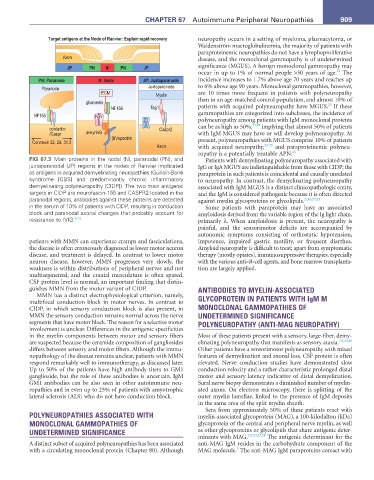
           FIG 67.3  Main proteins in the nodal (N), paranodal (PN), and   Patients with demyelinating polyneuropathy associated with
           juxtaparanodal (JP) regions in the nodes of Ranvier implicated   IgG or IgA MGUS are indistinguishable from those with CIDP; the
           as antigens in acquired demyelinating neuropathies (Guillain-Barré   paraprotein in such patients is coincidental and causally unrelated
           syndrome [GBS] and predominantly chronic inflammatory   to neuropathy. In contrast, the demyelinating polyneuropathy
           demyelinating polyneuropathy [CIDP]). The two main antigenic   associated with IgM MGUS is a distinct clinicopathologic entity,
           targets in CIDP are neurofascin-155 and CASPR2 located in the   and the IgM is considered pathogenic because it is often directed
           paranodal regions; antibodies against these proteins are detected   against myelin glycoproteins or glycolipids. 2,3,6,24,25
           in the serum of 10% of patients with CIDP, resulting in conduction   Some patients with paraprotein may have an associated
           block and paranodal axonal changes that probably account for   amyloidosis derived from the variable region of the Ig light chain,
           resistance to IVIG. 4,13                               primarily  λ.  When amyloidosis is present, the neuropathy is
                                                                  painful, and the sensorimotor deficits are accompanied by
                                                                  autonomic symptoms consisting of orthostatic hypotension,
           patients with MMN can experience cramps and fasciculations,   impotence,  impaired  gastric  motility, or frequent diarrhea.
           the disease is often erroneously diagnosed as lower motor neuron   Amyloid neuropathy is difficult to treat; apart from symptomatic
           disease, and treatment is delayed. In contrast to lower motor   therapy (mostly opiates), immunosuppressive therapies, especially
           neuron disease, however, MMN progresses very slowly, the   with the various anti–B-cell agents, and bone marrow transplanta-
           weakness is within distributions of peripheral nerves and not   tion are largely applied.
           multisegmental, and the cranial musculature is often spared.
           CSF protein level is normal, an important finding that distin-
           guishes MMN from the motor variant of CIDP.            ANTIBODIES TO MYELIN-ASSOCIATED
             MMN has a distinct electrophysiological criterion, namely,   GLYCOPROTEIN IN PATIENTS WITH IgM M
           multifocal conduction block in motor nerves. In contrast to
           CIDP,  in  which  sensory  conduction  block  is  also  present,  in   MONOCLONAL GAMMOPATHIES OF
           MMN the sensory conduction remains normal across the nerve   UNDETERMINED SIGNIFICANCE
           segments that have motor block. The reason for a selective motor   POLYNEUROPATHY (ANTI-MAG NEUROPATHY)
           involvement is unclear. Differences in the antigenic specificities
           in the myelin components between motor and sensory fibers   Most of these patients present with a sensory, large-fiber, demy-
           are suspected because the ceramide composition of gangliosides   elinating polyneuropathy that manifests as sensory ataxia. 2,3,24,26
           differs between sensory and motor fibers. Although the immu-  Other patients have a sensorimotor polyneuropathy with mixed
           nopathology of the disease remains unclear, patients with MMN   features of demyelination and axonal loss. CSF protein is often
           respond remarkably well to immunotherapy, as discussed later.   elevated. Nerve conduction studies have demonstrated slow
           Up to 50% of the patients have high antibody titers to GM1   conduction velocity and a rather characteristic prolonged distal
           ganglioside, but the role of these antibodies is uncertain. IgM   motor and sensory latency indicative of distal demyelination.
           GM1 antibodies can be also seen in other autoimmune neu-  Sural nerve biopsy demonstrates a diminished number of myelin-
           ropathies and in even up to 25% of patients with amyotrophic   ated axons. On electron microscopy, there is splitting of the
           lateral sclerosis (ALS) who do not have conduction block.  outer myelin lamellae, linked to the presence of IgM deposits
                                                                  in the same area of the split myelin sheath.
                                                                    Sera from approximately 50% of these patients react with
           POLYNEUROPATHIES ASSOCIATED WITH                       myelin-associated glycoprotein (MAG), a 100-kilodalton (kDa)
           MONOCLONAL GAMMOPATHIES OF                             glycoprotein of the central and peripheral nerve myelin, as well
           UNDETERMINED SIGNIFICANCE                              as other glycoproteins or glycolipids that share antigenic deter-
                                                                  minants with MAG. 2,3,24,27,28  The antigenic determinant for the
           A distinct subset of acquired polyneuropathies has been associated   anti-MAG IgM resides in the carbohydrate component of the
                                                                              3
           with a circulating monoclonal protein (Chapter 80). Although   MAG molecule.  The anti-MAG IgM paraproteins coreact with

