


Page 984 - Clinical Immunology_ Principles and Practice ( PDFDrive )
P. 984
950 ParT SEvEN Organ-Specific Inflammatory Disease
proteinlike domains. TPO antibodies may have pathogenic CLINICaL PEarLS
significance in that they can fix complement and target the
17
thyrocyte for cellmediated cytotoxicity. In contrast to TSHR Clinical Signs Specific to Graves Disease
antibodies, they do not appear to either stimulate or block the • Graves orbitopathy
enzymatic activity of TPO. • Thyroid bruit
• Thyroid acropachy
Clinical Presentation • Pretibial myxedema
Hyperthyroid GD can present with manifestations affecting
almost any organ system in the body, and as with many endocrine
conditions, affected individuals may report a gradual onset of Investigation and Diagnosis of GD
nonspecific symptoms, typically over a period of months. This The diagnosis of GD is a clinical one, supported by laboratory
often leads to a delay in seeking medical attention and in the investigations. Imaging is occasionally required if the diagnosis
initial diagnosis being made. The signs and symptoms of GD can is in doubt. Thyrotoxicosis is diagnosed biochemically on the
be divided into those associated with hyperthyroidism in general basis of an elevated serum free T 3 (fT 3 ) or free T 4 (fT 4 ) in the
and those specific to GD. These are summarized in Table 70.1. presence of a completely suppressed TSH. If thyrotoxicosis is
found in a patient with extrathyroidal signs, such as GO or
pretibial myxedema, the diagnosis of hyperthyroid GD is clear
and further investigations are not required. If no extrathyroidal
TABLE 70.1 Common and rarer Clinical signs are present, the presence of serum autoantibodies should
Manifestations of Hyperthyroidism be sought. TSHR antibodies are highly sensitive for GD, and
assays are now available in many laboratories. The TSHbinding
Common rare inhibitory immunoglobulin (TBII) assay is also commonly used,
Neuropsychiatric which is an indirect means of detecting TSHstimulating antibod
Anxiety Chorea ies. TPO antibodies are often measured as a surrogate for thyroid
Fatigue and exhaustion Collapse (periodic paralysis) autoimmunity, as the presence of either TSHR antibodies or
Fine tremor Pseudobulbar palsy TPO antibodies has more than 90% sensitivity for GD.
Restlessness and fidgeting Spasticity Imaging is reserved for individuals in whom the diagnosis is
99
not clear. Radionuclide scanning, for example, Tc or 123 I, is
Gastrointestinal favored over ultrasonography, as the former gives functional
Increased appetite Hepatosplenomegaly information on the activity of the thyroid gland, although Doppler
Loose stools
Increased frequency of defecation flow studies are making ultrasound evaluation of the thyroid
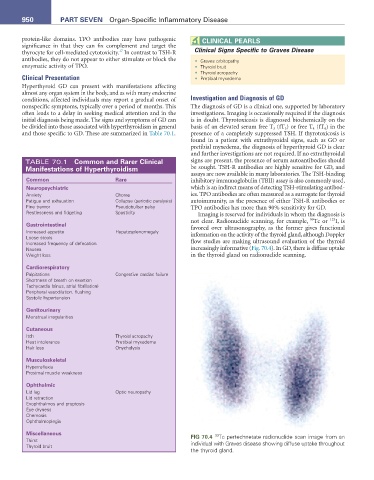
Nausea increasingly informative (Fig. 70.4). In GD, there is diffuse uptake
Weight loss in the thyroid gland on radionuclide scanning.
Cardiorespiratory
Palpitations Congestive cardiac failure
Shortness of breath on exertion
Tachycardia (sinus, atrial fibrillation)
Peripheral vasodilation, flushing
Systolic hypertension
Genitourinary
Menstrual irregularities
Cutaneous
Itch Thyroid acropachy
Heat intolerance Pretibial myxedema
Hair loss Onycholysis
Musculoskeletal
Hyperreflexia
Proximal muscle weakness
Ophthalmic
Lid lag Optic neuropathy
Lid retraction
Exophthalmos and proptosis
Eye dryness
Chemosis
Ophthalmoplegia
Miscellaneous 99
FIG 70.4 Tc pertechnetate radionuclide scan image from an
Thirst individual with Graves disease showing diffuse uptake throughout
Thyroid bruit
the thyroid gland.

