


Page 1126 - Hall et al (2015) Principles of Critical Care-McGraw-Hill
P. 1126
CHAPTER 83: ICU-Acquired Weakness  765


                     These studies show that decrements in physical function occur across     TABLE 83-2    Diagnostic Features of ICUAW
                    the spectrum of critical illness. Although these outcomes may be influ-
                    enced by other factors—such as age, preexisting comorbidities, acquired   1.  Weakness is diffuse, symmetric, and often spares the cranial nerves
                    psychological and cognitive dysfunction, and social support—it is clear   2.  Causes of weakness other than those from the underlying illness have been excluded
                    that ICUAW needs to be recognized early to enable preventive interven-  3.  Alert patient who can follow simple commands and participate in neuromuscular  examination
                    tions. However, the recognition of ICUAW has often been hindered   4.  MRC sumscore <48 or mean MRC <4 in all testable muscle groups
                    by challenges with various diagnostic testing approaches and complex   MRC, Medical research Council.
                    nomenclature.                                         Modified with permission from Stevens et al. A framework for diagnosing and classifying intensive care
                                                                          unit-acquired weakness. Crit Care Med. October 2009;37(suppl 10):S299-S308.
                    CLINICAL PRESENTATION OF ICUAW
                                                                          limb; therefore, sum scores span from zero (complete paralysis) to 60
                    The clinical approach is based on the recognition of generalized weak-  (full strength). This scoring has demonstrated excellent inter-rater reli-
                    ness in the appropriate setting, the exclusion of causes extrinsic to   ability and can be utilized to document the extent of disease and track
                    critical illness, and the measurement of muscle strength.  The historian   serial changes over time. 20,21
                                                            5
                    should carefully review the time course of neuromuscular symptoms   To better characterize the incidence of acquired neuromuscular
                    as they relate to the underlying critical illness. Potential risk factors for   disorders in the ICU and to validate the bedside muscle strength exami-
                    ICUAW should be identified—including sepsis, multiple organ failure,   nation, De Jonghe and colleagues prospectively evaluated 95 patients
                    mechanical ventilation, hyperglycemia, and exposure to pharmaco-  without preexisting neuromuscular injury that had undergone mechani-
                    logic agents like glucocorticoids and neuromuscular blocking agents   cal ventilation for greater than 7 days.  The first day a patient was awake
                                                                                                    22
                    (NMBAs). Neurologic examination evaluates key functional domains   and following commands was considered day 1. On the seventh day
                    including consciousness, cognitive function, cranial nerves, motor and   after awakening, patients underwent MRC muscle strength testing to
                    sensory systems, deep tendon reflexes, and coordination. Motor assess-  determine a sum score. A priori, they labeled patients with a sum score
                    ment should include tone and bulk in addition to strength.  of less than 48 to have “ICU-acquired paresis.” To confirm the peripheral
                     Physical examination of patients for ICUAW is dependent on the   neuromuscular origin of the clinical weakness, all patients underwent
                    cooperation and maximal effort of the patient—an aspect of bedside   an electrophysiologic examination exam at day 7 and persistently weak
                    assessment that can be confounded by sedation and delirium. When   patients underwent muscle biopsy at day 14. All patients with ICU-
                    a reliable motor examination is possible, affected patients will exhibit   acquired paresis demonstrated sensory-motor axonopathy. Histological
                    diffuse, generally symmetrical motor deficits in all limbs, ranging from   features of primary myopathic changes were observed in all patients
                    paresis to true quadriplegia.  Weakness affects the extremities and   with paresis persisting 1 week after the initial diagnosis.
                                         18
                    diaphragm yet often spares the cranial nerves; accordingly, pupillary   Since this landmark trial, leaders in the field have established use of the
                    and  oculomotor function and facial grimace are usually preserved.   term “ICU-acquired weakness” to characterize clinically detected weak-
                    Patients often have concurrent respiratory failure with protracted   ness in critically ill patients in whom there is no plausible etiology other
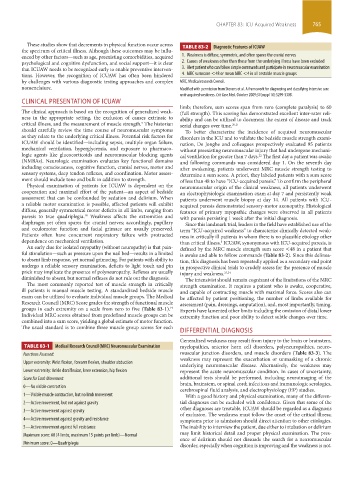
                    dependence on mechanical ventilation.                 than critical illness.  ICUAW, synonymous with ICU-acquired paresis, is
                                                                                       5
                     An early clue for isolated myopathy (without neuropathy) is that pain-  defined by the MRC muscle strength sum score <48 in a patient that
                    ful stimulation—such as pressure upon the nail bed—results in a limited   is awake and able to follow commands (Table 83-2). Since this delinea-
                    to absent limb response, yet normal grimacing. For patients with ability to   tion, this diagnosis has been repeatedly applied as a  secondary end point
                    undergo a reliable sensory examination, deficits to light touch and pin   in prospective clinical trials to crudely assess for the presence of muscle
                    prick may implicate the presence of polyneuropathy. Reflexes are usually   injury and weakness. 23,24
                    diminished to absent, but normal reflexes do not rule out the diagnosis.  The intensivist should remain cognizant of the limitations of the MRC
                     The most commonly reported test of muscle strength in critically   strength examination. It requires a patient who is awake, cooperative,
                    ill patients is manual muscle testing. A standardized bedside muscle   and capable of contracting muscle with maximal force. Scores also can
                    exam can be utilized to evaluate individual muscle groups. The Medical   be affected by patient positioning, the number of limbs available for
                    Research Council (MRC) Score grades the strength of functional muscle   assessment (pain, dressings, amputation), and, most importantly, timing.
                    groups in each extremity on a scale from zero to five (Table 83-1).    Experts have lamented other limits including the omission of distal lower
                                                                      19
                    Individual MRC scores obtained from predefined muscle groups can be   extremity function and poor ability to detect subtle changes over time.
                    combined into a sum score, yielding a global estimate of motor function.
                    The usual standard is to combine three muscle group scores for each
                                                                          DIFFERENTIAL DIAGNOSIS
                                                                          Generalized weakness may result from injury to the brain or brainstem,
                      TABLE 83-1    Medical Research Council (MRC) Neuromuscular Examination  myelopathies, anterior horn cell disorders, polyneuropathies, neuro-
                    Functions Assessed:                                   muscular junction disorders, and muscle disorders (Table 83-3). The
                                                                          weakness may represent the exacerbation or unmasking of a chronic
                    Upper extremity: Wrist flexion, forearm flexion, shoulder abduction
                                                                          underlying neuromuscular disease. Alternatively, the weakness may
                    Lower extremity: Ankle dorsiflexion, knee extension, hip flexion  represent the acute neuromuscular condition. In cases of uncertainty,
                    Score for Each Movement:                              additional  tests  should  be  performed,  including  neuroimaging  of  the
                    0—No visible contraction                              brain, brainstem, or spinal cord; infectious and immunologic serologies,
                                                                          cerebrospinal fluid analysis, and electrophysiology (EP) studies.
                    1—Visible muscle contraction, but no limb movement     With a good history and physical examination, many of the differen-
                    2—Active movement, but not against gravity            tial diagnoses can be excluded with confidence. Given that some of the
                                                                          other diagnoses are treatable, ICUAW should be regarded as a diagnosis
                    3—Active movement against gravity                     of exclusion. The weakness must follow the onset of the critical illness;
                    4—Active movement against gravity and resistance      symptoms prior to admission should direct attention to other etiologies.
                    5—Active movement against full resistance             The inability to interview the patient, due either to intubation or delirium
                    Maximum score: 60 (4 limbs, maximum 15 points per limb)—Normal  may limit historical detail and proper physical examination. The pres-
                                                                          ence of delirium should not dissuade the search for a neuromuscular
                    Minimum score: 0—Quadriplegia                         disorder, especially when cognition is improving and the weakness is not.


            section06.indd   765                                                                                       1/23/2015   12:55:30 PM

