


Page 1186 - Hall et al (2015) Principles of Critical Care-McGraw-Hill
P. 1186
CHAPTER 87: Neuromuscular Diseases Leading to Respiratory Failure  823


                    and a VC <15 to 20 mL/kg greatly increases the likelihood of respiratory   MIP less negative than −46 cm H O (<4.5 kPa; 1 kPa = 10.19 cm H O),
                                                                                                  2
                                                                                                                          2
                    failure. 2,5,12                                       sleep-disordered breathing is common. 17
                     Recently, ultrasound of the diaphragm has been shown to be a use-
                    ultrasound of the diaphragm at its zone of apposition with the rib cage   ■  GENERAL MANAGEMENT OF ACUTE RESPIRATORY FAILURE
                                                                     An
                    ful noninvasive technique to assess for diaphragmatic paralysis.
                                                                 3,13,14
                    normally reveals thickening of the diaphragm with inspiration second-  SECONDARY TO NEUROMUSCULAR DISEASE
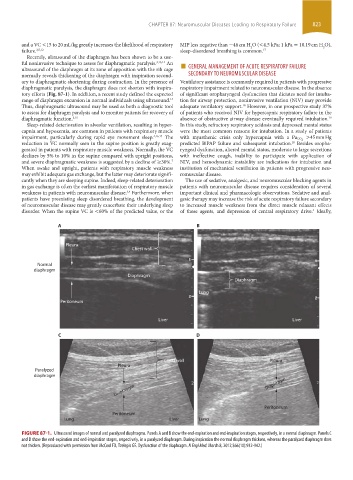
                    ary to diaphragmatic shortening during contraction. In the presence of   Ventilatory assistance is commonly required in patients with progressive
                    diaphragmatic paralysis, the diaphragm does not shorten with inspira-  respiratory impairment related to neuromuscular disease. In the absence
                    tory efforts (Fig. 87-1). In addition, a recent study defined the expected   of significant oropharyngeal dysfunction that dictates need for intuba-
                    range of diaphragm excursion in normal individuals using ultrasound.    tion for airway protection, noninvasive ventilation (NIV) may provide
                                                                      14
                    Thus, diaphragmatic ultrasound may be used as both a diagnostic tool   adequate ventilatory support.  However, in one prospective study 37%
                                                                                               18
                    to assess for diaphragm paralysis and to monitor patients for recovery of   of patients who received NIV for hypercapnic respiratory failure in the
                                                                                                                            19
                    diaphragmatic function. 3,15                          absence of obstructive airway disease eventually required intubation.
                     Sleep-related deterioration in alveolar ventilation, resulting in hyper-  In this study, refractory respiratory acidosis and depressed mental status
                    capnia and hypoxemia, are common in patients with respiratory muscle   were the most common reasons for intubation. In a study of patients
                    impairment, particularly  during rapid eye movement sleep. 4,16,17  The   with myasthenic crisis only hypercapnia with a Pa CO 2   >45 mm Hg
                    reduction in VC normally seen in the supine position is greatly exag-  predicted BiPAP failure and subsequent intubation.  Besides oropha-
                                                                                                                20
                    gerated in patients with respiratory muscle weakness. Normally, the VC   ryngeal dysfunction, altered mental status, moderate to large  secretions
                    declines by 5% to 10% in the supine compared with upright positions,   with ineffective cough, inability to participate with application of
                    and severe diaphragmatic weakness is suggested by a decline of ≥30%.    NIV, and hemodynamic instability are indications for intubation and
                                                                       7
                    When awake and upright, patients with respiratory muscle weakness     institution of mechanical ventilation in patients with progressive neu-
                    may exhibit adequate gas exchange, but the latter may deteriorate signifi-  romuscular disease.
                    cantly when they are sleeping supine. Indeed, sleep-related deterioration   The use of sedative, analgesic, and neuromuscular blocking agents in
                    in gas exchange is often the earliest manifestation of respiratory muscle   patients with neuromuscular disease requires consideration of several
                    weakness in patients with neuromuscular disease.  Furthermore, when   important clinical and pharmacologic observations. Sedative and anal-
                                                       3,4
                    patients have preexisting sleep disordered breathing, the development   gesic therapy may increase the risk of acute respiratory failure secondary
                    of neuromuscular disease may greatly exacerbate their underlying sleep   to increased muscle weakness from the direct muscle relaxant effects
                    disorder. When the supine VC is <60% of the predicted value, or the   of  these  agents,  and  depression  of  central  respiratory  drive.   Ideally,
                                                                                                                       4
                                A                                              B


                                   Pleura
                                                         Chest wall

                         Normal
                        diaphragm
                                                        Diaphragm
                                                                                            Diaphragm
                                                                                Lung
                                 Peritoneum


                                                                  Liver                                         Liver

                                C                                              D


                                                                    Chest wall                          Pleura
                                                    Pleura
                        Paralyzed
                        diaphragm
                                                   Diaphragm                                           Diaphragm


                                                                                                      Peritoneum
                                                   Peritoneum
                                  Lung                                Liver     Lung

                    FIGURE 87-1.  Ultrasound images of normal and paralyzed diaphragms. Panels A and B show the end-expiration and end-inspiration stages, respectively, in a normal diaphragm. Panels C
                    and D show the end-expiration and end-inspiration stages, respectively, in a paralyzed diaphragm. During inspiration the normal diaphragm thickens, whereas the paralyzed diaphragm does
                    not thicken. (Reproduced with permission from McCool FD, Tzelepis GE. Dysfunction of the diaphragm. N Engl Med. March 8, 2012;366(10):932-942.)


            section06.indd   823                                                                                       1/23/2015   12:56:18 PM

