


Page 1184 - Hall et al (2015) Principles of Critical Care-McGraw-Hill
P. 1184
CHAPTER 87: Neuromuscular Diseases Leading to Respiratory Failure  821


                     CHAPTER    Neuromuscular Diseases                      TABLE 87-1    Causes of Acute and Subacute Bilateral Weakness
                      87        Leading to Respiratory                    Syndrome/level of   Representative Disorders
                                                                          Abnormality
                                Failure                                   Basilar artery occlusion  Embolic, thrombotic, vasculitic

                                William Marinelli                         Myelopathy   Cord compression (eg, abscess, neoplasm,
                                                                                       disc herniation, trauma)
                                James W. Leatherman
                                                                                       Transverse myelitis
                                                                          Central nervous    Poliomyelitis
                     KEY POINTS                                           system infections  West Nile virus
                        • Neuromuscular disorders (NMDs) in critical care may be divided   Central nervous   Neurotoxic fish poisoning
                      into those that precipitate admission to the ICU and those that     system toxins
                      arise during ICU management.                        Peripheral nerve   Guillain-Barre syndrome
                        • Many patients who present to the ICU as a result of an underlying   disorders
                      neuromuscular disorder will have a previously defined diagnosis.   Phrenic nerve injury (eg, trauma, surgery neoplasm)
                      However, when a patient presents with recent onset of acute or   Infections with phrenic nerve involvement (eg, diphtheria, herpes
                      subacute bilateral muscle weakness, a broad differential diagnosis   zoster, Lyme disease, West Nile
                      must be considered.                                              Parsonage-Turner Syndrome with phrenic nerve involvement
                        • A  rapidly  progressive spinal cord lesion is  the  most important   Heavy metal toxicity
                        diagnosis to consider and immediately exclude in patients present-
                      ing with ascending or flaccid paralysis.                         Vasculitic neuropathy
                                                                          Disorders of   Myasthenia gravis
                        • The maximal inspiratory pressure (MIP), maximal expiratory
                      pressure (MEP), vital capacity (VC), and qualitative judgment of     neuromuscular   Eaton-Lambert syndrome
                      oropharyngeal function are the most important parameters to fol-    transmission  Botulism
                      low in patients with NMDs.                                       Tick paralysis
                        • An effective cough is unlikely with a MEP <40 cm H O and risk of
                                                            2
                      hypercapnia increases when MIP is less negative than −30 cm H O.    Organophosphate poisoning
                                                                    2
                      A VC <30 mL/kg impairs secretion clearance and respiratory fail-  Penicillamine toxicity
                      ure is common at values <15 to 20 mL/kg.            Myopathic disorders  Dermatomyositis/polymyositis
                        • Sleep-related deterioration in alveolar ventilation resulting in hyper-  Metabolic myopathy (eg, mitochondrial disease)
                      capnia and hypoxia is common in patients with respiratory muscle
                        impairment.                                                    Toxic myopathy (eg, corticosteroid injury, alcohol, cocaine,
                                                                                         rhabdomyolysis)
                        • Most patients with Guillain-Barré syndrome or myasthenia gravis
                      of  sufficient severity to precipitate ICU admission will benefit from   Electrolyte disorders Hypokalemia
                      treatment with plasma exchange or intravenous immunoglobulin.    Periodic paralysis
                       • Muscle biopsy is useful in the diagnosis of polymyositis, mitochon-  Hypophosphatemia
                      drial disease, and other myopathies, and should be considered when   Hyperkalemia
                      electrophysiologic and other testing does not offer a clear diagnosis   Hypermagnesemia
                      of peripheral neuropathy or myoneural junction diseases.
                                                                                       Hypocalcemia


                    NEUROMUSCULAR DISORDERS IN CRITICAL CARE:             Although lesions involving the upper and lower motor neuron may
                    GENERAL ASSESSMENT AND MANAGEMENT                     occasionally be responsible, more often the underlying disorder affects
                                                                          the peripheral nerves (eg, Guillain-Barré syndrome, GBS), neuromuscu-
                    Neuromuscular weakness may result from disorders involving the   lar junction (eg, myasthenia gravis, MG), or skeletal muscles (eg, derma-
                    peripheral nerves, neuromuscular transmission, or skeletal muscles.   tomyositis and polymyositis, DM/PM). In this chapter, we will address
                    Neuromuscular disorders encountered in the critical care setting may   neuromuscular disorders that may present with acute or   subacute
                    be divided into those that result in ICU admission and those that are   declines in respiratory muscle strength leading to acute respiratory
                    acquired during treatment of critical illness. Most patients who present     failure. Our discussion will primarily focus on GBS, MG, and DM/PM.
                    to the ICU as a result of an underlying neuromuscular disorder will have   We  will  also  offer  a  brief  review  of  several  additional  disorders  that
                    a previously defined diagnosis. However, when a patient presents with   should be considered in the differential diagnosis of patients presenting
                    recent onset of acute or subacute bilateral muscle weakness, a broad dif-  to the ICU with progressive neuromuscular impairment. Before discuss-
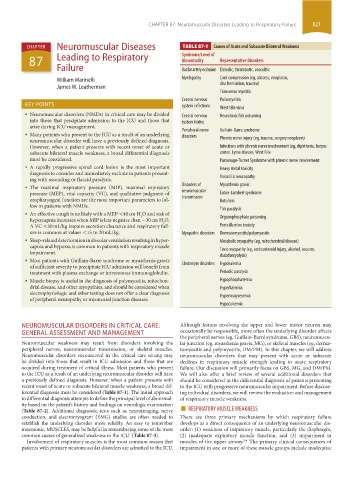
                    ferential diagnosis must be considered (Table 87-1). The initial approach   ing individual disorders, we will review the evaluation and management
                    to differential diagnosis attempts to define the principal level of abnormal-  of respiratory muscle weakness.
                    (Table 87-2). Additional diagnostic tests such as neuroimaging, nerve   ■  RESPIRATORY MUSCLE WEAKNESS
                    ity based on the patient’s history and findings on neurologic examination
                    conduction, and electromyogram (EMG) studies are often needed to   There are three primary mechanisms by which respiratory failure
                    establish the underlying disorder more reliably. An easy to remember   develops as a direct consequence of an underlying neuromuscular dis-
                    mnemonic, MUSCLES, may be helpful in remembering some of the most   order: (1) weakness of inspiratory muscle, particularly the diaphragm,
                    common causes of generalized weakness in the ICU  (Table 87-3).  (2)  inadequate expiratory muscle function, and (3) impairment in
                                                        1
                     Involvement of respiratory muscles is the most common reason that   muscles of the upper airway.  The primary clinical consequences of
                                                                                               2-4
                    patients with primary neuromuscular disorders are admitted to the ICU.    impairment in one or more of these muscle groups include inadequate


            section06.indd   821                                                                                       1/23/2015   12:56:16 PM

