


Page 1183 - Hall et al (2015) Principles of Critical Care-McGraw-Hill
P. 1183
820     PART 6: Neurologic Disorders


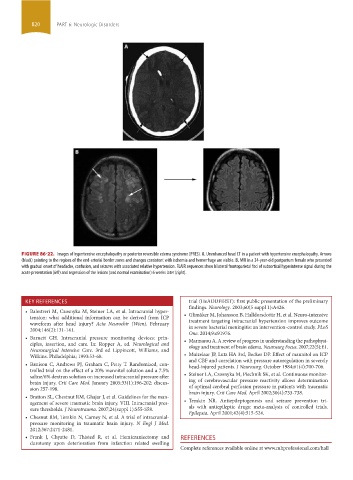
                 FIGURE 86-22.  Images of hypertensive encephalopathy or posterior reversible edema syndrome (PRES). A. Unenhanced head CT in a patient with hypertensive encephalopathy. Arrows
                 (black) pointing to the regions of the end-arterial border zones and changes consistent with ischemia and hemorrhage are visible. B. MRI in a 34-year-old postpartum female who presented
                 with gradual onset of headache, confusion, and seizures with associated relative hypertension. FLAIR sequences show bilateral frontoparietal foci of subcortical hyperintense signal during the
                 acute presentation (left) and regression of the lesions (and normal examination) 6 weeks later (right).


                   KEY REFERENCES                                         trial (HeADDFIRST): first public presentation of the preliminary
                                                                            findings. Neurology. 2003;60(5 suppl 1):A426.
                     • Balestreri M, Czosnyka M, Steiner LA, et al. Intracranial hyper-
                    tension: what additional information can be derived from ICP     • Glimåker M, Johansson B, Halldorsdottir H, et al. Neuro-intensive
                    waveform after head injury?  Acta Neurochir (Wien). February   treatment targeting intracranial hypertension improves outcome
                    2004;146(2):131-141.                                  in severe bacterial meningitis: an intervention-control study. PLoS
                                                                          One. 2014;9:e91976.
                     • Barnett GH. Intracranial pressure monitoring devices: prin-    • Marmarou A. A review of progress in understanding the pathophysi-
                    ciples,  insertion,  and  care.  In:  Ropper  A,  ed.  Neurological  and   ology and treatment of brain edema. Neurosurg Focus. 2007;22(5):E1.
                    Neurosurgical Intensive Care. 3rd ed Lippincott, Williams, and
                    Wilkins. Philadelphia; 1993:53-68.                     • Muizelaar JP, Lutz HA 3rd, Becker DP. Effect of mannitol on ICP
                     • Battison C, Andrews PJ, Graham C, Petty T. Randomized, con-  and CBF and correlation with pressure autoregulation in severely
                                                                          head-injured patients. J Neurosurg. October 1984;61(4):700-706.
                    trolled trial on the effect of a 20% mannitol solution and a 7.5%
                    saline/6% dextran solution on increased intracranial pressure after     • Steiner LA, Czosnyka M, Piechnik SK, et al. Continuous monitor-
                    brain injury. Crit Care Med. January 2005;33(1):196-202; discus-  ing of cerebrovascular pressure reactivity allows determination
                    sion 257-198.                                         of optimal cerebral perfusion pressure in patients with traumatic
                     • Bratton SL, Chestnut RM, Ghajar J, et al. Guidelines for the man-  brain injury. Crit Care Med. April 2002;30(4):733-738.
                    agement of severe traumatic brain injury. VIII. Intracranial pres-    • Temkin NR. Antiepileptogenesis and seizure prevention tri-
                    sure thresholds. J Neurotrauma. 2007;24(suppl 1):S55-S58.  als with antiepileptic drugs: meta-analysis of controlled trials.
                                                                          Epilepsia. April 2001;42(4):515-524.
                     • Chesnut RM, Temkin N, Carney N, et al. A trial of intracranial-
                    pressure  monitoring  in traumatic  brain injury.  N Engl J Med.
                    2012;367:2471-2481.
                     • Frank J, Chyatte D, Thisted R, et al. Hemicraniectomy and   REFERENCES
                    durotomy upon deterioration from infarction related swelling
                                                                       Complete references available online at www.mhprofessional.com/hall


            section06.indd   820                                                                                       1/23/2015   12:56:16 PM

