


Page 1244 - Hall et al (2015) Principles of Critical Care-McGraw-Hill
P. 1244
CHAPTER 90: Bleeding Disorders  851


                                                                          develop within hours in patients who have had recent prior exposure
                      TABLE 90-6    Common Drugs Associated With Thrombocytopenia
                                                                          to  heparin.   While  subcutaneous  prophylactic  unfractionated  heparin
                                                                                  64
                    Drug Class            Specific Drugs                  and intravenous therapeutic unfractionated heparin are most commonly
                    Antibiotics           Penicillin, methicillin, vancomycin, rifampin,   implicated in the disease, HIT may result from any exposure to heparin
                                          ciprofloxacin, trimethoprim/sulfamethoxazole and   and heparin-like compounds including intermittent low-dose catheter
                                          sulfonamides, linezolid, rifampin, amphotericin B  flushes, low- molecular-weight heparins, and related medications including
                                                                          fondaparinux. 65-67  The second major feature of HIT is thrombosis. Venous
                    Analgesics            Ibuprofen, diclofenac, naproxen, acetaminophen
                                                                          clotting including deep venous thrombosis and pulmonary thromboem-
                    Cinchona alkaloids    Quinine, quinidine              bolism are the most common manifestations of this clotting risk. However,
                    Cardiac glycosides and antiarrhythmics Digoxin, procainamide, amiodarone  arterial clotting with stroke, myocardial infarction, and limb necrosis also
                                                                          occur with clinically significant frequency and devastating consequences.
                                                                                                                            68
                    Chemotherapeutic and    Oxaliplatin, fludarabine, cyclosporine, rituximab,   Thrombocytopenia-associated bleeding is rare in HIT.
                    immunosuppressive agents  gold salts, d-penicillamine
                                                                           The risk of developing HIT depends on both patient-specific factors
                    Diuretics             Chlorothiazide, hydrochlorothiazide  as well as the type of heparin exposure. Risk increases with age, female
                                                                                                69
                    Heparins              Unfractionated heparin, low-molecular-weight heparin  gender, and postsurgical status.  In particular, orthopedic and cardiac
                                                                                                                            70
                    Histamine-receptor antagonists  Cimetidine, ranitidine  surgery patients have higher risk than obstetric and medical patients.
                                                                          While both LMWH and unfractionated heparin have caused HIT, the risk
                    Platelet inhibitors   Abciximab, eptifibatide, tirofiban  is substantially higher with unfractionated heparin at 1% to 5% compared
                                                                                       71
                    Sedatives and antiseizure agents  Carbamazepine, haloperidol, phenytoin, valproic   with 0.1% to 1.0%.  Given the potentially severe adverse consequences of
                                          acid, diazepam                  unrecognized HIT, patients groups with more than 1% incidence of HIT,
                    Data from reference 56, 57, 175.                      such as cardiac surgery and postoperative patients receiving unfraction-
                                                                          ated heparin, expert guidelines recommend intermittent platelet count
                                                                          surveillance and screening every 2 to 3 days while receiving heparin. 72
                    and bone marrow megakaryocytes, but also may cause significant reduc-  The nonspecific  findings of thrombocytopenia and  thrombosis in
                    tions in the productive capacity of surviving megakaryocytes. 59  critically ill patients make the clinical diagnosis of HIT particularly
                                                                          difficult unless the diagnostic and therapeutic approach is based on
                    Heparin-Induced  Thrombocytopenia:  Heparins,  including  unfraction-  carefully selected features of the disease. While several scoring systems
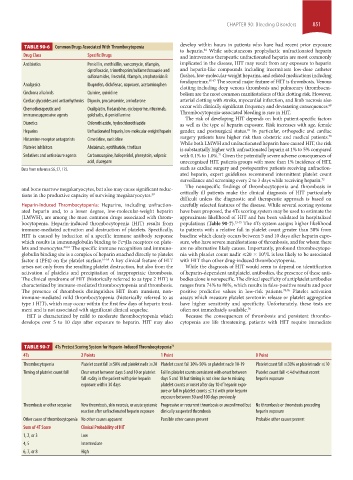
                    ated heparin and, to a lesser degree, low-molecular-weight heparin   have been proposed, the 4Ts scoring system may be used to estimate the
                    (LMWH), are among the most common drugs associated with throm-  approximate likelihood of HIT and has been validated in hospitalized
                    bocytopenia. Heparin-induced thrombocytopenia (HIT) results from   populations (Table 90-7). 73-75  The 4Ts system assigns higher likelihood
                    immune-mediated activation and destruction of platelets. Specifically,   to patients with a relative fall in platelet count greater than 50% from
                    HIT is caused by induction of a specific immune antibody response   baseline which clearly occurs between 5 and 10 days after heparin expo-
                    which results in immunoglobulin binding to FcγIIa receptors on plate-  sure, who have severe manifestations of thrombosis, and for whom there
                    lets and monocytes. 60,61  The specific immune recognition and immuno-  are no alternative likely causes. Importantly, profound thrombocytope-
                    globulin binding site is a complex of heparin attached directly to platelet   nia with platelet count nadir ≤20 × 10 /L is less likely to be associated
                                                                                                      9
                    factor 4 (PF4) on the platelet surface. 61-63  A key clinical feature of HIT   with HIT than other drug-induced thrombocytopenia.
                    arises not only from the resulting platelet destruction, but also from the   While the diagnosis of HIT would seem to depend on identification
                    activation of platelets and precipitation of inappropriate thrombosis.   of heparin-dependent antiplatelet antibodies, the presence of these anti-
                    The clinical syndrome of HIT (historically referred to as type 2 HIT) is   bodies alone is nonspecific. The clinical specificity of antiplatelet antibodies
                    characterized by immune-mediated thrombocytopenia and thrombosis.   ranges from 74% to 86%, which results in false-positive results and poor
                    The presence of thrombosis distinguishes HIT from transient, non-  positive predictive values  in  low-risk  patients. 70,76  Platelet activation
                    immune-mediated mild thrombocytopenia (historically referred to as   assays which measure platelet serotonin release or platelet aggregation
                    type 1 HIT), which may occur within the first few days of heparin treat-  have higher sensitivity and specificity. Unfortunately, these tests are
                    ment and is not associated with significant clinical sequelae.  often not immediately available. 76
                     HIT is characterized by mild to moderate thrombocytopenia which   Because  the  consequences  of  thrombosis  and  persistent  thrombo-
                    develops over 5 to 10 days after exposure to heparin. HIT may also   cytopenia are  life threatening,  patients  with  HIT  require  immediate


                      TABLE 90-7    4Ts Pretest Scoring System for Heparin-Induced Thrombocytopenia 74
                    4Ts                 2 Points                   1 Point                         0 Point
                    Thrombocytopenia    Platelet count fall ≥50% and platelet nadir ≥20 Platelet count fall 30%-50% or platelet nadir 10-19  Platelet count fall ≤30% or platelet nadir ≤10
                    Timing of platelet count fall  Clear onset between days 5 and 10 or platelet  Fall in platelet counts consistent with onset between   Platelet count fall <4 d without recent
                                        fall ≤day in the patient with prior heparin   days 5 and 10 but timing is not clear due to missing   heparin exposure
                                          exposure within 30 days  platelet counts or onset after day 10 of heparin expo-
                                                                   sure or fall in platelet counts ≤1 d with prior heparin
                                                                   exposure between 30 and 100 days previously
                    Thrombosis or other sequelae  New thrombosis, skin necrosis, or acute systemic  Progressive or recurrent thrombosis or unconfirmed but  No thrombosis or thrombosis preceding
                                        reaction after unfractionated heparin exposure    clinically suspected thrombosis  heparin exposure
                    Other cause of thrombocytopenia No other causes apparent  Possible other causes present  Probable other causes present
                    Sum of 4T Score     Clinical Probability of HIT
                    1, 2, or 3          Low
                    4, 5                Intermediate
                    6, 7, or 8          High


            section07.indd   851                                                                                       1/21/2015   7:42:44 AM

