


Page 1293 - Hall et al (2015) Principles of Critical Care-McGraw-Hill
P. 1293
900     PART 7: Hematologic and Oncologic Disorders


                 40% of patients and is characterized by peripheral neuropathy with weak-  of  administration. Ifosfamide can precipitate encephalopathy in 10% to
                 ness in the lower extremities, which if severe, can mimic Guillain-Barre   25% manifesting as decreased attention and agitation within hours of
                 Syndrome. Other associated symptoms can include headache and altered   administration lasting 1 to 4 days. High-dose ara-C can cause encepha-
                 consciousness. The mechanism of neurotoxicity is unknown. 82  lopathy in 10% to 30%, again within 24 hours of administration and
                   Another manifestation of cancer therapy–induced neurotoxicity,    resolves weeks after discontinuation. High-dose ara-C can also cause
                 particularly with VEGF inhibitors due to their tendency to cause hyper-  painful corneal toxicity associated with blurred vision, photophobia, and
                 tension, is posterior reversible encephalopathy syndrome or PRES. PRES   conjunctival injection, which can be prevented and treated with gluco-
                 is a clinical radiographic syndrome of headache, altered consciousness,   corticoid eye drops. Cerebellar syndrome has also been described with
                 visual  disturbances,  and  seizures associated with characteristic sym-  high-dose cytarabine and includes dysarthria, ataxia, and nystagmus.
                 metrical white matter edema in the posterior cerebral hemispheres on   Intrathecal methotrexate administration can cause aseptic meningitis in
                 MRI. These findings are frequently accompanied by hypertension and   10% of patients and manifests as headache, lethargy, and nuchal rigidity.
                 hypertensive crisis may precede the syndrome by  ≥24 hours. PRES   Overdosage of intrathecal MTX can cause fatal myeloencephalopathy
                 is a well-described complication of anticancer therapies including    manifest by seizure and coma. Subacute central neurologic toxicity
                 tacrolimus, cyclosporine, cisplatin, 5-FU, capecitabine, bevacizumab,     associated with moderate to high doses of MTX can occur weeks to
                 sorafenib, and sunitinib. The mechanism is secondary to acute endothelial     months after administration and may present with aphasia, dysarthria,
                 damage leading to microangiopathy with cerebrovascular dysregulation   hemiparesis, seizures, and behavioral abnormalities while chronic neu-
                 and vasogenic edema.  Treatment is largely supportive with antihyper-  rotoxicity occurring greater than 6 months after therapy in combination
                                 85
                 tensives and discontinuation of inciting agent. 82    with whole brain XRT is very common (>90%) and can present as
                   Another worrisome, though uncommon, complication of the VEGF   dementia, ataxia, and incontinence. All-trans-retinoic acid commonly
                 inhibitor bevacizumab is intratumoral bleeding in patients with cerebral   causes headache and in some cases can be associated with increased
                 metastasis leading to intracerebral hemorrhage. While this concern   intracranial pressure due to idiopathic intracranial hypertension as
                 is practical, no clear incidence has been determined as patients with   evidence by papilledema.  The peripheral and central manifestations of
                                                                                         87
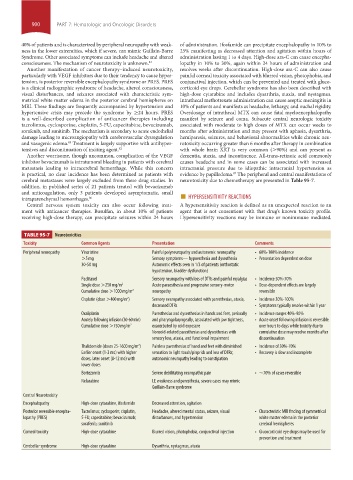
                 cerebral metastases were largely excluded from these drug studies. In   neurotoxicity due to chemotherapy are presented in Table 95-7.
                 addition, in published series of 21 patients treated with bevacizumab
                 and anticoagulation, only 3 patients developed asymptomatic, small     ■
                 intraparenchymal hemorrhages. 86                         HYPERSENSITIVITY REACTIONS
                   Central nervous system toxicity can also occur following treat-  A hypersensitivity reaction is defined as an unexpected reaction to an
                 ment with anticancer therapies. Busulfan, in about 10% of patients   agent that is not consentient with that drug’s known toxicity profile.
                   receiving high-dose therapy, can precipitate seizures within 24 hours   Hypersensitivity reactions may be immune or nonimmune mediated.


                   TABLE 95-7    Neurotoxicities
                  Toxicity            Common Agents           Presentation                       Comments
                  Peripheral neuropathy  Vincristine          Painful polyneuropathy and autonomic neuropathy  •  60%-100% incidence
                                      >5 mg                   Sensory symptoms— hypoesthesia and dysesthesia  •  Presentation dependent on dose
                                      30-50 mg                Autonomic effects seen in 1/3 of patients (orthostatic
                                                                hypotension, bladder dysfunction)
                                      Paclitaxel              Sensory neuropathy with loss of DTRs and painful myalgias  •  Incidence 50%-70%
                                      Single dose >250 mg/m 2  Acute paraesthesia and progressive sensory-motor   •  Dose-dependent effects are largely
                                      Cumulative dose >1000 mg/m 2    neuropathy                    reversible
                                      Cisplatin (dose >400 mg/m ) 2  Sensory neuropathy associated with paresthesias, ataxia,   •  Incidence 30%-100%
                                                              decreased DTRs                     •  Symptoms typically resolve within 1 year
                                      Oxaliplatin             Paresthesias and dysesthesias in hands and feet, periorally   •  Incidence ranges 40%-90%
                                      Acutely following infusion (30-60 min)  and pharyngolaryngeally, associated with jaw tightness,   •  Acute onset following infusion is reversible
                                      Cumulative dose >750 mg/m 2    exacerbated by cold exposure  over hours to days while toxicity due to
                                                              Noncold-related paresthesias and dysesthesias with   cumulative dose may resolve months after
                                                                sensory loss, ataxia, and functional impairment  discontinuation
                                      Thalidomide (doses 25-1600 mg/m ) 2  Painless paresthesias of hand and feet with diminished   •  Incidence of 30%-70%
                                      Earlier onset (1-2 mo) with higher     sensation to light touch/pinprick and loss of DTRs;   •  Recovery is slow and incomplete
                                      doses, later onset (8-12 mo) with     autonomic neuropathy leading to constipation
                                      lower doses
                                      Bortezomib              Severe debilitating neuropathic pain  •  ∼70% of cases reversible
                                      Nelarabine              LE weakness and paresthesia, severe cases may mimic
                                                                Guillain-Barre syndrome
                  Central Neurotoxicity
                  Encephalopathy      High-dose cytarabine, ifosfamide  Decreased attention, agitation
                  Posterior reversible encepha-  Tacrolimus; cyclosporin; cisplatin,   Headache, altered mental status, seizure, visual   •  Characteristic MRI finding of symmetrical
                  lopathy (PRES)      5-FU; capecitabine; bevacizumab;     disturbances, and hypertension  white matter edema in the posterior
                                      sorafenib; sunitinib                                          cerebral hemispheres
                  Corneal toxicity    High-dose cytarabine    Blurred vision, photophobia, conjunctival injection  •  Glucocorticoid eye drops may be used for
                                                                                                  prevention and treatment
                  Cerebellar syndrome  High-dose cytarabine   Dysarthria, nystagmus, ataxia


            section07.indd   900                                                                                       1/21/2015   7:43:08 AM

