


Page 1343 - Hall et al (2015) Principles of Critical Care-McGraw-Hill
P. 1343
916     PART 8: Renal and Metabolic Disorders


                   CHAPTER   Acute Kidney Injury                       of acute renal failure and the emergence of evidence that even small
                                                                       increases in serum creatinine are associated with increased mortality
                    97       Claire Hannon                             has led to widespread adoption of diagnostic criteria for the term acute
                                                                       kidney injury (AKI).  AKI has largely replaced the term acute renal
                                                                                       2
                             Patrick T. Murray
                                                                       failure (ARF). It is a syndrome that includes minor degrees of injury as
                                                                       well as more severe renal failure, and does not allude to the mechanism
                                                                       of injury. Glomerular filtration rate (GFR) is the best measure of kidney
                                                                       function, but  is not  easily  measured  in  clinical  practice.  A change  in
                  KEY POINTS
                                                                       serum creatinine or urine output is used as a marker for a change in GFR
                     • Prerenal azotemia and acute tubular necrosis account for the over-  and forms the basis for the various diagnostic criteria for AKI.
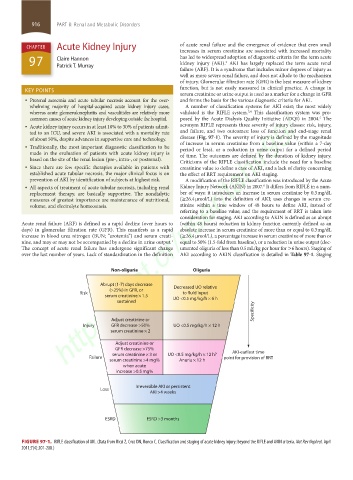
                    whelming majority of hospital-acquired acute kidney injury cases,   A number of classification systems for AKI  exist; the most widely
                                https://kat.cr/user/tahir99/
                    whereas acute glomerulonephritis and vasculitides are relatively more   validated is the RIFLE system.  This classification system was pro-
                                                                                              3,4
                                                                                                                       5
                    common causes of acute kidney injury developing outside the hospital.  posed by the Acute Dialysis Quality Initiative (ADQI) in 2004.  The
                     • Acute kidney injury occurs in at least 10% to 30% of patients admit-  acronym RIFLE represents three severity of injury classes: risk, injury,
                    ted to an ICU, and severe AKI is associated with a mortality rate   and failure, and two outcomes: loss of function and end-stage renal
                    of about 50%, despite advances in supportive care and technology.  disease (Fig. 97-1). The severity of injury is defined by the magnitude
                     • Traditionally, the most important diagnostic classification to be   of increase in serum creatinine from a baseline value (within a 7-day
                                                                       period or less), or a reduction in urine output for a defined period
                    made in  the evaluation of patients with  acute kidney injury is   of time. The outcomes are defined by the duration of kidney injury.
                    based on the site of the renal lesion (pre-, intra-, or postrenal).  Criticisms of the RIFLE classification include the need for a baseline
                     • Since there are few specific therapies available in patients with   creatinine value to define a case of AKI, and a lack of clarity concerning
                    established acute tubular necrosis, the major clinical focus is on   the effect of RRT requirement on AKI staging.
                    prevention of AKI by identification of subjects at highest risk.  A modification of the RIFLE classification was introduced by the Acute
                                                                                                    6
                     • All aspects of treatment of acute tubular necrosis, including renal   Kidney Injury Network (AKIN) in 2007.  It differs from RIFLE in a num-
                    replacement therapy, are basically supportive. The nondialytic   ber of ways: it introduces an increase in serum creatinine by 0.3 mg/dL
                    measures of greatest importance are maintenance of nutritional,   (≥26.4 µmol/L) into the definition of AKI; uses changes in serum cre-
                    volume, and electrolyte homeostasis.               atinine within a  time window  of 48 hours to define AKI, instead of
                                                                       referring to a baseline value; and the requirement of RRT is taken into
                                                                       consideration for staging. AKI according to AKIN is defined as an abrupt
                 Acute renal failure (ARF) is defined as a rapid decline (over hours to   (within 48 hours) reduction in kidney function currently defined as an
                 days) in glomerular filtration rate (GFR). This manifests as a rapid   absolute increase in serum creatinine of more than or equal to 0.3 mg/dL
                 increase in blood urea nitrogen (BUN; “azotemia”) and serum creati-  (≥26.4 µmol/L), a percentage increase in serum creatinine of more than or
                 nine, and may or may not be accompanied by a decline in urine output.    equal to 50% (1.5-fold from baseline), or a reduction in urine output (doc-
                                                                    1
                 The concept of acute renal failure has undergone significant change   umented oliguria of less than 0.5 mL/kg per hour for >6 hours). Staging of
                 over the last number of years. Lack of standardization in the definition   AKI according to AKIN classification is detailed in Table 97-1. Staging

                                                Non-oliguria                Oliguria

                                            Abrupt (1-7) days decrease  Decreased UO relative
                                               (>25%) in GFR, or
                                     Risk                               to fluid input
                                              serum creatinine × 1.5  UO <0.5 mg/kg/h × 6 h
                                                  sustained
                                                                                                Specificity
                                                Adjust creatinine or
                                      Injury    GFR decrease >50%    UO <0.5 mg/kg/h × 12 h
                                                serum creatinine × 2

                                                 Adjust creatinine or
                                                 GFR decrease >75%
                                                serum creatinine × 3 or  UO <0.5 mg/kg/h × 12 h?  AKI-earliest time
                                        Failure                                       point for provision of RRT
                                               serum creatinine >4 mg%  Anuria × 12 h
                                                    when acute
                                                 increase >0.5 mg%

                                                        Irreversible AKI or persistent
                                            Loss
                                                             AKI >4 weeks


                                              ESRD          ESRD >3 months


                 FIGURE 97-1.  RIFLE classification of AKI. (Data from Ricci Z, Cruz DN, Ronco C. Classification and staging of acute kidney injury: beyond the RIFLE and AKIN criteria. Nat Rev Nephrol. April
                 2011;7(4):201-208.)


            section08.indd   916                                                                                       1/14/2015   8:27:52 AM

