


Page 1347 - Hall et al (2015) Principles of Critical Care-McGraw-Hill
P. 1347
920     PART 8: Renal and Metabolic Disorders


                                                                                 Tubular damage
                                           Ischemia
                                         nephrotoxins                          (proximal tubules and
                                                                                 ascending thick limb


                                                    (1)             (2)           (3)           (4)
                                               Vasoconstriction  Obstruction    Tubular       Interstitial
                                               renin-angiotensin  by casts      backleak    inflammation
                                                 endothelin
                                                     PGI 2
                                https://kat.cr/user/tahir99/
                                                     NO
                                                                  Intratubular        Tubular
                                                                  pressure          fluid flow
                                            (5)
                                       ? Direct glomerular           GFR        Oliguria
                                           effect
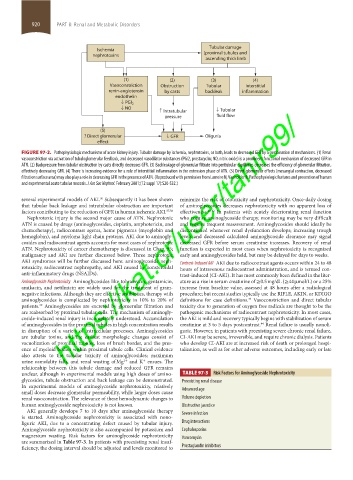
                 FIGURE 97-2.  Pathophysiologic mechanisms of acute kidney injury. Tubular damage by ischemia, nephrotoxins, or both, leads to decreased GFR by a combination of mechanisms. (1) Renal
                 vasoconstriction via activation of tubuloglomerular feedback, and decreased vasodilator substances (PGI2, prostacyclin; NO, nitric oxide) is a prominent functional mechanism of decreased GFR in
                 ATN. (2) Backpressure from tubular obstruction by casts directly decreases GFR. (3) Backleakage of glomerular filtrate into peritubular capillaries decreases the efficiency of glomerular filtration,
                 effectively decreasing GFR. (4) There is increasing evidence for a role of interstitial inflammation in the extension phase of ATN. (5) Direct glomerular effects (mesangial contraction, decreased
                 filtration surface area) may also play a role in decreasing GFR in the presence of ATN. (Reproduced with permission from Lameire N, Vanholder R. Pathophysiologic features and prevention of human
                 and experimental acute tubular necrosis. J Am Soc Nephrol. February 2001;(12 suppl 17):S20-S32.)

                   several experimental models of AKI.  Subsequently it has been shown   minimize the risk of ototoxicity and nephrotoxicity. Once-daily dosing
                                            36
                 that tubular back leakage and intratubular obstruction are important   of aminoglycosides decreases nephrotoxicity with no apparent loss of
                 factors contributing to the reduction of GFR in human ischemic AKI. 37,38  effectiveness. 40-42  In patients with acutely deteriorating renal function
                   Nephrotoxic injury is the second major cause of ATN. Nephrotoxic   who require aminoglycoside therapy, monitoring may be very difficult
                 ATN is caused by drugs (aminoglycosides, cisplatin, amphotericin, and   and require frequent reassessment. Aminoglycosides should ideally be
                 chemotherapy), radiocontrast agents, heme pigments (myoglobin and   discontinued  whenever  renal  dysfunction  develops;  increasing  trough
                 hemoglobin), and myeloma light chain proteins. AKI due to aminogly-  levels and decreased calculated aminoglycoside clearance may signal
                 cosides and radiocontrast agents accounts for most cases of nephrotoxic   decreased GFR before serum creatinine increases. Recovery of renal
                 ATN. Nephrotoxicity of cancer chemotherapy is discussed in Chap. 95;   function is expected in most cases when nephrotoxicity is recognized
                 malignancy and AKI are further discussed below. Three nephrotoxic   early and aminoglycosides held, but may be delayed for days to weeks.
                 AKI syndromes will be further discussed here: aminoglycoside neph-  Contrast-Induced AKI  AKI due to radiocontrast agents occurs within 24 to 48
                 rotoxicity, radiocontrast nephropathy, and AKI caused by nonsteroidal   hours of intravenous radiocontrast administration, and is termed con-
                 anti-inflammatory drugs (NSAIDs).                     trast-induced (CI-AKI). It has most commonly been defined in the liter-
                 Aminoglycoside Nephrotoxicity  Aminoglycosides like tobramycin, gentamicin,   ature as a rise in serum creatinine of ≥0.5 mg/dL (≥44 µmol/L) or a 25%
                 amikacin, and netilmicin are widely used for the treatment of gram-  increase from baseline value, assessed at 48 hours after a radiological
                 negative infections. Although they are effective antibiotics, therapy with   procedure; but recent studies typically use the RIFLE, AKIN, or KDIGO
                 aminoglycosides is complicated by nephrotoxicity in 10% to 20% of   definitions for case definitions.  Vasoconstriction and direct tubular
                                                                                              43
                 patients.   Aminoglycosides  are  excreted  by  glomerular  filtration  and   toxicity due to generation of oxygen free radicals are thought to be the
                       39
                 are reabsorbed by proximal tubular cells. The mechanism of aminogly-  pathogenic mechanisms of radiocontrast nephrotoxicity. In most cases,
                 coside-induced renal injury is incompletely understood. Accumulation   the AKI is mild and recovery typically begins with stabilization of serum
                 of aminoglycosides in the proximal tubules in high concentration results   creatinine at 3 to 5 days postcontrast.  Renal failure is usually nonoli-
                                                                                                   44
                 in disruption of a variety of intracellular processes. Aminoglycosides   guric. However, in patients with preexisting severe chronic renal failure,
                 are tubular toxins, and the earliest morphologic changes consist of   CI-AKI may be severe, irreversible, and require chronic dialysis. Patients
                 vacuolization of proximal tubules, loss of brush border, and the pres-  who develop CI-AKI are at increased risk of death or prolonged hospi-
                 ence of myeloid bodies within proximal tubule cells. Clinical evidence   talization, as well as for other adverse outcomes, including early or late
                 also attests to the tubular toxicity of aminoglycosides; maximum
                 urine osmolality falls, and renal wasting of Mg  and K  ensues. The
                                                           +
                                                    2+
                   relationship  between  this  tubule  damage  and  reduced  GFR  remains
                 unclear, although in experimental models using high doses of amino-    TABLE 97-3    Risk Factors for Aminoglycoside Nephrotoxicity
                 glycosides, tubule obstruction and back leakage can be demonstrated.   Preexisting renal disease
                 In experimental models of aminoglycoside nephrotoxicity, relatively   Advanced age
                 small doses decrease glomerular permeability, while larger doses cause
                 renal vasoconstriction. The relevance of these hemodynamic changes to   Volume depletion
                 human aminoglycoside nephrotoxicity is not known.      Obstructive jaundice
                   AKI generally develops 7 to 10 days after aminoglycoside therapy
                 is started. Aminoglycoside nephrotoxicity is associated with nono-  Severe infection
                 liguric AKI, due to a concentrating defect caused by tubular injury.   Drug interactions
                 Aminoglycoside nephrotoxicity is also accompanied by potassium and   Cephalosporins
                 magnesium wasting. Risk factors for aminoglycoside nephrotoxicity   Vancomycin
                 are summarized in Table 97-3. In patients with preexisting renal insuf-
                 ficiency, the dosing interval should be adjusted and levels monitored to   Prostaglandin inhibitors


            section08.indd   920                                                                                       1/14/2015   8:27:53 AM

