


Page 1348 - Hall et al (2015) Principles of Critical Care-McGraw-Hill
P. 1348
CHAPTER 97: Acute Kidney Injury  921


                    cardiovascular events. The mortality is higher in patients who develop   However, further doubt has been cast over these inconsistent findings
                    severe CI-AKI requiring dialysis compared to those not requiring    by emerging experimental data that suggest that the apparent efficacy of
                    dialysis. In a study of 1896 patients undergoing coronary angiography,   acetylcysteine in these studies may have been artifactual. Specifically, ace-
                    the hospital mortality was 7.1% in CI-AKI and 35.7% in patients who   tylcysteine causes a decrement in serum creatinine (but not cystatin C)
                    required dialysis. 45                                 by a GFR-independent mechanism,  perhaps by inhibiting creatinine
                                                                                                    57
                     The risk of nephrotoxicity due to contrast agents varies with the type   phosphokinase function.  In one of the largest randomized studies to
                                                                                            58
                    and dose of agent. Low- or iso-osmolal agents are less nephrotoxic than   date, involving 2308 patients assessing the utility of oral N-acetylcysteine
                    ionic high-osmolal agents. 46,47  The incidence of AKI due to radiocontrast   to prevent CIN, the authors concluded that it did not lower the risk of
                    agents is less than 2% in patients with normal renal function, but is   CI-AKI or other renal outcomes.  However, the generalizability of this
                                                                                                  59
                    inversely related to GFR in patients with CKD; in high-risk patients the   study may be limited; only 362 patients (15.7%) had a baseline serum
                    incidence is as high as 60%.  There are several important risk factors for   creatinine greater than 1.5 mg/dL, the median contrast volume was low
                                       48
                                  https://kat.cr/user/tahir99/
                    radiocontrast nephropathy, including CKD (the major risk factor; CI-AKI   at 100 mL and there was imprecision regarding which patients received
                    is usually a form of AKI superimposed on CKD), diabetic nephropathy   hydration and what volume was given. It may be more appropriate to
                    (see below), severe congestive heart failure, intravascular volume deple-  conclude that N-acetylcysteine is not effective at preventing CI-AKI in
                    tion, high contrast dose, and multiple myeloma (Table 97-4). Of note, the   low-risk groups; however, it may still have a role in preventing CI-AKI
                    risk of radiocontrast nephropathy at any GFR level in CKD is approxi-  in patients at high risk.
                    mately double in diabetics compared to nondiabetics. The group at risk   Other approaches such as vasodilation with dopamine  or fenoldopam
                                                                                                                            61
                                                                                                                 60
                    for radiocontrast nephropathy can be reliably identified, and a variety of   failed to prevent radiocontrast nephropathy, and mannitol and furose-
                    prophylactic strategies have been used, several successfully.  mide appeared to increase the rate of AKI postcontrast in one study.
                                                                                                                            62
                     A number of measures are used for prevention of radio-contrast   Prophylactic hemodialysis has not been shown to be beneficial in the
                    nephropathy. Alternative imaging approaches (ultrasound, noninfused   prevention of contrast nephropathy.  A recent meta-analysis looked at
                                                                                                    63
                    CT) are preferred to radiocontrast studies in patients with a high risk of   nine randomized and two nonrandomized trials involving 1010 patients
                    radiocontrast nephropathy. Nonionic low-osmolal agents  and nonionic   who underwent RRT (hemodialysis or hemofiltration) to prevent
                                                            46
                    iso-osmolol agents  are less nephrotoxic, and these agents are used to   CI-AKI. RRT did not decrease CI-AKI incidence compared with stan-
                                 47
                    decrease the incidence of AKI due to radiocontrast agents. Volume   dard medical therapy (RR 1.02; 95% CI, 0.54-1.93). However, intertrial
                    expansion has been shown to reduce the incidence of CIN in a number   heterogeneity was high. Limiting the analysis to trials involving hemo-
                    of studies, but the optimum solution and administration regimen has yet   dialysis only (eight trials) reduced heterogeneity. Hemodialysis appeared
                    to be conclusively demonstrated. Isotonic saline (1 mL/kg per hour for   to confer an increased risk of CI-AKI (RR 1.61; 95% CI, 1.13-2.28) and
                    12 hours pre- and postcontrast) was associated with a lower incidence of   had no effect on need for permanent RRT or progression to ESRD (RR
                    CIN than a hypotonic saline regimen in a prospective randomized trial   1.47; 95% CI, 0.56-3.89).  Since RRT is also expensive, associated with
                                                                                            64
                    involving 1620 patients.  It has been suggested that sodium bicarbonate   a variety of risks, and a limited resource, we do not recommend this
                                     49
                    may be superior to normal saline, as urinary alkalinization may reduce   approach to CI-AKI prevention.
                    free radical formation. The results of randomized controlled trials and   A novel method of preventing CI-AKI is the RenalGuard system (PLC
                    meta-analyses have  been variable with  some  reporting  lower rates of   Medical, Franklin, MA); a fluid management device which precisely
                    CIN and others equivalent rates. The largest meta-analysis published   measures urine output and replaces the same amount of fluid intrave-
                    involved 14 trials and 2290 patients, but there was considerable clinical   nously. The REMEDIAL II trial evaluated the effects of a forced diuresis
                    and statistical heterogeneity between trials (largely owing to variable   induced by furosemide and replacement with saline as guided by the
                    trial size). Pooling the three large trials (1145 patients), there was no   RenalGuard system.  This strategy theoretically would reduce contrast
                                                                                        65
                    difference between CI-AKI rates with sodium chloride or sodium bicar-  exposure to tubular cells and increase its elimination. It evaluated the
                    bonate. The pooled relative risk of CI-AKI with sodium bicarbonate   incidence of CI-AKI in 392 high-risk patients with an eGFR ≤30 mL/
                    was 0.50 (0.27-0.93) in the 12 smaller trials; however, these trials were of   min. Patients randomized to the RenalGuard system achieved urinary
                    lower methodological quality. 50                      flow rates of  ∼350 mL/min. CI-AKI occurred in 30/146 (20.5%) of
                     In some studies, the administration of acetylcysteine, a thiol-containing     patient in the control group (N-acetylcysteine and isotonic bicarbon-
                    antioxidant, in combination with saline hydration has been shown to   ate solution) compared with 16/146 (11%) in the RenalGuard group
                    be beneficial in reducing the incidence of contrast nephropathy when   (N-acetylcysteine, furosemide, and isotonic saline administration as
                    administered in various oral regimens (1200 mg once or 600 mg every   controlled by the RenalGuard system), (OR, 0.47; 95% CI 0.24-0.92).
                                                                                                                            65
                    12 hours before and after radiocontrast). 51-53  One successful study used   However, concerns have been raised about the volume of fluid replace-
                    intravenous acetylcysteine for radiocontrast nephropathy prophylaxis.    ment precipitating pulmonary edema in patients with cardiac dys-
                                                                      54
                    Although other studies did not show any benefit,  a recent meta- analysis   function, and the development of electrolyte abnormalities such as
                                                      55
                    of eight randomized controlled trials involving 855 patients reported   hypokalemia developing following diuretic use. Further research is
                    that the use of acetylcysteine reduced the risk of radiocontrast by 59%.    required to determine the optimal approach to CI-AKI prevention.
                                                                      56
                                                                          Nonsteroidal Anti-Inflammatory Drugs and Acute Renal Failure  NSAIDs  can cause
                                                                          hemodynamically mediated AKI. Vasodilatory prostaglandins (prosta-
                      TABLE 97-4    Risk Factors for Radiocontrast Nephrotoxicity  cyclin and prostaglandin E  [PGE ]) are essential for the maintenance of
                                                                                                  2
                                                                                             2
                    Preexisting renal failure                             renal blood flow and GFR in states of effective volume depletion, such as
                                                                          congestive heart failure, cirrhosis of the liver, nephrotic syndrome, and
                    Diabetes mellitus
                                                                          in states of true volume depletion.  Prostaglandins counterbalance the
                                                                                                   66
                    Volume depletion                                      effects of vasoconstrictors such as angiotensin II and catecholamines.
                    Previous contrast nephropathy                         NSAIDs inhibit prostaglandins and thus would lead to unopposed
                                                                          effect of  angiotensin II  and catecholamines,  leading to reduced GFR.
                    Multiple contrast procedures
                                                                          Hyperkalemia may be prominent because NSAIDs impair renin secre-
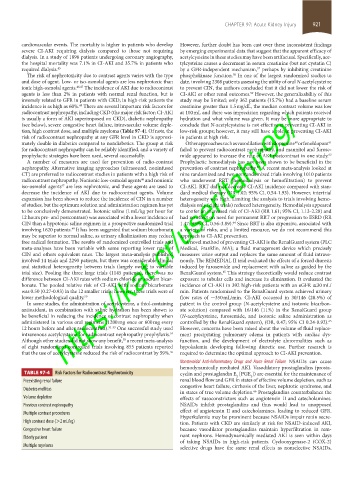
                    High contrast dose (>2 mL/kg)                         tion. Patients with CKD are similarly at risk for NSAID-induced AKI,
                    Congestive heart failure                              because vasodilator prostaglandins maintain hyperfiltration in rem-
                    Elderly patient                                       nant nephrons. Hemodynamically mediated AKI is seen within days
                                                                          of taking NSAIDs  in high-risk patients. Cyclooxygenase-2 (COX-2)
                    Multiple myeloma
                                                                          selective drugs have the same  renal effects as  nonselective NSAIDs,


            section08.indd   921                                                                                       1/14/2015   8:27:53 AM

