


Page 1466 - Hall et al (2015) Principles of Critical Care-McGraw-Hill
P. 1466
CHAPTER 104: Jaundice, Diarrhea, Obstruction, and Pseudoobstruction  1005


                                                                          obstipation, bloating) can make the diagnosis, and history of previous
                      TABLE 104-6    Causes of Large Bowel Obstruction in Adults
                                                                          malignancies and abdominal operations can provide clues regarding
                    Common                       Less Common              the etiology and location of the obstruction along the gastrointestinal
                                                 •  Fecal impaction       tract. A physical examination is essential to exclude hernias or rectal
                    •  Cancer (primary, metastatic)  •  Foreign body      obstruction as an etiology, as well as to assess for any signs of peritoneal
                    •  Volvulus (sigmoid > cecal)  •  Intussusception       irritation that may indicate complications of obstruction such as isch-
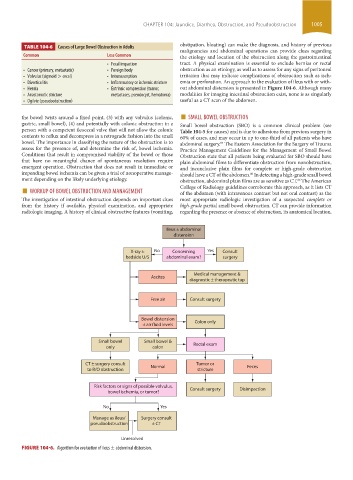
                    •  Diverticulitis            •  Inflammatory or ischemic stricture  emia or perforation. An approach to the evaluation of ileus with or with-
                    •  Hernia                    •  Extrinsic compression (tumor,    out abdominal distension is presented in Figure 104-6. Although many
                    •  Anastomotic stricture      metastases, pseudocyst, hematoma)  modalities for imaging intestinal obstruction exist, none is as singularly
                    •  Ogilvie (pseudoobstruction)                        useful as a CT scan of the abdomen.
                                                                              ■
                    the bowel twists around a fixed point, (3) with any volvulus (colonic,   SMALL BOWEL OBSTRUCTION
                    gastric, small bowel), (4) and potentially with colonic obstruction in a   Small bowel obstruction  (SBO) is a  common clinical problem (see
                    person with a competent ileocecal valve that will not allow the colonic   Table 104-5 for causes) and is due to adhesions from previous surgery in
                    contents to reflux and decompress in a retrograde fashion into the small   60% of cases, and may occur in up to one-third of all patients who have
                    bowel. The importance in classifying the nature of the obstruction is to   abdominal surgery.  The Eastern Association for the Surgery of Trauma
                                                                                       85
                    assess for the presence of, and determine the risk of, bowel ischemia.   Practice Management Guidelines for the Management of Small Bowel
                    Conditions that result in compromised viability of the bowel or those   Obstruction state that all patients being evaluated for SBO should have
                    that have no meaningful chance of spontaneous resolution require   plain abdominal films to differentiate obstruction from nonobstruction,
                    emergent operation. Obstruction that does not result in immediate or   and inconclusive plain films for complete or high-grade obstruction
                    impending bowel ischemia can be given a trial of nonoperative manage-  should have a CT of the abdomen.  In detecting a high-grade small bowel
                                                                                                 86
                    ment depending on the likely underlying etiology.     obstruction, abdominal plain films are as sensitive as CT.  The American
                                                                                                                  86
                        ■  WORKUP OF BOWEL OBSTRUCTION AND MANAGEMENT     College of Radiology guidelines corroborate this approach, as it lists CT
                                                                          of the abdomen (with intravenous contrast but not oral contrast) as the
                    The investigation of intestinal obstruction depends on important clues   most appropriate radiologic investigation of a suspected  complete or
                    from the history if available, physical examination, and appropriate   high-grade partial small bowel obstruction. CT can provide information
                    radiologic imaging. A history of clinical obstructive features (vomiting,   regarding the presence or absence of obstruction, its anatomical location,


                                                                     Ileus ± abdominal
                                                                       distension

                                                         X-ray ±  No   Concerning  Yes  Consult
                                                       bedside U/S   abdominal exam?    surgery

                                                                              Medical management &
                                                                Ascites
                                                                             diagnostic ± therapeutic tap


                                                                Free air     Consult surgery


                                                            Bowel distension   Colon only
                                                             ± air fluid levels


                                              Small bowel    Small bowel &    Rectal exam
                                                only            colon

                                         CT ± surgery consult   Normal         Tumor or         Feces
                                          to R/O obstruction                   stricture

                                            Risk factors or signs of possible volvulus,  Consult surgery  Disimpaction
                                                 bowel ischemia, or tumor?

                                               No                  Yes

                                            Manage as ileus/  Surgery consult
                                           pseudoobstruction    ± CT

                                                      Unresolved
                    FIGURE 104-6.  Algorithm for evaluation of ileus ± abdominal distension.


            section09.indd   1005                                                                                      1/14/2015   9:27:07 AM

