


Page 1467 - Hall et al (2015) Principles of Critical Care-McGraw-Hill
P. 1467
1006     PART 9: Gastrointestinal Disorders


                 the degree of the obstruction, the presence of complicating features such     TABLE 104-7    Causes and Risk Factors of Intestinal Pseudoobstruction
                 as ischemia or perforation, as well as if any other intra-abdominal cause
                 of ileus is present should no obstruction be found. Recent studies have   Intra-abdominal  •  Postoperative
                 demonstrated CT to have an accuracy of 85% to 100% 86,87  in diagnosing    •  Prolonged mechanical bowel obstruction
                 strangulation, with accuracy increased when combined with classical        •  Trauma
                 clinical criteria such as the presence of tachycardia, fever, abdominal     •  Peritonitis (chemical, infectious, autoimmune)
                 tenderness, and leukocytosis.  CT findings suggestive of ischemia          •  Impaired bowel perfusion
                                       87
                 include mesenteric haziness, reduced wall enhancement, wall thickening,   Retroperitoneal  •  Orthopedic, spinal, vascular, renal, or other surgery
                 mesenteric fluid, mesenteric venous congestion, and ascites.               •  Trauma, hematoma, infection
                   A partial small bowel obstruction can be treated successfully            •  Pancreatitis
                 with nonoperative management in over 80% of cases, with a risk of     Thoracic  •  Myocardial infarction
                 progression to strangulation in 3% to 6%. As the vast majority of patients   •  Infection
                 being treated nonoperatively improve within 48 hours, those that do
                 not improve after such a trial should with rare exception be taken for   Systemic  •  Medications (eg, narcotics, anticholinergics)
                 surgery. Patients with complete small bowel obstruction require surgery    •  Electrolyte imbalances
                 with resection of compromised bowel in approximately 30% of cases.         •  Increasing age
                                                                    86
                 As mortality is increased by up to sevenfold when an operation is per-     •  Bedrest
                 formed for intestinal strangulation compared with simple obstruction,      •  Uremia
                 earlier surgery is preferred. Of note, there is no evidence supporting     •  Sepsis
                 the use of routine antibiotics as adjunctive therapy in the nonoperative   •  Neurologic disorders, spinal cord injury
                 treatment of small bowel obstruction, and as such, antibiotics should      •  Hypothyroidism, hypo/hyperparathyroidism
                 only be used for patients with signs of intestinal compromise who are on
                 their way to the operating theatre. There is also no evidence of benefit
                 of long intestinal tubes over conventional oro- or nasogastric tubes. 86
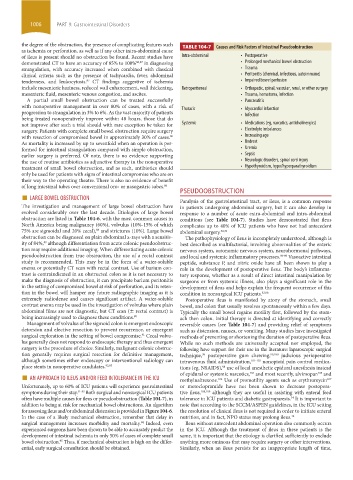
                     ■  LARGE BOWEL OBSTRUCTION                        PSEUDOOBSTRUCTION

                 The investigation and management of large bowel obstruction have   Paralysis of the gastrointestinal tract, or ileus, is a common response
                                                                       in patients undergoing abdominal surgery, but it can also develop in
                 evolved  considerably  over  the  last  decade.  Etiologies  of  large  bowel   response to a number of acute extra-abdominal and intra-abdominal
                 obstruction are listed in Table 104-6, with the most common causes in   conditions (see  Table 104-7). Studies have demonstrated that ileus
                 North America being malignancy (60%), volvulus (10%-15% of which   complicates up to 40% of ICU patients who have not had antecedent
                 75% are sigmoidal and 20% cecal),  and strictures (10%). Large bowel   abdominal surgery. 32,33
                                           88
                 obstruction can be diagnosed on plain abdominal x-rays with a sensitiv-  The pathophysiology of ileus is incompletely understood, although is
                 ity of 84%,  although differentiation from acute colonic pseudoobstruc-  best described as multifactorial, involving abnormalities of the enteric
                         89
                 tion may require additional imaging. When differentiating acute colonic   nervous system, autonomic nervous system, neurohormonal pathways,
                 pseudoobstruction from true obstruction, the use of a rectal contrast   and local and systemic inflammatory processes. 96-98  Vasoactive intestinal
                 study is recommended. This may be in the form of a water-soluble   peptide, substance P, and nitric oxide have all been shown to play a
                 enema or potentially CT scan with rectal contrast. Use of barium con-  role in the development of postoperative ileus. The body’s inflamma-
                 trast is contraindicated in an obstructed colon as it is not necessary to   tory response, whether as a result of direct intestinal manipulation by
                 make the diagnosis of obstruction, it can precipitate barium peritonitis   surgeons or from systemic illness, also plays a significant role in the
                 in the setting of compromised bowel at risk of perforation, and its reten-  development of ileus and helps explain the frequent occurrence of this
                 tion in the bowel will hamper any future radiographic imaging as it is   condition in nonsurgical ICU patients. 32,98
                 extremely radiodense and causes significant artifact. A water-soluble   Postoperative ileus is manifested by atony of the stomach, small
                 contrast enema may be used in the investigation of volvulus where plain   bowel, and colon that usually resolves spontaneously within a few days.
                 abdominal films are not diagnostic, but CT scan (± rectal contrast) is   Typically the small bowel regains motility first, followed by the stom-
                 being increasingly used to diagnose these conditions. 90  ach then colon. Initial therapy is directed at identifying and correctly
                   Management of volvulus of the sigmoid colon is emergent endoscopic   reversible causes (see  Table 104-7) and providing relief of symptoms
                 detorsion and elective resection to prevent recurrence, or emergent     such as distension, nausea, or vomiting. Many studies have investigated
                 surgical exploration in the setting of bowel compromise.  Cecal volvu-  methods of preventing or shortening the duration of postoperative ileus.
                                                          91
                 lus generally does not respond to endoscopic therapy and thus emergent   While no such methods are universally accepted nor employed, the
                 surgery is the procedure of choice. Similarly, malignant colonic obstruc-  following have support for their use in the literature: laparoscopic surgical
                 tion generally requires surgical resection for definitive management,   technique,  postoperative gum chewing, 99,100  judicious perioperative
                                                                               98
                 although sometimes either endoscopy or interventional radiology can   intravenous fluid administration, 101-103  nonopioid pain control medica-
                 place stents in nonoperative candidates. 92,93        tions (eg, NSAIDS),  use of local anesthetic epidural anesthesia instead
                                                                                      98
                     ■  AN APPROACH TO ILEUS AND/OR FEED INTOLERANCE IN THE ICU  of epidural or systemic narcotics,  and most recently, alvimopan  and
                                                                                                                      105
                                                                                               104
                                                                       methylnaltrexone.  Use of promotility agents such as erythromycin
                                                                                    106
                                                                                                                         107
                 Unfortunately, up to 60% of ICU patients will experience gastrointestinal   or  metoclopramide have not  been  shown  to  decrease postopera-
                 symptoms during their stay. 31-33  Both surgical and nonsurgical ICU patients   tive ileus, 108,109  although they are useful in assisting with enteral feed
                 often have multiple causes for ileus or pseudoobstruction (Table 104-7), in   tolerance in ICU patients and diabetic gastroparesis.  It is important to
                                                                                                             34
                 addition to being at risk for mechanical bowel obstructions. An algorithm   note that according to the SCCM/ASPEN guidelines, in the ICU setting
                 for assessing ileus and/or abdominal distension is provided in Figure 104-6.     the resolution of clinical ileus is not required in order to initiate enteral
                 In the case of a likely mechanical obstruction, remember that delay in   nutrition, and in fact, NPO status may prolong ileus. 34
                 surgical management increases morbidity and mortality.  Indeed, even   Ileus without antecedent abdominal operation also commonly occurs
                                                          94
                 experienced surgeons have been shown to be able to accurately predict the   in the ICU. Although the treatment of ileus in these patients is the
                 development of intestinal ischemia in only 50% of cases of complete small   same, it is important that the etiology is clarified sufficiently to exclude
                 bowel obstruction.  Thus, if mechanical obstruction is high on the differ-  anything more ominous that may require surgery or other interventions.
                              95
                 ential, early surgical consultation should be obtained.  Similarly,  when  an  ileus  persists  for  an  inappropriate  length  of  time,


            section09.indd   1006                                                                                      1/14/2015   9:27:07 AM

