


Page 1468 - Hall et al (2015) Principles of Critical Care-McGraw-Hill
P. 1468
CHAPTER 104: Jaundice, Diarrhea, Obstruction, and Pseudoobstruction  1007


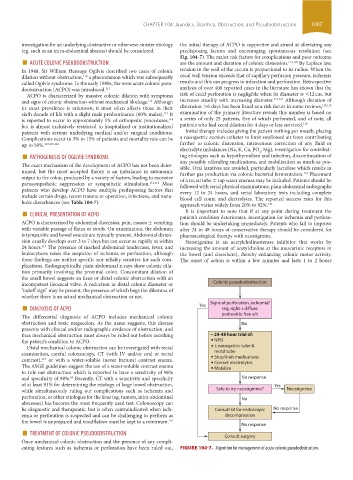
                    investigation for an underlying obstructive or otherwise sinister etiology   the initial therapy of ACPO is supportive and aimed at alleviating any
                    (eg, such as an intra-abdominal abscess) should be considered.  predisposing factors and encouraging spontaneous resolution (see
                        ■  ACUTE COLONIC PSEUDOOBSTRUCTION                Fig. 104-7). The major risk factors for complications and poor outcome
                                                                          are the amount and duration of colonic distension.
                                                                                                                   By Laplace law,
                                                                                                              113,118
                    In 1948, Sir William Heneage Ogilvie described two cases of  colonic   tension in the wall of the cecum is proportional to its radius. When the
                    dilation without obstruction,  a phenomenon which was subsequently   cecal wall tension exceeds that of capillary perfusion pressure, ischemia
                                        110
                    called Ogilvie syndrome. In the early 1980s, the term acute colonic pseu-  results and this can progress to infarction and perforation. Retrospective
                    doobstruction (ACPO) was introduced. 111              analysis of over 400 reported cases in the literature has shown that the
                     ACPO is characterized by massive colonic dilation with symptoms   risk of cecal perforation is negligible when its diameter is <12 cm, but
                    and signs of colonic obstruction without mechanical blockage.  Although   increases steadily with increasing diameter. 113,116  Although duration of
                                                               112
                    its exact prevalence is unknown, it most often affects those in their   distension >6 days has been listed as a risk factor in some reviews, 112,119
                    sixth decade of life with a slight male predominance (60% males).  It   examination of the primary literature reveals this number is based on
                                                                    113
                    is reported to occur in approximately 1% of orthopedic procedures,    a series of only 25 patients, five of which perforated, and of note, all
                                                                      114
                    but is almost exclusively restricted to hospitalized or institutionalized   patients who had cecal dilation for 4 days or less survived. 118
                    patients with serious underlying medical and/or surgical conditions.   Initial therapy includes giving the patient nothing per mouth, placing
                    Complications occur in 3% to 15% of patients and mortality rate can be   a nasogastric suction catheter to limit swallowed air from contributing
                    up to 50%. 113,115,116                                further to  colonic distension, intravenous  correction of  any fluid  or
                        ■  PATHOGENESIS OF OGILVIE SYNDROME               ing etiologies such as hypothyroidism and infection, discontinuation of
                                                                          electrolyte imbalances (Na, K, Ca, PO , Mg), investigation for contribut-
                                                                                                     4
                    The exact mechanism of the development of ACPO has not been deter-  any possibly offending medications, and mobilization as much as pos-
                                                                          sible. Oral laxatives are avoided, particularly lactulose which results in
                    mined, but the most accepted theory is an imbalance in autonomic   further gas production via colonic bacterial fermentation.  Placement
                                                                                                                    112
                    output to the colon, produced by a variety of factors, leading to excessive     of a rectal tube ± tap water enemas may be included. Patients should be
                    parasympathetic suppression or sympathetic stimulation. 112,116  Most   followed with serial physical examinations, plain abdominal radiographs
                    patients who develop ACPO have multiple predisposing factors that   every 12 to 24 hours, and serial laboratory tests including complete
                    include certain drugs, recent trauma or operation, infections, and meta-  blood cell count and electrolytes. The reported success rates for this
                    bolic disturbances (see Table 104-7).                 approach varies widely from 20% to 92%. 120
                        ■  CLINICAL PRESENTATION OF ACPO                   It is important to note that if at any point during treatment the
                    ACPO is characterized by abdominal distension, pain, nausea ± vomiting,     patient’s condition deteriorates, investigation for ischemia and perfora-
                                                                          tion should be undertaking immediately. Patients who fail to improve
                    with variable passage of flatus or stools. On examination, the abdomen   after 24 to 48 hours of conservative therapy should be considered for
                    is tympanitic and bowel sounds are typically present. Abdominal disten-  pharmacological therapy with neostigmine.
                    sion usually develops over 3 to 7 days but can occur as rapidly as within   Neostigmine is  an  acetylcholinesterase  inhibitor  that  works  by
                    24 hours.  The presence of marked abdominal tenderness, fever, and   increasing the amount of acetylcholine at the muscarinic receptors in
                          113
                    leukocytosis raises the suspicion of ischemia or perforation, although   the  bowel  (and  elsewhere),  thereby  enhancing  colonic  motor  activity.
                    these findings are neither specific nor reliably sensitive for such com-  The onset of action is within a few minutes and lasts 1 to 2 hours
                    plications. Radiographically, plain abdominal x-rays show colonic dila-
                    tion primarily involving the proximal colon. Concomitant dilation of
                    the small bowel suggests an ileus or distal colonic obstruction with an
                    incompetent ileocecal valve. A reduction in distal colonic diameter or   Colonic pseudoobstruction
                    “cutoff sign” may be present, the presence of which begs the dilemma of
                    whether there is an actual mechanical obstruction or not.
                        ■  DIAGNOSIS OF ACPO                                    Yes  Signs of perforation, ischemia?
                                                                                        (eg, right ± diffuse
                    The differential diagnosis of ACPO includes mechanical colonic      peritonitis; free air)
                    obstruction  and  toxic  megacolon.  As  the  name  suggests,  this  disease   No
                    presents with clinical and/or radiographic evidence of obstruction, and
                    thus mechanical obstruction must always be ruled out before ascribing   ~ 24-48 hour trial of:
                    the patient’s condition to ACPO.                                    NPO
                     Distal mechanical colonic obstruction can be investigated with rectal       ± nasogastric tube &
                    examination, careful colonoscopy, CT (with IV and/or oral or rectal       rectal tube
                    contrast),   or  with  a water-soluble  (never  barium)  contrast  enema.       Stop/limit medications
                          117
                    The ASGE guidelines suggest the use of a water-soluble contrast enema       Correct electrolytes
                                                                                        Mobilize
                    to rule out obstruction which is reported to have a sensitivity of 96%
                    and specificity of 98%.  Recently, CT with a sensitivity and specificity   No response
                                    89
                    of at least 91% for determining the etiology of large bowel obstruction,              Yes
                    while simultaneously ruling out complications such as ischemia and   Safe to try neostigmine?  Neostigmine
                    perforation, or other etiologies for the ileus (eg, tumors, intra-abdominal   No
                    abscesses) has become the most frequently used test. Colonoscopy can
                    be diagnostic and therapeutic, but is often contraindicated when isch-  Consult GI for endoscopic  No response
                    emia or perforation is suspected and can be challenging to perform as   decompression
                    the bowel is unprepared and insufflation must be kept to a minimum. 116    No response
                        ■  TREATMENT OF COLONIC PSEUDOOBSTRUCTION

                    Once mechanical colonic obstruction and the presence of any compli-  Consult surgery
                    cating features such as ischemia or perforation have been ruled out,   FIGURE 104-7.  Algorithm for management of acute colonic pseudoobstruction.


            section09.indd   1007                                                                                      1/14/2015   9:27:08 AM

