


Page 1493 - Hall et al (2015) Principles of Critical Care-McGraw-Hill
P. 1493
1032     PART 9: Gastrointestinal Disorders


                 Acute pancreatitis is currently the most frequent gastrointestinal cause     TABLE 108-1    Etiology of Acute Pancreatitis
                 of hospital admissions in the United States with a total of 275,000
                 admissions in 2009  and approximately $2.2 billion in annual health   Toxic  Alcohol
                                1
                 care costs.  The overall mortality among patients with acute pancreatitis   Methanol
                         2
                 is around 5%, but patients who develop severe acute pancreatitis have    Smoking
                 mortality rates as high as 15%  and even higher when multiorgan failure   Organophosphates
                                       3
                 is present. Appropriate intensive care management of these patients and   Scorpion bite
                 a multi-disciplinary approach play a very important role in treatment of   Mechanical obstruction/duct   Biliary pancreatitis (gallstones)
                 those patients who develop severe acute pancreatitis. In 2012, a revised   damage  Biliary sludge
                 version of the original Atlanta classification was published that focused   Parasitic infections (ascariasis)
                 on defining the severity of acute pancreatitis and classification of pan-  Malignancy (pancreatic, ampullary, cholangiocarcinoma)
                 creatic and peripancreatic fluid collections. 4                          Periampullary diverticulum
                                                                                          Abdominal trauma/duct disruption
                 PATHOPHYSIOLOGY                                        Metabolic         Hypertriglyceridemia

                 Acute pancreatitis is believed to be triggered by an increase in the     Hypercalcemia
                 intraductal pressure or direct injury to acinar cells from metabolic   Immune-related  Auto-immune pancreatitis
                 or toxic stimuli which leads to breakdown of the junctional barrier      Vasculitis (SLE, polyarteritis nodosa)
                 between acinar cells and leakage of pancreatic fluid and enzymes   Drugs  5-ASA/salicylates, azathioprine/6-MP, didanosine, pent-
                 into  the  interstitial  space.   Intrapancreatic  activation  of  proteolytic   amidine, furosemide, tetracyclines, thiazides, estrogen
                                     5
                 enzymes leads to autophagy and autodigestion of acinar cells.
                                                                    6
                 Lysosomal enzymes such as cathepsin B initiate the activation of   Infections  Viral: mumps, varicella-zoster, coxsackie, HSV, HIV
                 trypsinogen to trypsin which then leads to activation of more trypsin    Bacterial: Mycoplasma, Leptospira, Legionella
                 as well as other pancreatic enzymes including phospholipase, chy-        Parasitic: Toxoplasma, cryptosporidium
                 motrypsin, and elastase.  The acinar tissue death leads to an intense    Fungal: Aspergillus
                                   7
                 systemic inflammatory response syndrome (SIRS) caused by the   Miscellaneous  Idiopathic
                 release of activated pancreatic enzymes and mediated by cytokines,       Post-ERCP pancreatitis
                 immunocytes, and the complement system. Inflammatory cytokines           Pancreas divisum in some patients
                 (such as tumor necrosis factor) cause macrophages to migrate into        Ischemia
                 tissues distant from the pancreas, including lungs and kidneys.          Genetic mutations in PRSS1, SPINK, CTRC, or CFTR genes
                 Immunocytes attracted by cytokines released from macrophages   Common etiologies highlighted. CFTR, cystic fibrosis transmembrane conductance regulator; CTRC,
                 release more   cytokines, free radicals, and nitric oxide; the result is   chymotrypsin C; ERCP, endoscopic retrograde cholangiopancreatography; HIV, human immunodeficiency
                 tissue destruction, fluid and electrolyte loss, hypotension, renal and   virus; HSV, herpes simplex virus; PRSS1, serine protease 1; SLE, systemic lupus erythematosus; SPINK,
                 pulmonary complications, late septic complications, and, in severe   serine protease inhibitor Kazal type 1.
                 cases, multisystem organ failure (MSOF) and death.
                                                                         The diagnosis of acute pancreatitis requires two of the following three
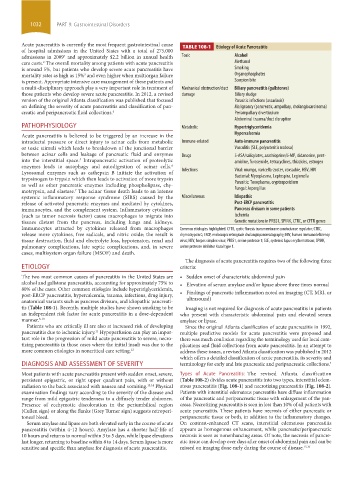
                 ETIOLOGY                                              criteria:

                 The two most common causes of pancreatitis in the United States are     • Sudden onset of characteristic abdominal pain
                 alcohol and gallstone pancreatitis, accounting for approximately 75% to     • Elevation of serum amylase and/or lipase above three times normal
                 80% of the cases. Other common etiologies include hypertriglyceridemia,
                 post-ERCP pancreatitis, hypercalcemia, trauma, infections, drug injury,     • Findings of pancreatic inflammation noted on imaging (CT, MRI, or
                 anatomical variants such as pancreas divisum, and idiopathic pancreati-  ultrasound)
                 tis (Table 108-1). Recently, multiple studies have shown smoking to be   Imaging is not required for diagnosis of acute pancreatitis in patients
                 an independent risk factor for acute pancreatitis in a dose-dependent   who  present with  characteristic  abdominal  pain  and  elevated  serum
                 manner. 8-10                                          amylase or lipase.
                   Patients who are critically ill are also at increased risk of developing    Since the original Atlanta classification of acute pancreatitis in 1992,
                 pancreatitis due to ischemic injury.  Hypoperfusion can play an impor-  multiple predictive models for acute pancreatitis were proposed and
                                          11
                 tant role in the progression of mild acute pancreatitis to severe, necro-  there was much confusion regarding the terminology used for local com-
                 tizing pancreatitis in those cases where the initial insult was due to the   plications and fluid collections from acute pancreatitis. In an attempt to
                 more common etiologies in noncritical care setting. 12  address these issues, a revised Atlanta classification was  published in 2012
                                                                       which offers a detailed classification of acute pancreatitis, its severity and
                 DIAGNOSIS AND ASSESSMENT OF SEVERITY                  terminology for early and late pancreatic and peripancreatic collections. 4
                 Most patients with acute pancreatitis present with sudden onset, severe,   Types  of  Acute  Pancreatitis:  The revised Atlanta classification
                 persistent epigastric, or right upper quadrant pain, with or without   (Table 108-2) divides acute pancreatitis into two types, interstitial edem-
                 radiation to the back associated with nausea and vomiting. 13,14  Physical   atous pancreatitis (Fig. 108-1) and necrotizing pancreatitis (Fig. 108-2).
                 examination findings vary according to the severity of the disease and   Patients with interstitial edematous pancreatitis have diffuse inflammation
                 range from mild epigastric tenderness to a diffusely tender abdomen.     of the pancreatic and peripancreatic tissue with enlargement of the pan-
                 Presence of ecchymotic discoloration in the periumbilical region   creas. Necrotizing pancreatitis is seen in less than 10% of all patients with
                 (Cullen sign) or along the flanks (Grey Turner sign) suggests retroperi-  acute pancreatitis. These patients have necrosis of either pancreatic or
                 toneal bleed.                                         peripancreatic tissue or both, in addition to the inflammatory changes.
                   Serum amylase and lipase are both elevated early in the course of acute     On contrast-enhanced CT scans, interstitial edematous pancreatitis
                 pancreatitis (within 4-12 hours). Amylase has a shorter half-life of     appears as homogenous enhancement, while pancreatic/peripancreatic
                 10 hours and returns to normal within 3 to 5 days, while lipase elevations   necrosis is seen as nonenhancing areas. Of note, the necrosis of pancre-
                 last longer, returning to baseline within 8 to 14 days. Serum lipase is more   atic tissue can develop over days after onset of abdominal pain and can be
                 sensitive and specific than amylase for diagnosis of acute pancreatitis.  missed on imaging done early during the course of disease. 15,16


            section09.indd   1032                                                                                      1/14/2015   9:27:19 AM

