


Page 1555 - Hall et al (2015) Principles of Critical Care-McGraw-Hill
P. 1555
1074     PART 10: The Surgical Patient


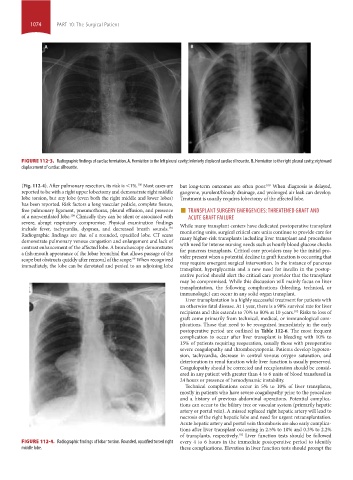
                 FIGURE 112-3.  Radiographic findings of cardiac herniation. A. Herniation to the left pleural cavity; inferiorly displaced cardiac silhouette. B. Herniation to the right pleural cavity; rightward
                 displacement of cardiac silhouette.

                 (Fig. 112-4). After pulmonary resection, its risk is <1%.  Most cases are   but long-term outcomes are often poor.  When diagnosis is delayed,
                                                         100
                                                                                                     100
                 reported to be with a right upper lobectomy and demonstrate right middle   gangrene, purulent/bloody drainage, and prolonged air leak can develop.
                 lobe torsion, but any lobe (even both the right middle and lower lobes)   Treatment is usually requires lobectomy of the affected lobe.
                 has been reported. Risk factors a long vascular pedicle, complete fissure,
                 free pulmonary ligament, pneumothorax, pleural effusion, and presence     ■  TRANSPLANT SURGERY EMERGENCIES: THREATENED GRAFT AND
                 of a nonventilated lobe.  Clinically they can be silent or associated with   ACUTE GRAFT FAILURE
                                  100
                 severe, abrupt respiratory compromise. Physical examination findings
                 include  fever,  tachycardia,  dyspnea,  and  decreased  breath  sounds.    While many transplant centers have dedicated postoperative transplant
                                                                   101
                                                                       monitoring units, surgical critical care units continue to provide care for
                 Radiographic findings are that of a rounded, opacified lobe. CT scans
                 demonstrate pulmonary venous congestion and enlargement and lack of   many higher-risk transplants including liver transplant and procedures
                                                                       with need for intense nursing needs such as hourly blood glucose checks
                 contrast enhancement of the affected lobe. A bronchoscopy demonstrates
                 a fish-mouth appearance of the lobar bronchial that allows passage of the   for pancreas transplants. Critical care providers may be the initial pro-
                                                                       vider present when a potential decline in graft function is occurring that
                 scope but obstructs quickly after removal of the scope.  When recognized
                                                       99
                 immediately, the lobe can be derotated and pexied to an adjoining lobe   may require emergent surgical intervention. In the instance of pancreas
                                                                       transplant, hyperglycemia and a new need for insulin  in the postop-
                                                                       erative period should alert the critical care provider that the transplant
                                                                       may be compromised. While this discussion will mainly focus on liver
                                                                       transplantation, the following complications (bleeding, technical, or
                                                                       immunologic) can occur in any solid organ transplant.
                                                                         Liver transplantation is a highly successful treatment for patients with
                                                                       an otherwise fatal disease. At 1 year, there is a 90% survival rate for liver
                                                                       recipients and this extends to 70% to 80% at 10 years.  Risks to loss of
                                                                                                              102
                                                                       graft come primarily from technical, medical, or immunological com-
                                                                       plications. Those that need to be recognized immediately in the early
                                                                       postoperative period are outlined in  Table 112-6. The most frequent
                                                                       complication to occur after liver transplant is bleeding with 10% to
                                                                       15% of patients requiring reoperation, usually those with preoperative
                                                                       severe coagulopathy and thrombocytopenia. Patients develop hypoten-
                                                                       sion, tachycardia, decrease in central venous oxygen saturation, and
                                                                       deterioration in renal function while liver function is usually preserved.
                                                                       Coagulopathy should be corrected and reexploration should be consid-
                                                                       ered in any patient with greater than 4 to 6 units of blood transfused in
                                                                       24 hours or presence of hemodynamic instability.
                                                                         Technical complications  occur  in 5%  to 10%  of liver  transplants,
                                                                       mostly in patients who have severe coagulopathy prior to the procedure
                                                                       and a history of previous abdominal operations. Potential complica-
                                                                       tions can occur to the biliary tree or vascular system (primarily hepatic
                                                                       artery or portal vein). A missed replaced right hepatic artery will lead to
                                                                       necrosis of the right hepatic lobe and need for urgent retransplantation.
                                                                       Acute hepatic artery and portal vein thrombosis are also early complica-
                                                                       tions after liver transplant occurring in 2.5% to 10% and 0.3% to 2.2%
                                                                       of transplants, respectively.  Liver function tests should be followed
                                                                                           102
                 FIGURE 112-4.  Radiographic findings of lobar torsion. Rounded, opacified torsed right   every 4 to 6 hours in the immediate postoperative period to identify
                 middle lobe.                                          these complications. Elevation in liver function tests should prompt the


            section10.indd   1074                                                                                      1/20/2015   9:19:46 AM

