


Page 1557 - Hall et al (2015) Principles of Critical Care-McGraw-Hill
P. 1557
1076     PART 10: The Surgical Patient


                                                                       vascular malformations, and cerebrovascular reactivity.  Management
                                                                                                               108
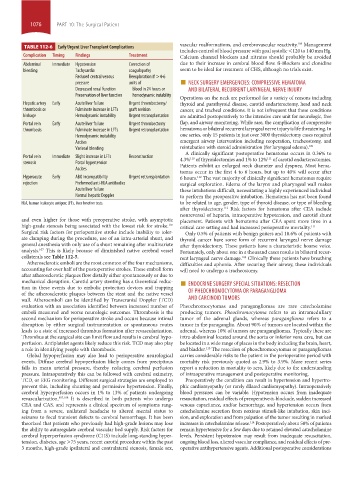
                   TABLE 112-6    Early Urgent Liver Transplant Complications
                                                                       includes control of blood pressure with goal systolic <120 to 140 mm Hg.
                  Complication  Timing  Findings      Treatment        Calcium channel blockers and nitrates should probably be avoided
                  Abdominal   Immediate  Hypotension  Correction of    due to their increase in cerebral blood flow. ß-Blockers and clonidine
                  bleeding          Tachycardia       coagulopathy     seem to be ideal for treatment of CHS, although no trials exist.
                                    Reduced central venous   Reexploration if >4-6     ■
                                    pressure          units of            NECK SURGERY EMERGENCIES: COMPRESSIVE HEMATOMA
                                    Decreased renal function  blood in 24 hours or   AND BILATERAL RECURRENT LARYNGEAL NERVE INJURY
                                    Preservation of liver function  hemodynamic instability
                                                                       Operations on the neck are performed for a variety of reasons including
                  Hepatic artery   Early  Acute liver failure  Urgent thrombectomy/  thyroid and parathyroid disease, carotid endarterectomy, head and neck
                  thrombosis or     Fulminate increase in LFTs  graft revision  cancer, and tracheal conditions. It is not infrequent that these conditions
                  kinkage           Hemodynamic instability  Urgent retransplantation  are admitted postoperatively to the intensive care unit for neurologic, free
                  Portal vein    Early  Acute liver failure  Urgent thrombectomy  flap, and airway monitoring. While rare, the complication of compressive
                  thrombosis        Fulminate increase in LFTs  Urgent retransplantation  hematoma or bilateral recurrent laryngeal nerve injury is life threatening. In
                                    Hemodynamic instability            one series, only 15 patients in just over 3000 thyroidectomy cases required
                                    Ascites                            emergent airway intervention including reoperation, tracheostomy, and
                                    Variceal bleeding                  reintubation with steroid administration (for laryngeal edema). 109
                                                                         A clinically significant postoperative hematoma occurs in 0.36% to
                  Portal vein   Immediate  Slight increase in LFTs  Reconstruction  4.3%  of thyroidectomies and 1% to 12%  of carotid endarterectomies.
                                                                           110
                                                                                                     111
                  stenosis          Portal hypertension                Patients exhibit an enlarged neck diameter and dyspnea. Most hema-
                                    Ascites
                                                                       tomas occur in the first 4 to 6 hours, but up to 40% will occur after
                  Hyperacute   Early  ABO incompatibility  Urgent retransplantation  6 hours.  The vast majority of clinically significant hematomas require
                                                                             112
                  rejection         Preformed anti-HLA antibodies      surgical exploration. Edema of the larynx and pharyngeal wall makes
                                    Acute liver failure                these intubations difficult, necessitating a highly experienced individual
                                    Normal hepatic Doppler             to perform the preoperative intubation. Hematoma has not been found
                 HLA, human leukocyte antigen; LFTs, liver function tests.  to be related to age, gender, type of thyroid disease, or type of bleeding
                                                                       after thyroidectomy.  Risk factors for hematoma after CEA include
                                                                                      112
                                                                       nonreversal of heparin, intraoperative hypotension, and carotid shunt
                 and  even  higher  for  those  with  preoperative  stroke,  with  asymptotic   placement. Patients with hematoma after CEA spent more time in a
                 high-grade stenosis being associated with the lowest risk for stroke.    critical care setting and had increased perioperative mortality. 111
                                                                   107
                 Surgical risk factors for perioperative stroke include inability to toler-  Only 0.5% of patients with benign goiters and 10.6% of patients with
                 ate clamping during the procedure, use of an intra-arterial shunt, and   thyroid  cancer  have  some  form of  recurrent laryngeal nerve damage
                 general anesthesia with only use of a shunt remaining after multivariate   after thyroidectomy. These patients have a characteristic hoarse voice.
                 analysis.  This is likely because of diminished native cerebral vessel   Fortunately, only about one in a thousand cases results in bilateral recur-
                       107
                 collaterals see Table 112-5.                          rent laryngeal nerve damage.  Clinically these patients have breathing
                                                                                            109
                   Atherosclerotic emboli are the most common of the four mechanisms,   difficulties and aphonia. After securing their airway, these individuals
                 accounting for over half of the postoperative strokes. These emboli form   will need to undergo a tracheostomy.
                 after atherosclerotic plaques flow distally either spontaneously or due to
                 mechanical disruption. Carotid artery stenting has a theoretical reduc-    ■  ENDOCRINE SURGERY SPECIAL SITUATIONS: RESECTION
                 tion in these events due to embolic protection devices and trapping
                 of the atherosclerotic plaques between the stent and the native vessel   OF PHEOCHROMOCYTOMA OR PARAGANGLIOMA
                 wall. Atheroemboli can be identified by Transcranial Doppler (TCD)   AND CARCINOID TUMORS
                 evaluation with an association identified between increased number of   Pheochromocytomas and paragangliomas are rare catecholamine
                 emboli  measured  and  worse  neurologic  outcomes.  Thrombosis  is  the   producing tumors.  Pheochromocytoma refers to an intramedullary
                 second mechanism for perioperative stroke and occurs because intimal   tumor of the adrenal glands, whereas  paraganglioma refers to a
                 disruption by either surgical instrumentation or spontaneous routes   tumor in the paraganglia. About 90% of tumors are located within the
                 leads to a state of increased thrombus formation after revascularization.   adrenal, whereas 10% of tumors are paragangliomas. Typically these are
                 Thrombus at the surgical site can limit flow and results in cerebral hypo-  intra-abdominal located around the aorta or inferior vena cava, but can
                 perfusion. Antiplatelet agents likely reduce this risk. TCD may also play   be located in a wide range of places in the body including the brain, heart,
                 a role in identifying people with thrombosis.         and bladder.  The resection of pheochromocytomas or paragangliomas
                                                                                113
                   Global hypoperfusion may also lead to perioperative neurological   carries considerable risks to the patient in the perioperative period with
                 events.  Diffuse  cerebral hypoperfusion likely comes  from precipitous   mortality risk previously quoted as 2.9% to 3.9%. More recent series
                 falls  in  mean arterial  pressure,  thereby  reducing  cerebral  perfusion   report a reduction in mortality to zero, likely due to the understanding
                 pressure. Intraoperatively this can be followed with cerebral oximetry,   of intraoperative management and postoperative monitoring.
                 TCD, or EEG monitoring. Different surgical strategies are employed to   Preoperatively the condition can result in hypertension and hypertro-
                 prevent this, including shunting and permissive hypertension. Finally,   phic cardiomyopathy (or rarely dilated cardiomyopathy). Intraoperatively
                 cerebral  hyperperfusion  occurs  in  1%  to  13%  of  patients  undergoing   blood  pressures  can  be  variable.  Hypotension  occurs  from  inadequate
                 revascularization. 107,108  It is described in both patients who undergo   resuscitation, residual effects of preoperative α-blockade, sudden increased
                 CEA and CAS, and represents a clinical spectrum of symptoms rang-  venous capacitance,  and/or hemorrhage, and hypertension occurs  from
                 ing from a severe, unilateral headache to altered mental status  to   catecholamine secretion from noxious stimuli-like intubation, skin inci-
                 seizures to focal transient defects to cerebral hemorrhage. It has been   sion, and exploration and from palpation of the tumor resulting in marked
                 theorized that patients who previously had high-grade lesions may lose   increases in catecholamine release.  Postoperatively about 50% of patients
                                                                                               114
                 the ability to autoregulate cerebral vascular bed supply. Risk factors for   remain hypertensive for a few days due to retained elevated catecholamine
                 cerebral hyperperfusion syndrome (CHS) include long-standing hyper-  levels. Persistent hypotension may result from inadequate resuscitation,
                 tension, diabetes, age >75 years, recent carotid procedure within the past    ongoing blood loss, altered vascular compliance, and residual effects of pre-
                 3 months, high-grade ipsilateral and contralateral stenosis, female sex,   operative antihypertensive agents. Additional postoperative considerations


            section10.indd   1076                                                                                      1/20/2015   9:19:47 AM

